Most small businesses still treat backlinks as the only thing that counts. In 2026 that is half the picture. Brand mentions, the plain references to your business across the web, now feed both Google's understanding of your brand and the way AI tools like ChatGPT and Perplexity decide which businesses to name.
A brand mention with no link still works, because people read it, search engines record it, and AI models learn from it. Building brand mentions for SEO and AI visibility takes free tools and a weekly habit, not a budget.
TL;DR (Quick Summary)
Short answer: earn brand mentions where your customers and the AI tools already look, track them for free, and treat a nearby link as a bonus rather than the goal.
An unlinked brand mention is your business name, product, or founder named on a page that does not link to you.
For Google, brand mentions support entity recognition and brand authority, sometimes called brand signals or implied links.
For AI search, brand mentions are one of the strongest signals that decide whether your business gets named in an answer.
Find brand mentions with free Google operators, track them with Google Alerts and F5Bot, and earn them by being genuinely useful on Reddit, Quora, review platforms, and niche directories.
A link next to the mention adds direct SEO value, but the brand mention alone already builds recognition.
The honest catch: Google has never officially confirmed unlinked brand mentions as a direct ranking factor, so treat them as an authority and AI-visibility signal, not a guaranteed rankings lever.
What are unlinked brand mentions?
Short answer: a brand mention is any reference to your business, and an unlinked brand mention has no clickable link attached.
A brand mention is any time your business name, product, slogan, or a key person such as your founder appears in online content. A linked mention includes a hyperlink to your website. An unlinked brand mention names you in plain text with no link. Both are brand mentions, but they pass different value, which the next sections explain. You will also see brand mentions called brand citations, brand signals, or implied links, and for the newest layer, AI citations. The wording varies, but the idea is the same: your brand named across the web.
An unlinked brand mention in practice: ChatGPT names a tool inside an answer, with no link attached. The brand is recognised and recommended on its name alone.
Unlinked brand mentions show up almost anywhere: blog posts, news articles, podcast notes, YouTube descriptions, forum threads, review sites, and community discussions on Reddit or Quora. A common example is an article that names a tool by its brand and never links to it. The reference is real, readers see it, but no link points home.
This matters for small businesses for a reason that is easy to miss. A brand mention is not only an SEO signal. It is something a real person reads. When someone sees your business named inside a helpful answer or a comparison, that is brand recognition working directly, before any algorithm gets involved. Mentions of your brand make a business familiar, and familiarity is what turns a search into a click later.
Do brand mentions help SEO?
Short answer: brand mentions help Google understand and trust your brand, though Google has never confirmed unlinked mentions as a direct ranking factor.
Brand mentions for SEO is one of the most searched questions in this area, so here is the honest answer. Brand mentions help your SEO, but not in the simple way most articles claim. They build the brand signals that Google uses to identify and trust your business as a real entity. They do not reliably work as a direct ranking lever you can pull.
Many SEO professionals have argued for years that Google uses unlinked brand mentions as a direct ranking factor. Google has never officially confirmed this. A frequently cited Google patent describes brand searches as a signal of popularity, which is a different idea, and the patent does not clearly support the claim that an unlinked mention directly lifts rankings.
So the defensible position on unlinked brand mentions SEO impact in 2026 is this: brand mentions strengthen how Google understands and trusts your brand, which can influence when your content is treated as relevant, and they strongly influence AI visibility. Treat that as the benefit, and do not promise yourself a direct rankings jump from brand mentions alone.
The opportunity
One analysis of 177 brands found that around 90% had zero AI search mentions (Search Engine Journal, 2026). For most small businesses this is an open field rather than a crowded race, so even a modest, steady presence can put you ahead of competitors who have none.
How brand citations work for Google
Short answer: Google reads brand mentions as part of how it identifies your business as an entity and judges its authority.
Google builds a model of real-world entities, which include people, places, organisations, and brands. When your business name appears across credible sites, Google notes the topic and the context around each appearance. Over time, consistent references help Google associate your business with a subject area and a level of credibility. This is the entity and Knowledge Graph layer of how search works, and it is where brand signals do their job.
Brand mentions also feed branded search. When more people see your business named online, more of them search for you by name, and branded search volume is itself a signal of authority. There is also a quality angle: when a trusted, relevant site mentions your brand, it acts as a vote of confidence that supports the experience, expertise, authoritativeness, and trust that Google's quality guidelines reward. None of this requires a link, which is why unlinked brand mentions still carry weight for Google.
How brand mentions work for AI search
Short answer: AI tools scan brand mentions across the web to decide which businesses to name, and each tool trusts different sources.
AI answer engines do not show a ranked list of ten links. They name a few businesses inside one answer. To decide who gets named, they draw on training data, live web results, and the sources they trust, and mentions of your brand across the web are a core part of that decision. This is why brand mentions for AI search have become as important as links once were. An Ahrefs study of 75,000 brands found that brand web mentions correlate with AI Overview visibility at 0.664, roughly three times stronger than backlinks at 0.218, making mentions the single strongest off-site predictor measured (Ahrefs, 2025). The same study found that brands in the top 25% for web mentions earn up to 10 times more mentions in AI Overviews than the next quartile down. Most of this happens off your own site: around 85% of brand mentions originate on third-party pages rather than owned domains (AirOps, 2026).
Brand mentions outrank backlinks as a predictor of AI visibility. Sources: Ahrefs (75,000 brands, 2025) and 5W (2026).
The important practical detail is that different engines trust different sources. One analysis of more than 680 million citations mapped where each engine pulls from (5W, 2026):
Engine
Top source
Share of its top-10 sources
ChatGPT
Wikipedia and established publications
~47.9% Wikipedia
Perplexity
Reddit and fresh community content
~46.7% Reddit
Overlap between the two
Domains cited by both engines
~11%
In plain terms, ChatGPT leans on Wikipedia and major publications, while Perplexity leans on Reddit and recent community threads, and a single strategy rarely wins on both. Being named in one engine does not guarantee being named in another, because each one reads a different mix of the web.
Two cautions before you act on these numbers:
Wikipedia is not a surface you can post on. It requires notability, usually significant coverage in three to five independent sources, and self-created pages get removed (5W, 2026). A Wikipedia presence follows brand mentions rather than creating them, so it belongs at the end of the work, not the start.
These shares move. The platforms are volatile, so treat any single figure as a snapshot rather than a fixed rule.
A useful habit is to read your own citation supply chain: ask the questions your customers ask inside ChatGPT and Perplexity, see which domains keep appearing in the answers, and treat that set of domains as your brand citation strategy.
Short answer: a link adds direct SEO value and a click path, but for AI recognition the brand mention often works on its own.
This is the question that decides how much effort to spend. A linked mention and an unlinked brand mention do different jobs.
A linked mention passes link equity, sends referral traffic directly, and is the classic SEO asset, the kind you build with deliberate backlink outreach. An unlinked brand mention builds recognition and feeds entity signals, and for AI tools it often counts even without a link, because models read the text and the context rather than following a hyperlink. Many social and community platforms also apply nofollow attributes, so even a link there rarely passes classic SEO authority, which means the value on those surfaces comes from the brand mention itself.
The table below sums up the linked vs unlinked mentions trade-off.
Aspect
Linked mention
Unlinked brand mention
Passes link equity to Google
Yes
No
Sends referral clicks
Yes, directly
Only via branded search later
Builds entity and brand signals
Yes
Yes
Counts for AI naming
Yes
Yes, often without a link
Effort to earn
Higher (needs outreach)
Lower (the mention is enough)
“A brand mention works on its own. A link next to it is a bonus, not the goal.”
The practical rule: aim for the brand mention first, because it works across Google, AI, and readers. When a mention sits on a credible site and a link would genuinely help the reader, a short, polite request to add one turns it into a linked mention. That conversion is usually easier than cold outreach, because the writer already knows your brand.
How to find existing brand mentions (free)
Short answer: finding means going to look for brand mentions that already exist, using Google search operators and your browser's find command, with no paid tool.
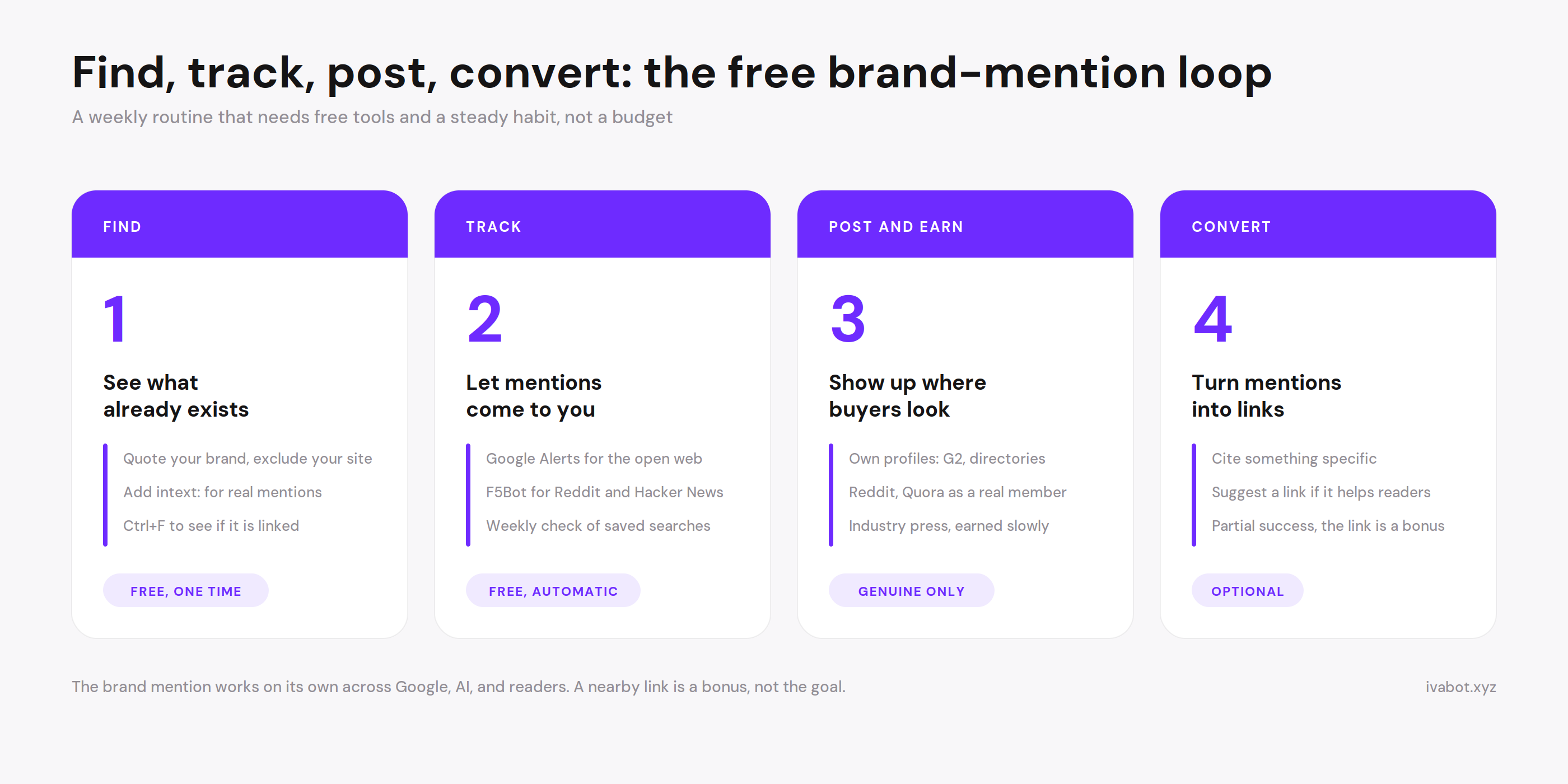
The free brand-mention loop. The four steps below cover the whole cycle, from finding what already exists to converting the easy mentions into links.
Finding and tracking are two different jobs. Finding is the one-time, manual search for what is already published about your brand right now. Start with finding, because it shows you what already exists before you set anything up.
Google itself is the first tool. The core search is your brand name in quotation marks, with your own site excluded:
"Your Brand" -site:yourdomain.com
This shows pages that name your brand but are not your own site. Three operators do the work here. Quotation marks tell Google to match the exact phrase rather than scattered words. The site: operator limits results to one website, and the minus sign in front of it does the opposite, removing your own site from the results. To narrow to genuine in-content mentions rather than titles or menus, add the intext: operator:
intext:"Your Brand" -site:yourdomain.com
A brand search with your own domain excluded surfaces third-party mentions across the web.
To focus on one platform, add a site filter. For community mentions, search "Your Brand" site:reddit.com or "Your Brand" site:quora.com. To find recent mentions, open Google's Tools menu under the search bar and set the time filter to the past week or month. Once you open a result, press Ctrl+F on Windows or Command+F on Mac, type your brand name, and check whether the highlighted mention is plain text or a clickable link. If it is plain text, you have found an unlinked brand mention.
Search variations as well: common misspellings of your name, your product names, and the name of your founder or other public figures in the business. Each is a brand mention that AI and Google can attribute to you. This manual sweep is how to find unlinked brand mentions free, and it is worth doing once before you automate anything, so you know your starting point.
How to track new mentions automatically (free)
Short answer: tracking means setting up free alerts once so new brand mentions come to you, instead of searching by hand every time.
Where finding is a manual sweep of what already exists, tracking is automatic and forward-looking. You set it up one time, and new mentions arrive in your inbox as they get published. This matters because the window to respond to a mention or to request a link is widest right after publication, and manual searching will always catch those late. Here is how to track brand mentions free, in three layers.
Google Alerts watches the general web and emails you when new pages match your terms. Set an alert for your exact brand name, and separate alerts for your founder's name and main product. Keep the queries specific so the inbox stays useful.
Google Alerts emails you when a new page mentions your brand. Set one for the brand, one for the founder, one for the product.
F5Bot covers Reddit and Hacker News, which Google Alerts catches poorly. It emails you within minutes when your keyword appears in a post or comment, and it is free. It works best for distinctive terms, so your brand name is ideal. Very common phrases can hit its daily limit and get disabled, so reserve it for your brand and close competitor names.
F5Bot watches Reddit and Hacker News and emails you within minutes of a keyword match.
Saved Google operator searches handle the rest. Build the operator searches from the previous section with a freshness filter applied, then bookmark the results pages in one folder. Open the folder once a week to scan for any mentions the alerts missed, especially on Quora, which the alert tools cover unevenly. Talkwalker Alerts is a useful free backup for Google Alerts if you want a second net. The same weekly habit is the basis of tracking your AI citations and AI search traffic.
These free tools cover the whole job for most small businesses:
Free tool
What it covers
Google search operators
Manual discovery of brand mentions across the whole web
Google Alerts
Email alerts for new web brand mentions
F5Bot
Reddit and Hacker News keyword alerts
Talkwalker Alerts
Web mention alerts, a Google Alerts backup
Paid tools exist, and they add filtering, sentiment, and dashboards, but they earn their place only when mention volume outgrows a weekly manual check. For a small business starting out, they are usually unnecessary.
Paid tool
Price
What it adds
Brand24
Paid, scales with volume
Web and social with sentiment analysis
Semrush, BrandMentions
Paid SEO suites
Filtering by authority and bulk export
One more tool belongs here for a different reason. The monitoring tools above tell you where your brand is named. IvaBot's Content Coverage and AI Readiness check does the step after that: it tells you whether the page a mention points to is built to be cited, whether it leads with a direct answer, carries extractable passages and a real FAQ, and has the structured data in place, then shows what to fix first.
A simple weekly rhythm keeps tracking sane: one short session, scan the alerts and the bookmark folder, and note any mention worth a response or a link request. Watch tone as well as volume, because AI reads the context around your name, so a negative mention left unanswered can shape how you are described. A brief, factual reply in the same thread usually does more than trying to get the mention removed. The category moves slowly enough that weekly is enough for most small businesses.
Where to post brand mentions
Short answer: post where your customers and the AI engines already look, and match the platform to your business type.
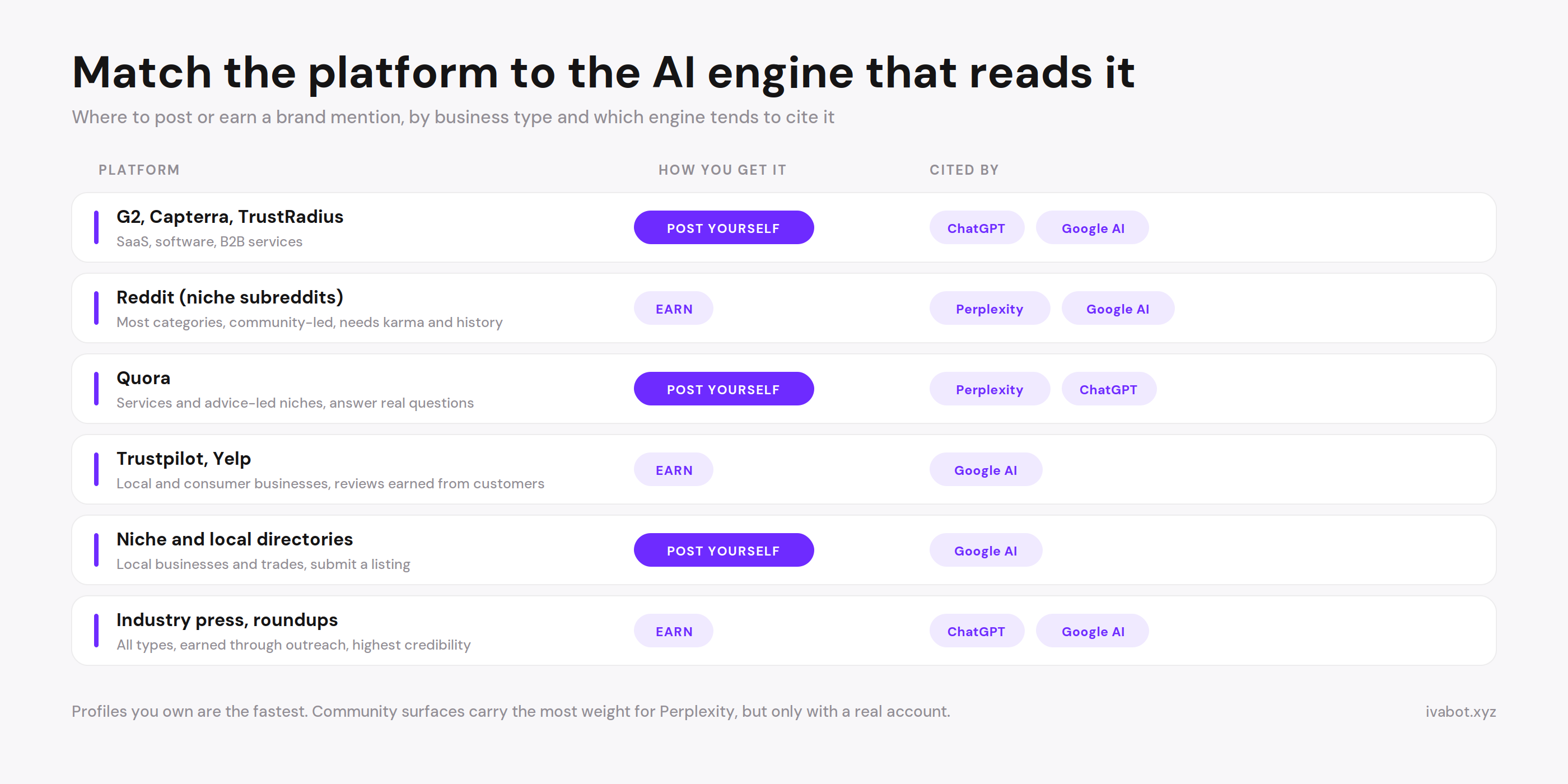
Some mentions of your brand you earn, and some you can post yourself by being present on the right platforms. The map below pairs platforms with business types, shows whether you can post the mention yourself, and flags which AI engines tend to read that surface for citations.
Match the platform to your business type and to the AI engine that tends to cite it.
Platform
Best for
Post it yourself?
Account authority
Good for citation
G2, Capterra, TrustRadius
SaaS, software, B2B services
Yes, create a profile
Low, the profile is yours
ChatGPT, Google AI
Reddit (niche subreddits)
Most categories, community-led
Indirectly, via helpful replies
High, needs karma and history
Perplexity, Google AI
Quora
Services, advice-led niches
Yes, answer real questions
Medium, profile should look real
Perplexity, ChatGPT
Trustpilot, Yelp
Local and consumer businesses
Indirectly, ask customers
Low to set up, reviews earned
Google AI, some ChatGPT
Niche and local directories
Local businesses, trades
Yes, submit a listing
Low
Google AI
LinkedIn
B2B, founders, services
Yes, post and comment
Medium
Limited
Industry press, roundups
All types, earned coverage
No, earned through outreach
High credibility
ChatGPT, Google AI
The pattern to read from this map: profiles you own, such as G2, directories, and Quora answers, are the quickest places to post a legitimate brand mention yourself. For local and consumer businesses, a steady flow of Google reviews and presence in local directories does the same job. Community surfaces like Reddit and Quora carry the most weight for Perplexity, but they need a real account with history, not a fresh account dropping links. Earned press carries the most credibility but takes the most work.
A brand mention on a platform you control, here a LinkedIn comment. It fits naturally because it answers the thread, rather than dropping a link cold.
Match the platform to where your buyers actually ask questions, which you confirm by reading your citation supply chain.
Listen before you post
Reddit and Quora are research tools as much as posting surfaces. As Ann Smarty points out, these communities often spell out exactly what buyers struggle with and where competitors fall short, and what those communities know, AI tools tend to know too. Read the relevant threads before you contribute, so you learn the real problems your buyers describe and spot where a mention will land naturally.
How to increase brand mentions (step by step)
Short answer: brand mentions emerge from being useful and referenceable, so build something worth naming and show up where decisions happen.
The reason most advice on how to increase brand mentions feels vague or spammy is that people treat brand mentions as something to manufacture. The durable version treats them as a by-product of being worth referencing. Here is a step-by-step approach that holds up over time.
01
Create something people can point to
Original data, a simple framework, a clear comparison, or a strong point of view gives others a reason to mention your brand when the topic comes up. A business becomes part of how people discuss a category when it offers a reference point, not just a product.
02
Read your citation supply chain
Ask the buyer questions your customers ask inside ChatGPT and Perplexity, and note which domains recur in the answers. That set of domains is your target list.
03
Post and earn on exactly those surfaces
If the answers lean on G2, complete and strengthen your G2 profile. If they lean on Reddit threads, participate genuinely in the right subreddits. If they lean on industry publications, work toward coverage there.
04
Participate like a member, not a marketer
A brand named inside a helpful answer does more than a dropped link, and on most community platforms the link would pass no SEO value anyway. The brand mention in context is the asset.
05
Convert the easy mentions into links
When you find a mention on a credible, relevant site, read the piece, reference something specific from it, and politely suggest a link if it genuinely helps the reader. A short note works better than a template, along these lines: “Thanks for mentioning [Brand] in your piece on [topic]. If it is useful for your readers, here is the page with the full detail: [URL]. Either way, the write-up was helpful.” Expect a partial success rate, and do not chase every one.
06
Repeat on a schedule
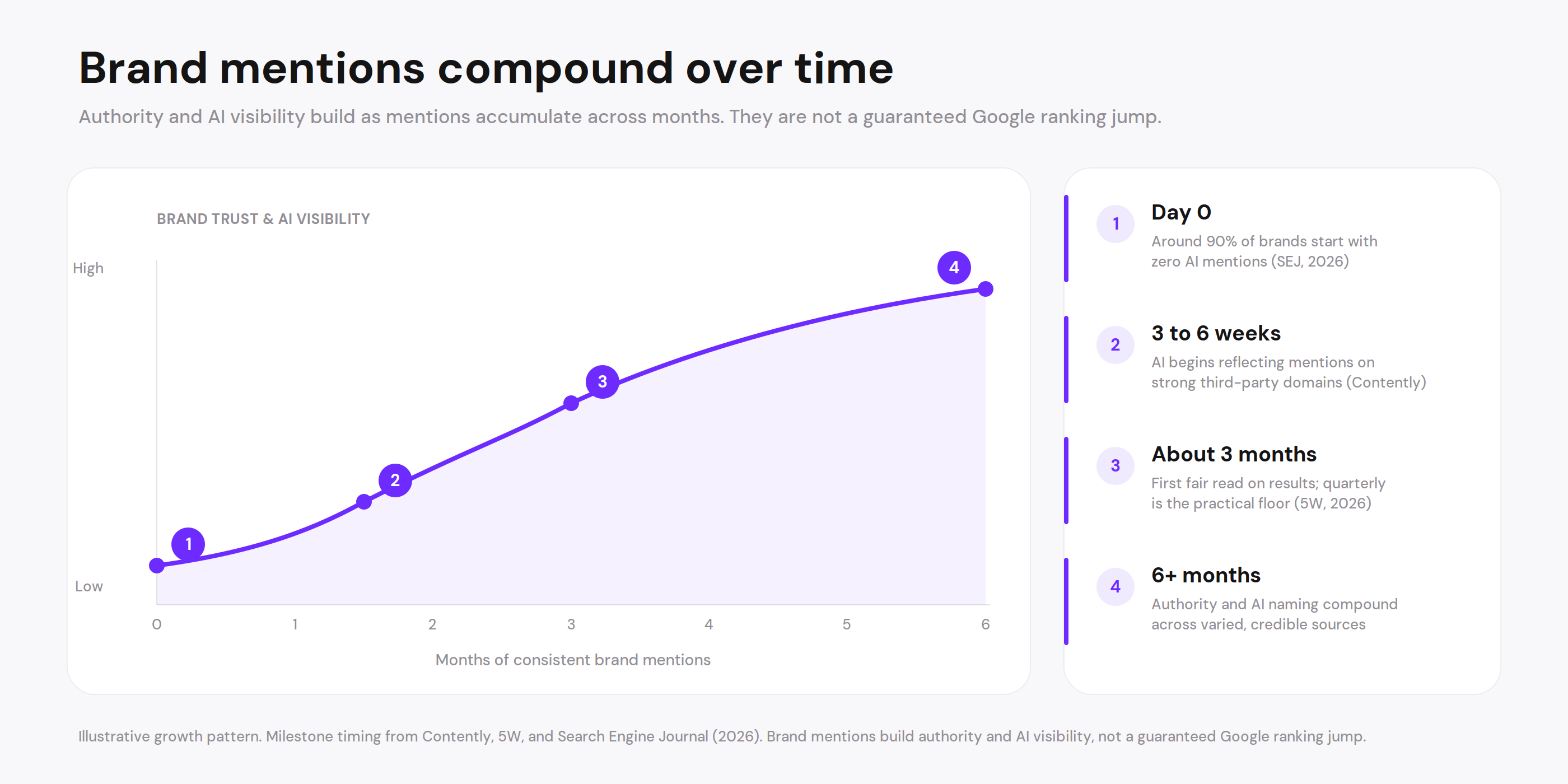
Consistent brand mentions across varied sources over months are what compound, both for Google's trust in your brand and for AI naming.
Common mistakes (natural vs manual vs automated)
Short answer: the natural and manual methods build durable brand mentions, while automated methods get your accounts banned and break trust.
The biggest mistakes here are not technical, they are trust mistakes. The clearest way to see it is to compare the three ways people build brand mentions.
Approach
What it looks like
Result
Natural (best)
A genuinely useful product and content that people reference on their own
Slow start, compounds, safest, trusted by Google and AI
Manual (good)
You personally answer questions and mention your brand only when it fits
Steady, controllable, builds real authority and relationships
Automated (avoid)
Bots or bought accounts posting brand mentions at scale
Bans, shadowbans, account loss, lost trust
The automated path deserves a direct warning. Using bots or bought “warmed” accounts to post brand mentions at scale breaks the rules of Reddit, Quora, and similar platforms. These platforms track device fingerprints, IP addresses, and account patterns, so multiple accounts and improper automation get detected. The consequences escalate from a removed post, to a subreddit ban, to a shadowban where your posts are invisible to everyone but you, up to a site-wide account suspension. For a small business building an honest reputation, one exposed astroturfing attempt in the community where your buyers gather can undo months of trust.
Two more mistakes deserve attention. The first is posting from a cold account: a brand-new account that immediately drops links to its own product is flagged as spam fast, so participate first and promote second, keeping promotional posts to a small fraction of your activity. The second is chasing volume over context: a pile of identical brand mentions in one place is weaker than the same number spread across varied, credible sources, which is exactly what manufactured mentions fail to imitate.
How many brand mentions do you need, and how long until results show?
Short answer: there is no fixed number, but consistent brand mentions across varied sources over months matter more than a single burst.
Question
What the data suggests
Source
How long until AI reflects new mentions?
Roughly 3 to 6 weeks for mentions on high-citation third-party domains, longer for your own domain
Contently, 2026
Does volume or spread matter more?
Spread wins: about 85% of brand mentions come from third-party pages, not your own site
AirOps, 2026
Best surfaces for AI naming
Reddit for Perplexity (~46.7% of its sources), Wikipedia and major sites for ChatGPT (~47.9%)
5W, 2026
Does freshness matter?
Pages updated within about 2 months earn roughly 28% more citations
Superlines, 2026
When to expect a fair read on results
After about 3 months of consistent presence; quarterly is the practical floor
5W, 2026
The honest summary is that nobody has exact thresholds, and anyone promising a precise number of brand mentions is guessing. The reliable signal is steady, varied, genuine brand mentions that build over months.
FAQ
Short answer: the most common questions about brand mentions are whether they help, how to find them, and whether you need paid tools.
Do unlinked brand mentions help SEO?
They help Google understand and trust your brand as an entity, and they strongly help AI tools decide to name you. Google has not confirmed unlinked brand mentions as a direct ranking factor, so treat them as an authority and AI-visibility signal rather than a guaranteed rankings lift.
How do I find unlinked brand mentions for free?
Search “Your Brand” minus your own site in Google using the -site: operator, add intext: to focus on in-content brand mentions, apply the time filter for recent ones, and use Ctrl+F on each page to check whether the mention is linked.
How do I track brand mentions without paying?
Use Google Alerts for the general web and F5Bot for Reddit and Hacker News, both free, plus a folder of saved Google operator searches you check weekly.
Where should I post brand mentions?
Start with profiles you control, such as G2 or relevant directories, then participate genuinely in the communities your buyers use, such as the right subreddits or Quora topics. Match the platform to your business type and to where AI answers already pull from.
Is it safe to post about my own brand on Reddit?
Yes, if you build a real account first, contribute helpfully before promoting, follow each subreddit's rules, and mention your product only when it genuinely answers a question. Cold accounts dropping links get removed or banned.
Do I need a link next to the brand mention?
Not for AI recognition, which often counts the mention alone. A link adds direct SEO value and a click path, so convert easy unlinked brand mentions into links when it helps the reader.
What's Next
Set up the free tracking stack today, run your brand and competitor searches, and read your citation supply chain in ChatGPT and Perplexity so you know which surfaces to focus on. Then make sure the pages those brand mentions point to are built to be quoted by AI.
You can check whether your own pages are ready for that in a few minutes with IvaBot's Content Coverage and AI Readiness instrument, which shows what to fix first.
 14 min read