Two years ago, the path from a question to an answer went through the ten blue links on a Google or Bing results page. People searched, opened a few websites, read, compared, decided.
Today the path is shorter. ChatGPT writes the answer in one paragraph. Perplexity gives a structured summary with sources. Google shows an AI Overview at the top of the results page, before the regular links even appear. The user often reads the summary first, and only clicks through to the websites that look most relevant or trustworthy among the cited sources.
If your site is one of those cited sources, you still get seen and clicked. If it isn't, you've quietly disappeared from this new path. That's the gap GEO is here to close.
TL;DR (Quick Summary)
- GEO is the new SEO, but on top of it, not instead of it. AI assistants like ChatGPT, Perplexity, Claude, and Google AI Overviews now answer questions before users click anything. Your goal is to be cited inside that answer.
- Most of GEO is good SEO done with care. Clear answers, real authors, fresh sources, structured pages. The new part is writing in a way that an AI can quote you with confidence.
- The numbers are real. Click-through rates dropped 61% on queries with AI Overviews, but cited brands earn 35% more clicks. The window to be early is still open: only 23% of marketers invest in GEO yet.
- Five things you can do this week: make content quotable, add author and sources, use FAQ schema, write what people actually search for, and set up Bing Webmaster Tools so ChatGPT can find you.
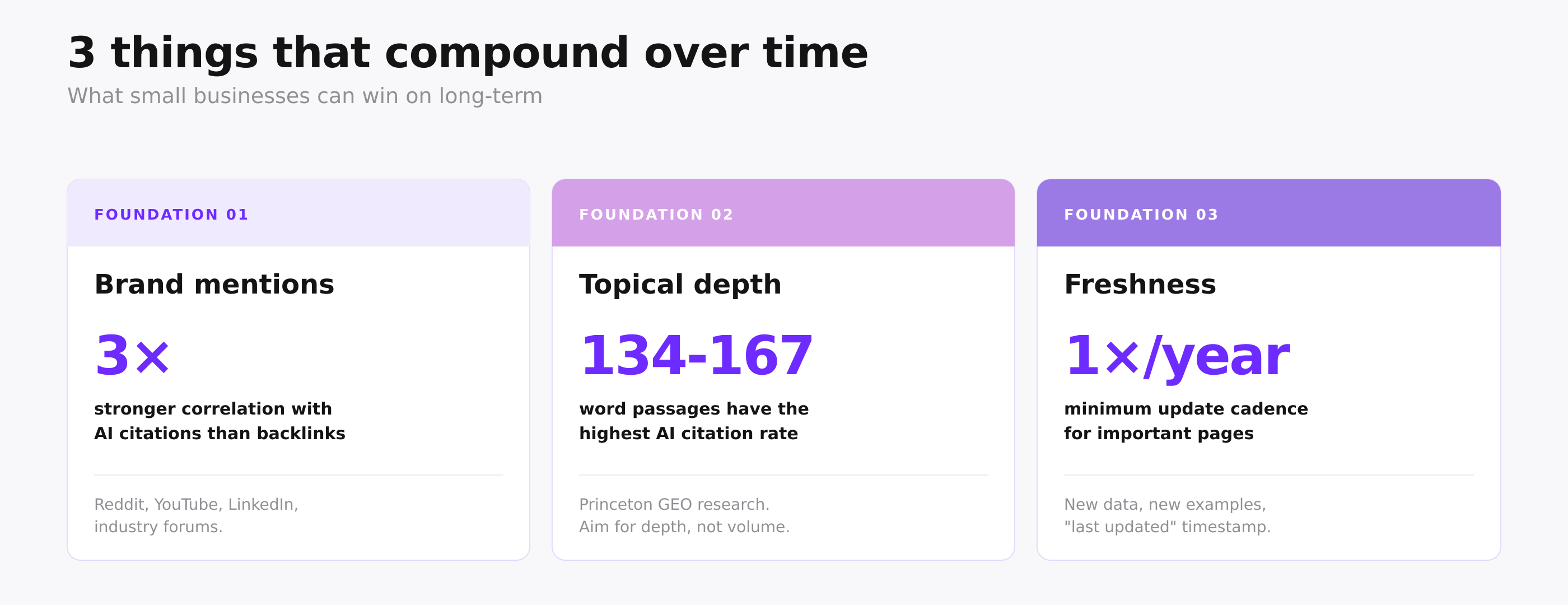
- Long-term wins compound for small businesses: brand mentions matter more than backlinks, narrow depth beats wide volume, and freshness keeps you in rotation.
- GEO is just a new branch of SEO. Keep doing regular SEO. Add GEO to it.
"SEO gets you clicked. GEO gets you quoted."
What is GEO and how it differs from SEO
Short answer: GEO is the practice of making your website easy for AI assistants to read, trust, and cite when they generate answers. It uses most of the same building blocks as SEO, but optimizes for being quoted, not clicked.
"From Google Search's perspective, optimizing for generative AI search is optimizing for the search experience, and thus still SEO." — Google Search Central, May 2026
Update May 2026
Google now officially confirms that AI search optimization is still SEO (official guide). Bing, ChatGPT, and Perplexity have not said the same, so AI crawler setup and the rest of this guide still apply.
The simplest generative engine optimization meaning, in plain words: it is the practice of making your website easy for AI assistants to read, trust, and cite when they generate answers for users. Some people also use the term geo seo for the same thing, since it sits at the intersection of search and AI.
If you have already worked on traditional SEO, you have a good head start. I covered the basics in SEO for Small Business: An Honest Founder's Guide. GEO uses most of the same building blocks: clear writing, real expertise, structured pages, fresh content. What is new is how you write, for a system that summarizes before it shows.
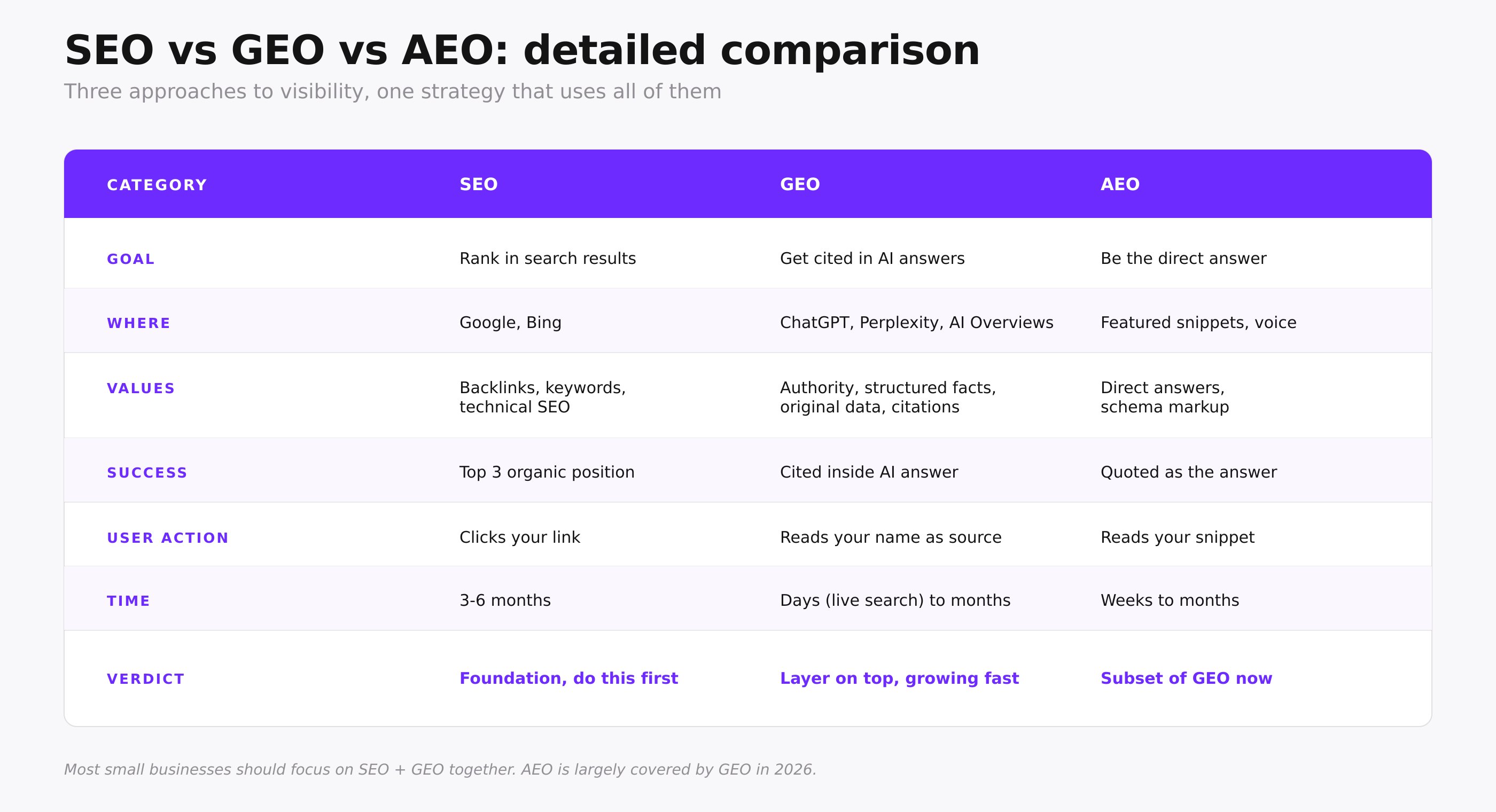
You will see three terms used a lot. Here is the short version:
- SEO (Search Engine Optimization): rank on Google or Bing for keywords, get clicks from search results. Still alive, still important.
- GEO (Generative Engine Optimization): get cited inside AI-generated answers. The user might never click your link, but they see your name as a source, which builds authority and brand recall.
- AEO (Answer Engine Optimization): get picked up as the direct answer in featured snippets, voice assistants, and "people also ask" boxes. Older than GEO, but uses the same core idea.
You will often see people debate aeo vs geo, but in practice aeo and geo have merged into the same discipline. Most people now use the terms interchangeably. The label matters less than whether your content is something an AI would quote with confidence.
Why this matters: the data
Short answer: AI search is changing how people find information, and the numbers show the shift is already happening. Click-through rates are dropping, but cited brands are gaining traffic.
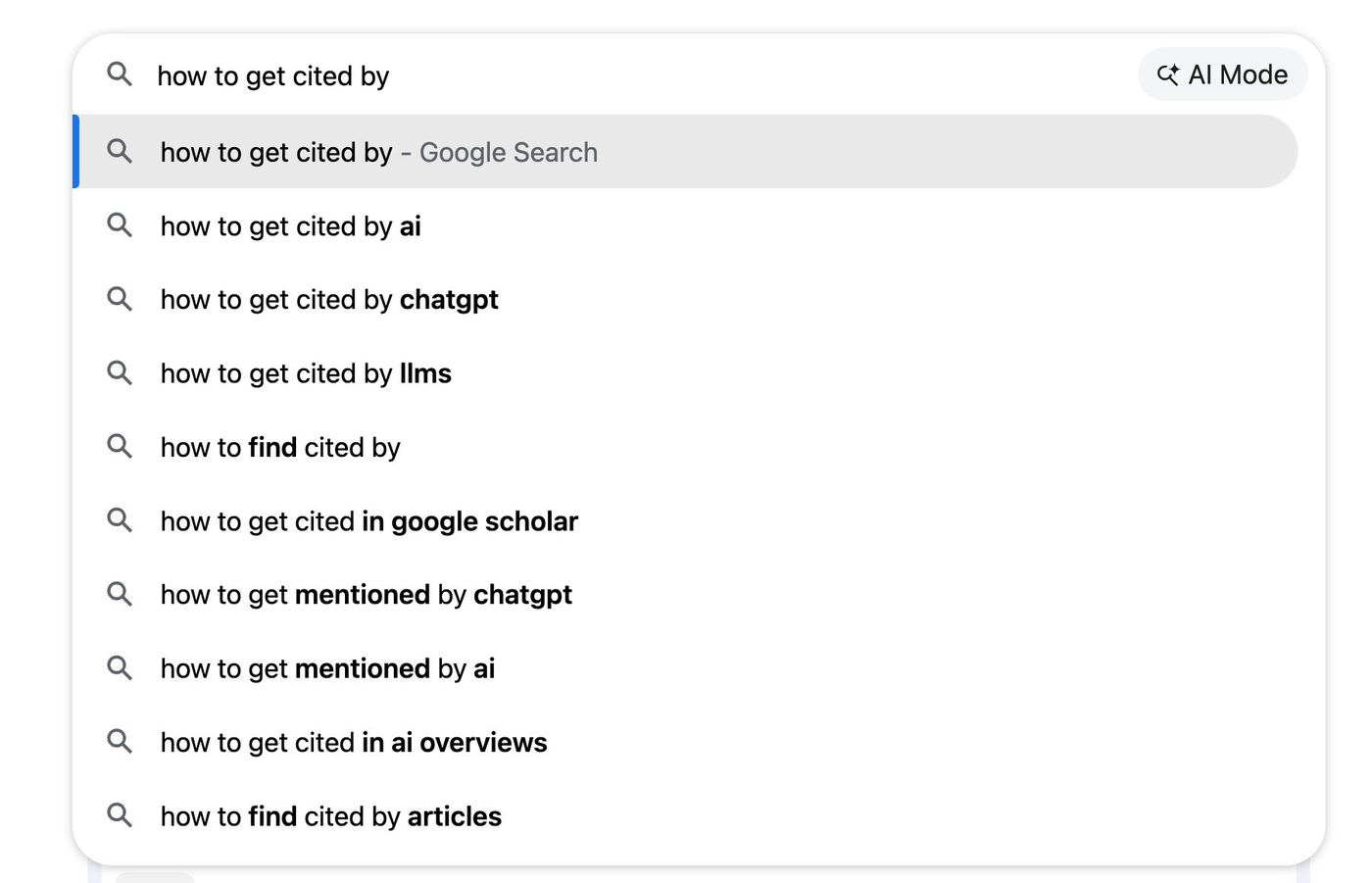
The shift is real, and the numbers explain why it matters. Before getting into the data, it helps to understand how does ai search optimization work at a basic level: AI engines pull short, well-structured passages from sources they trust, then synthesize them into one answer. That's why how to get cited by ai and how to get cited by llms come down to the same thing, write content that's easy to extract and worth quoting.
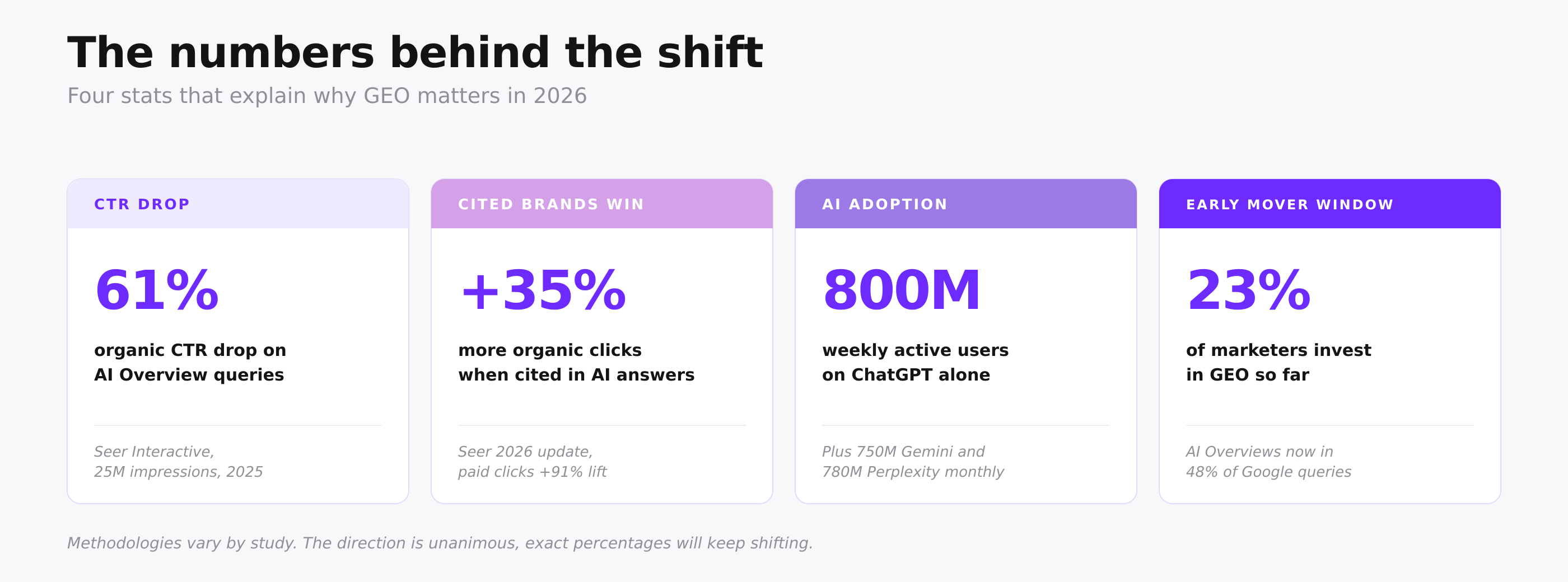
Click-through rates from Google are dropping when AI Overviews appear. Seer Interactive analyzed 25 million impressions across 42 organizations and found that organic CTR on queries with AI Overviews dropped 61%, from 1.76% to 0.61%. Ahrefs ran a similar study on 300,000 keywords and reported a 58% drop for top-ranking pages.
Being cited inside the AI answer changes everything. The same Seer study found that brands cited in AI Overviews actually earned 35% more organic clicks and 91% more paid clicks compared to similar brands that weren't cited. So the goal is not to fight AI Overviews, the goal is to be inside them.
It is still early. Only 23% of marketers were investing in GEO as of late 2025. The competition is real but most websites have not started yet, which is the kind of window that closes quickly once it gets noticed.
One note: this is a young area, and the numbers above come from studies done in 2025 and early 2026. Methodologies differ and results vary by industry. The direction of the trend is clear, but exact percentages will keep shifting.
"Cited brands earn 35% more clicks. The goal is not to fight AI Overviews, it is to be inside them."
Branded vs non-branded: where the real win is
You'll feel good when you type your business name into ChatGPT and see your brand in the answer. Don't trust that feeling. That's a branded prompt, and it only confirms ChatGPT can spell your name.
The real win is non-branded prompts. Someone types "best bakery for birthday cakes in Bucharest" and your bakery shows up in the answer. They didn't know you existed. Now they do. That's how AI search brings you new customers.
When you measure your AI visibility, focus on non-branded prompts.
Is GEO worth it for small business?
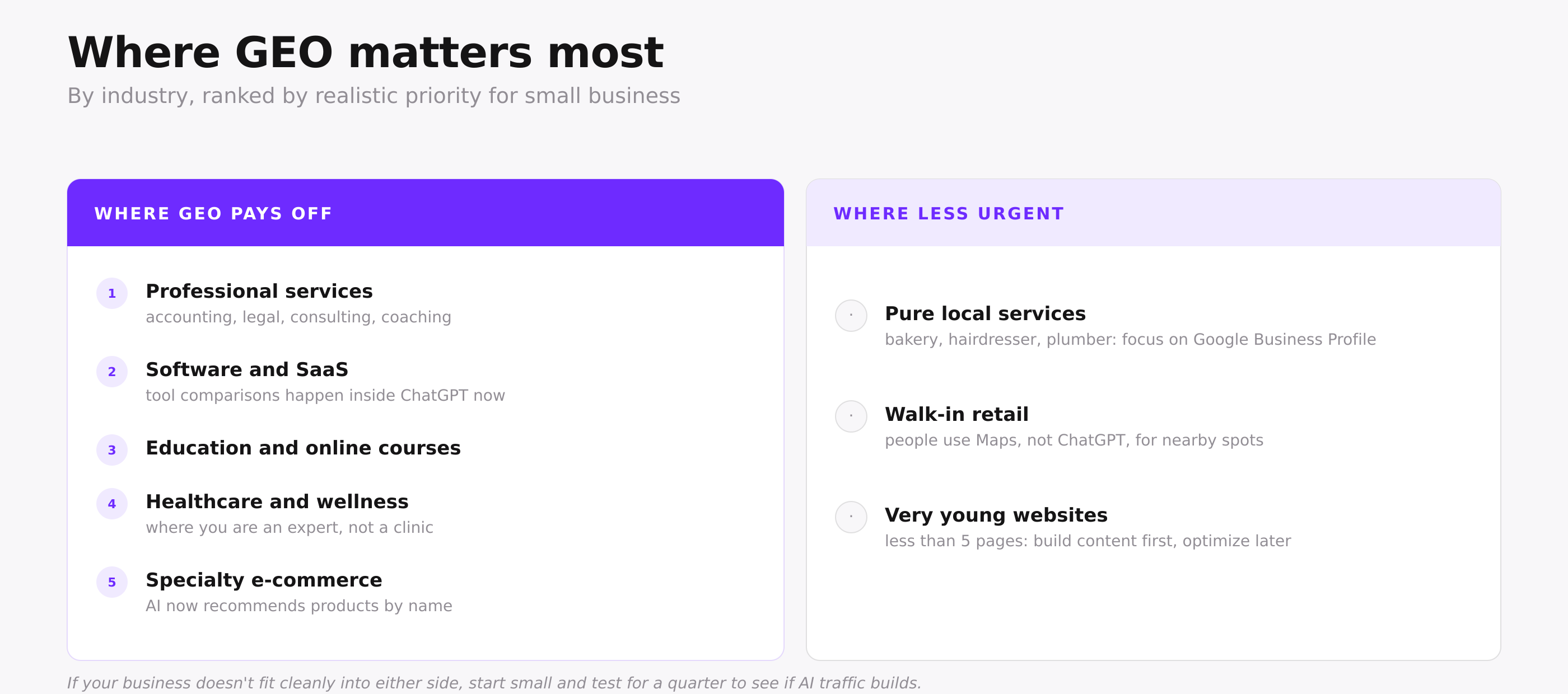
Short answer: usually yes, but not equally for every type of business. If your customers research before they buy, GEO will pay off. If they walk in or call directly, focus on local SEO first.
Where GEO pays off most
If your customers research before they buy or hire, AI assistants are increasingly part of that research:
- Professional services (accounting, legal, consulting, coaching)
- Software and SaaS: tool comparisons happen inside ChatGPT and Perplexity now
- Education and online courses
- Healthcare and wellness (where you are an expert, not a clinic)
- Specialty e-commerce: AI engines now recommend specific products by name
- NGOs and educational nonprofits
Where GEO is less urgent
- Pure local services (bakery, hairdresser, plumber): focus on Google Business Profile and local SEO instead
- Walk-in retail: people don't ask ChatGPT where to grab coffee on their commute
- Very young websites with less than 5 pages: build the content first, then optimize it
For most small businesses with an online audience, GEO is a small ongoing investment that compounds. A few hours a month is enough to start.
Step 0: Know your baseline before you change anything
Before you change anything, find out where you stand.
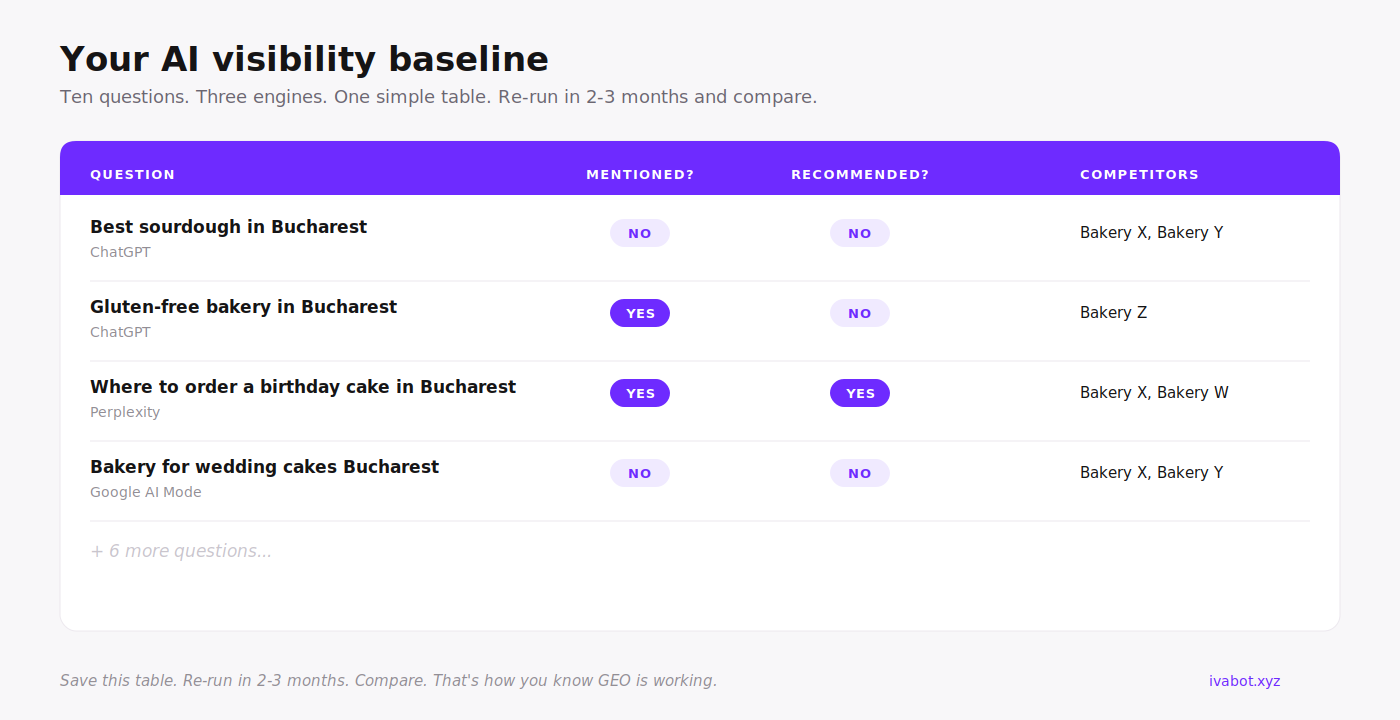
Write down 10 questions your customers would actually type into ChatGPT before buying from you. To find them:
- Read your last 30 customer emails. What did they ask before buying?
- Read your reviews. What do people say you helped them with?
- Type your category and city into Google. Look at the autocomplete suggestions.
Open ChatGPT, Perplexity, and Google AI Mode. Ask those 10 questions. Write down the answers in a simple table.
Save the table. In 2-3 months, ask the same 10 questions again. Compare. That's how you know if your work is paying off.
5 things you can do this week
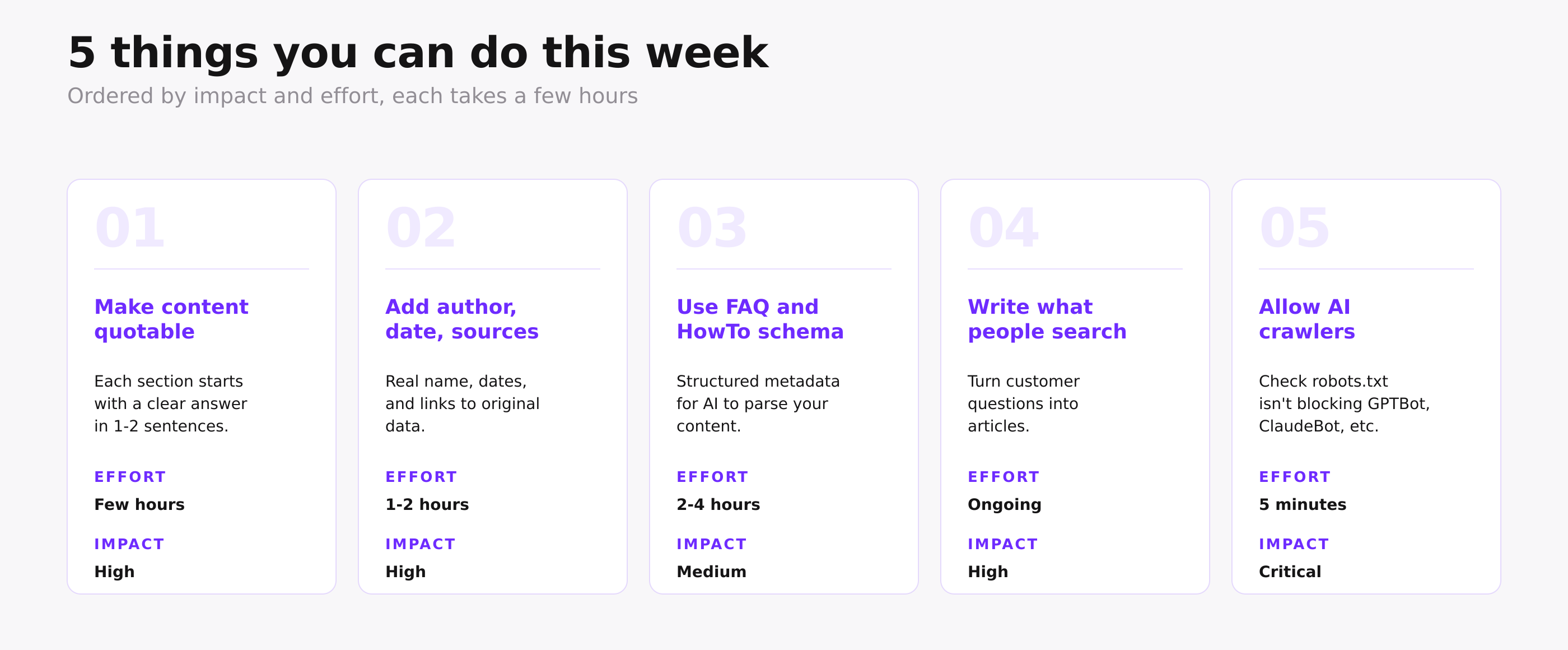
Short answer: focus on five concrete actions ordered by impact. Each takes a few hours, not weeks. Start at the top, finish what you can.
If you are wondering about generative engine optimization how to do it in practice, the answer is less complicated than it sounds. If you are running a small business or working solo, you probably don't have time for a full content overhaul. These five steps are the most realistic place to start, ordered by impact and effort.
01
Make your content quotable
AI engines pull short, self-contained sentences. Look at your most important pages and check whether each section has a clear answer in the first 1 or 2 sentences. Avoid burying the point in long intros.
Quick check: can someone copy a single sentence from your page and use it as a standalone answer? If yes, you are halfway there.
02
Add author, date, and sources (with a real photo)
Every important page should show who wrote it, when it was published, when it was last updated, and where the data comes from. AI assistants weigh these signals heavily because they need to cite reliable sources, not anonymous text.
Three things that move the needle most:
- Real name and photo of the author. Anonymous content with a generic avatar ranks lower than the same content with a face and a name. AI Overviews especially favor content with clear authorship.
- Short bio with credentials and ideally a link to LinkedIn or another verifiable profile. This is the E-E-A-T signal AI engines look for.
- Visible "last updated" date on every important page. Even if you only fixed a typo, update the date. AI engines weigh recency, and a 2024 article without an update looks stale next to a 2026 one.
03
Use FAQ and HowTo schema
Schema markup is structured metadata that tells search engines and AI assistants exactly what your page is about. The two most useful types for small business sites are FAQ schema (question and answer pairs) and HowTo schema (step-by-step guides).
Most CMS platforms have plugins or built-in support. If you use Webflow, Wix, or WordPress, search "FAQ schema" plus your platform name and follow the setup guide.
04
Write content humans actually search for
Look at the questions your customers ask in emails, on calls, or in your reviews. Each one is a small content opportunity. Turn the most common 5 to 10 questions into short articles or FAQ entries on your site. The detailed workflow for writing those articles with AI without losing your voice is in how to write SEO content with AI that gets traffic without sounding like a robot, which covers the full 10-step process and two ready-to-copy prompts.
This is also one of the most reliable ai search optimization techniques: AI engines love content that answers a specific question directly. The same logic applies whether you're working out how to optimise for ai search or just trying to write better articles.
05
Set up Bing Webmaster Tools and unblock AI crawlers
This is the step most people skip, and it's the easiest one. Two things to do, both free, both 5 minutes:
Set up Bing Webmaster Tools. ChatGPT search uses Bing's index, not Google's. If you've only set up Google Search Console, ChatGPT can't find your site through search. Go to bing.com/webmasters, verify your site, and submit your sitemap. This is the single biggest "I had no idea" finding for most people testing GEO.
Check your robots.txt for AI crawler blocks. A surprising number of sites block AI crawlers without realizing it. Webflow and WordPress sometimes ship with default rules that block GPTBot, ClaudeBot, PerplexityBot, or CCBot. Open yoursite.com/robots.txt in your browser. If you see lines like User-agent: GPTBot followed by Disallow: / and you want to be cited, remove them.
Common mistakes that keep AI from citing you
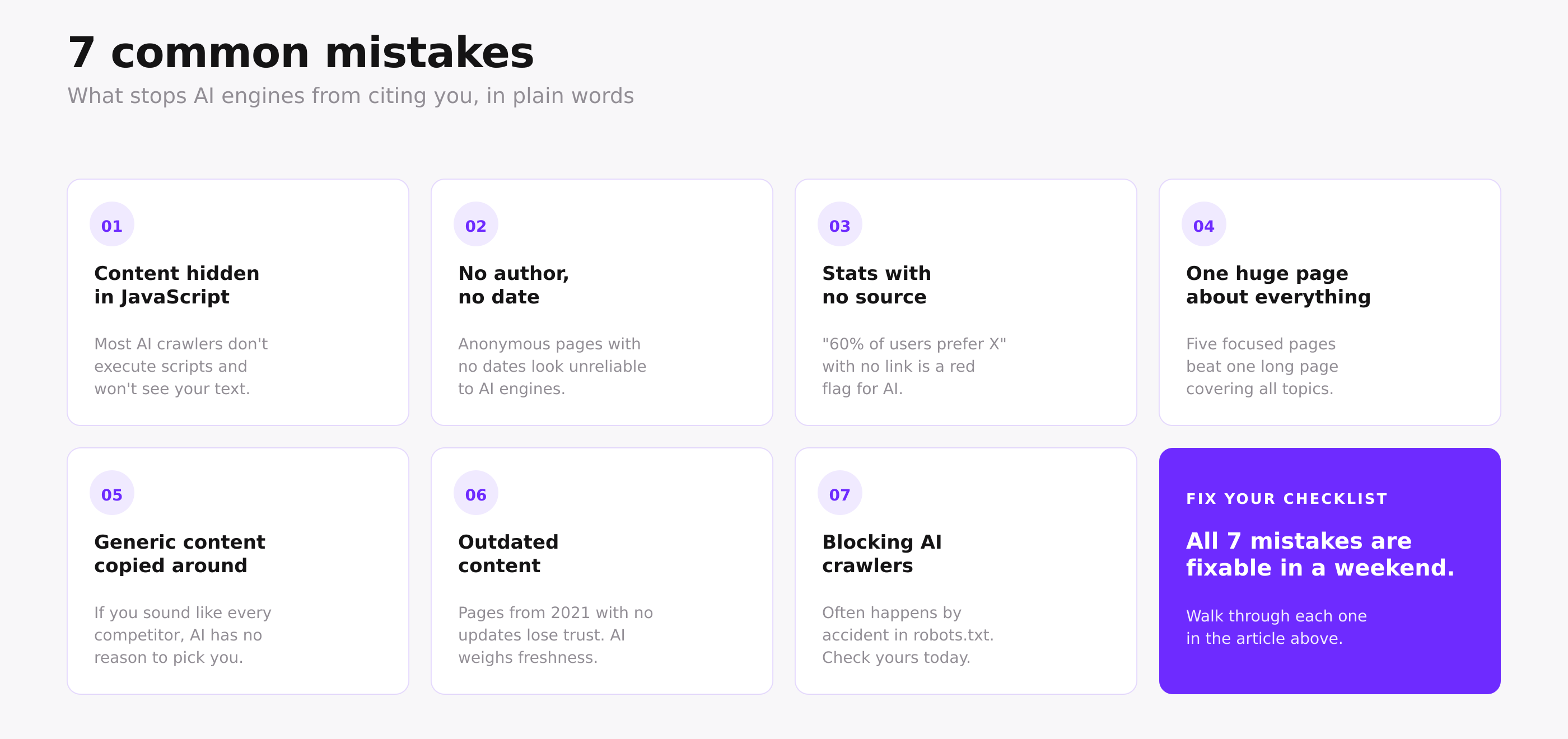
Short answer: most websites that don't get cited by AI are not failing for clever reasons. They are failing for boring, fixable ones. The list below covers what shows up most often.
Content that lives only in JavaScript. If your text appears only after scripts run, most AI crawlers will not see it. The fix: check your page source (right-click, View Page Source) and make sure your main text is there.
No author, no photo, no date. Pages with no human attribution and no publication date look unreliable to an AI engine. Generic avatars or stock photos for "team members" make it worse. The fix: real author name, real photo, publish date, last updated date. If you don't update the date when you edit, AI engines treat the article as stale.
Statistics with no source. Claiming "60% of users prefer X" with no link is a red flag. AI assistants prefer sources that cite their own sources. The fix: always link to the original study.
One huge page covering everything. AI engines prefer focused pages. The fix: break a 5000-word everything-page into five focused pages about specific topics.
Generic content copied across sites. If your "about" page or service description sounds like every competitor's, AI has no reason to pick you. The fix: write in your own voice with specific details.
Outdated content with no "last updated" date. Content from 2021 with no updates loses trust. Even worse, content that was updated but doesn't show a fresh "last updated" timestamp looks just as stale to an AI. The fix: review your top pages once a quarter, refresh data and examples, and visibly stamp the date.
Blocking AI crawlers without realizing it. The most common silent killer. Webflow, WordPress, and Wix sometimes block GPTBot or ClaudeBot in their default robots.txt. The fix: open yoursite.com/robots.txt, look for any AI bot blocks, remove them.
Only writing "what is X" content, never "which X should I choose" content. AI engines pull "what is" content for educational questions. For commercial questions ("best X", "X vs Y", "X for [audience]"), they look for pages that help users decide. If your site only explains your topic, you're invisible when buyers compare options. The fix: for every 3 explainer pages, write 1 comparison or selection page — "X vs Y", "best X for [audience]", "when X isn't the right fit".
Short answer: you don't need a stack of expensive tools to do GEO well. Free options cover most of what a small business needs to start.
Free tools
- Google Search Console (free): see which queries bring people to your site, which AI Overviews include you, and what Google sees on your pages.
- Bing Webmaster Tools (free): essential for ChatGPT, since ChatGPT search uses Bing's index. If you only have GSC, set this up today.
- Schema Markup Validator by Schema.org (free): paste any URL and see what structured data is detected.
- Perplexity Sources Check (free): ask Perplexity a question in your niche and see which sources it cites. That's your direct competition for visibility.
- Free AI visibility checkers (free): Ahrefs and Semrush both run one, and the Ahrefs one needs no signup. They tell you whether AI platforms mention your brand at all. What each one gives away is tested in how can I check AI visibility for free.
Paid tools
- Ahrefs (from $129/month): full SEO suite, keyword research, backlink analysis. Overkill for most small business owners but powerful if you take SEO seriously.
- Surfer SEO (from $89/month): content optimization based on top-ranking pages. Helps you write content that matches what already works.
- Semrush (from $139/month): similar to Ahrefs, slightly different feature mix.
- Frase.io (from $45/month): AI content optimization with focus on answer-style content. One of the more GEO-friendly options.
- Dedicated AI visibility trackers (from about $20/month): Rankscale, Otterly AI, Peec AI and Profound AI all track prompts across engines at very different prices. The full comparison, including cost per prompt, is in best AI visibility tracking tools for startups on a tight budget.
IvaBot
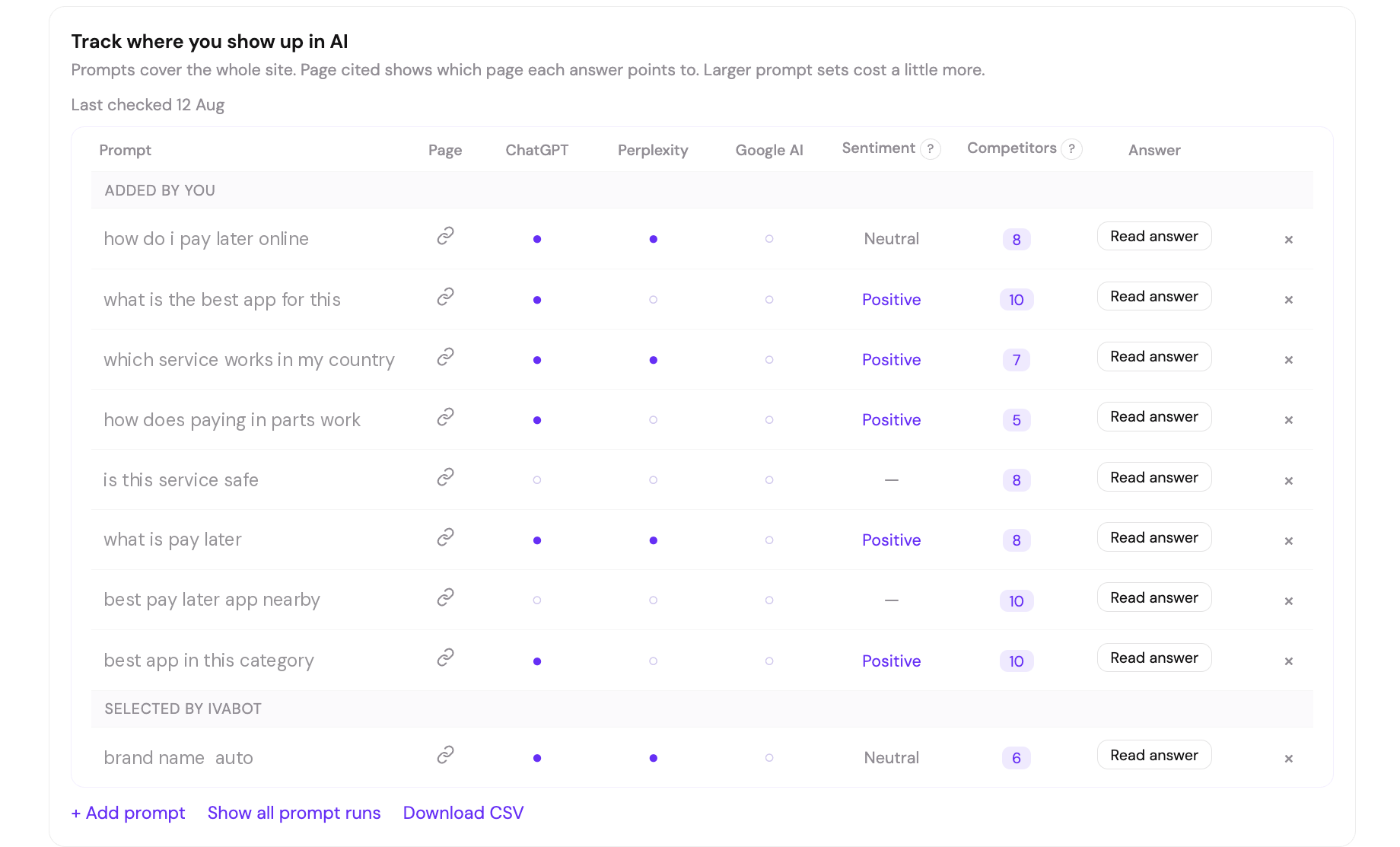
Once you have made the changes above, the question becomes whether they worked. IvaBot answers your prompts across ChatGPT, Perplexity and Google AI and records, for each one, whether the brand was mentioned, whether a page was cited and which page, the sentiment of the mention, the competitors named in the same answer, and the full answer text so you can read what the model actually said. Fifty prompts a month costs about five dollars, and new accounts get three free credits with no card. Run it on your page.
How to win long-term
Short answer: small businesses can't out-publish big competitors, but they don't need to. AI engines reward different signals than the old SEO playbook, and a few of them favor small, focused brands.
Brand mentions matter more than backlinks. Research from Ahrefs found that brand mentions correlate three times more strongly with AI citations than traditional backlink metrics. Every time someone writes your name in a Reddit comment, a YouTube description, or a LinkedIn post, you get closer to being cited by AI.
Go deep on a narrow topic. Princeton's GEO research found that focused, well-cited passages between 134 and 167 words have the highest chance of being extracted by AI. Aim for depth, not volume. A site that covers one subject thoroughly tends to outperform sites that cover the same subject broadly.
Keep your content fresh. AI engines weigh recency, and they read the visible "last updated" date as a signal. A guide written in 2024 with no updates loses ground to a 2026 article on the same topic. Update your most important pages at least once a year with new data, new examples, or a clear "last updated" timestamp visible on the page.
Get mentioned in the right third-party places. AI engines read what other sites say about you, not just your own site. For small businesses, the mentions that move the needle:
- Industry directories and review sites (G2 and Capterra for SaaS, Yelp and TripAdvisor for local, niche platforms for your category).
- Communities where your audience already hangs out — relevant subreddits, forums, industry Slack groups. Don't spam. Participate. Your name comes up naturally.
- Guest articles, podcast appearances, expert quotes in publications your customers read.
- Partner pages and integration listings.
One mention in a place your customers trust beats ten generic backlinks.
None of these are quick wins. They are the kind of slow accumulation that small businesses are actually good at, because they require care and consistency more than budget.
"Brand mentions correlate 3x more strongly with AI citations than backlinks."
FAQ: GEO and AI Search Optimization
Is SEO dead? Should I stop doing it?
No, SEO is not dead. AI search is growing fast, but Google's regular search still drives the majority of organic traffic for most websites in 2026. The right approach is to keep doing SEO and add GEO on top, since they share most of the same foundations.
What is the difference between local GEO SEO and Generative Engine Optimization (GEO)?
This is a real source of confusion. "Local GEO SEO" usually means geographic SEO, optimizing your site to rank in a specific city or region (Google Business Profile, local keywords, location pages). For that side of things, see our Local SEO for Small Business guide. "GEO" in the AI sense stands for Generative Engine Optimization, which has nothing to do with geography. When you read about GEO in 2026, it almost always means the AI version. Context usually makes it clear which one is meant.
How long does it take to get cited by AI engines?
It depends on the engine. Perplexity and Google AI Overviews can pick up new content within days, since they pull from live indexes. ChatGPT's training data updates less frequently, so it can take months for new content to appear there. The fastest wins come from making existing pages more quotable rather than writing brand new content.
How to rank in ChatGPT and how to get cited by ChatGPT?
The first step in figuring out how to rank in ChatGPT is making sure Bing can crawl and index your site, since ChatGPT search uses Bing's index. Set up Bing Webmaster Tools at bing.com/webmasters, submit your sitemap, and confirm GPTBot and Bingbot are not blocked in your robots.txt. Beyond that, the recipe for how to get cited by ChatGPT and how to get mentioned by ChatGPT is the same: clear structure, real authors with real photos, citations, and content that answers a specific question directly.
How do I check if AI is already citing me?
Ask the AI engines directly. Open ChatGPT, Perplexity, Claude, and Gemini, then search for queries your customers might use in your niche. Look at the cited sources. You can also check Google Search Console for traffic from "ChatGPT", "Perplexity", and similar referrers. For a full weekly routine, see our guide on how to track AI citations and AI search traffic in 15 minutes a week.
How do I get cited in AI Overviews on Google?
The recipe for how to get cited in ai overviews starts with traditional SEO: AI Overviews pull from pages that already rank well in regular Google search, especially those that answer specific questions clearly and have strong E-E-A-T signals (experience, expertise, authoritativeness, trustworthiness). Real author info with a photo is part of E-E-A-T. The same rules apply for how to get mentioned by ai in general. If you are wondering how to optimize website for ai search, focus on ranking for question-shaped queries ("how to", "what is", "best way to"), use FAQ schema, and keep your content updated.
Will Google's AI Overviews kill my organic traffic?
It is reducing click-through rates for some queries, especially purely informational ones where the AI Overview answers the question completely. For commercial, transactional, and complex queries, traffic patterns are mostly stable. The realistic plan is to expect some decline on simple "what is" queries and double down on content where users still need to click through to make a decision.
What does generative engine optimization mean in simple terms?
The generative engine optimization meaning is straightforward: writing and structuring your website so AI tools, like ChatGPT, Perplexity, Claude, and Google AI Overviews, can use your content as a source when they answer questions. The geo seo meaning is the same idea framed as the AI version of SEO. You may also see it written as aeo answer engine optimization, which originally referred to voice and snippet answers but now overlaps with GEO almost entirely.
What is the difference between generative engine optimization and SEO?
SEO optimizes your pages to rank in regular search results on Google or Bing, with the goal of getting clicks. Generative engine optimization optimizes your content to be cited inside AI-generated answers, with the goal of being mentioned as a trusted source. SEO gets you clicked, GEO gets you quoted. Most small businesses should do both, since they reinforce each other.
Are there generative engine optimization tools that actually help?
Yes, but you don't need many. The most useful starting setup combines free ai search optimization tools like Google Search Console and Bing Webmaster Tools with one paid ai search optimization platform that gives you concrete recommendations on your specific pages. Tools like Frase, Surfer, or IvaBot will check your pages for the signals AI engines look for. Free tools alone will get you 80% of the way there for most small businesses.
What if ChatGPT describes my business incorrectly?
AI engines build their description of you by reading every source about your business — your site, Google Business Profile, LinkedIn, Crunchbase, review platforms, directory listings, old articles. If half of these sources call you a "marketing agency" and the other half call you a "PR consultancy", AI mixes them up.
The fix is to clean up the sources. Make sure your business is described the same way everywhere. A full guide on fixing AI misrepresentation is coming soon.
Do AI visibility tracking tools actually help?
Tracking tools like Profound, Otterly, and Peec AI run prompts through ChatGPT, Perplexity, and Gemini on a schedule. They count how often your brand is mentioned and how that changes over time. Useful when you already have visibility and want to measure changes. Also useful when you compete with known brands and need to see share-of-voice.
Less useful when you're starting from zero. If you're invisible now, the tool will tell you you're invisible next month too. It doesn't tell you what to fix. Prices run from about $20 to $675 a month depending on how many prompts and engines you need, and one of them gives a complete report on a trial without a card. Both are covered in the pricing comparison and the free trial test. For most small businesses, the 10-prompt manual check above gives the same signal for free.
What's Next
If you've read this far, you have the map. The hard part is consistency: doing one thing per week for three months, instead of trying to do everything in one weekend.
Start with what's quickest. Open one of your most important pages and rewrite the first paragraph so it answers the page's question in two sentences. Add author info with a real photo and a publication date. Link to one source for any statistic. That alone moves you ahead of most websites in your niche.
Then pick one of the five steps and do it this week. Set up Bing Webmaster Tools if you haven't. Check your robots.txt for AI crawler blocks. Add a "last updated" date to your top pages. Each one is a 5-15 minute task that pays off for years.
The rest is content. Write about the questions your customers ask, in your own voice, with sources. By month seven, you'll have a small library of pages that AI engines pull from when someone asks a question in your niche. That's what compounding citations look like.
After you make changes, wait 2-4 weeks and re-run the same 10 baseline questions. AI engines update on their own schedule. Some fixes show results in a week, others take months, some never work and you try something else.
Once you've started the optimization work, the next thing is measuring whether it's actually working. See our follow-up guide: How to Track AI Citations and AI Search Traffic in 15 Minutes a Week, which covers a simple weekly routine to check ChatGPT, Perplexity, Google AI Overviews, and GA4 referral traffic.
For the full step-by-step writing process behind every content recommendation in this guide, see how to write SEO content with AI that gets traffic without sounding like a robot. It covers the 10-step workflow, two ready-to-copy prompts, and the structure that gets articles cited by Google and AI tools, even for non-native English writers.
For local businesses specifically, the AI-ready FAQ pattern and other tactics that help AI engines cite you in local queries are covered in Local SEO Tips for Small Businesses: 9 Tactics Worth Trying After the Basics (tactic 9 in particular).
And if you want to understand why each AI engine cites such different sources to begin with, see our latest deep dive: Where do ChatGPT, Perplexity, Claude, and Google AI get their information? (2026).
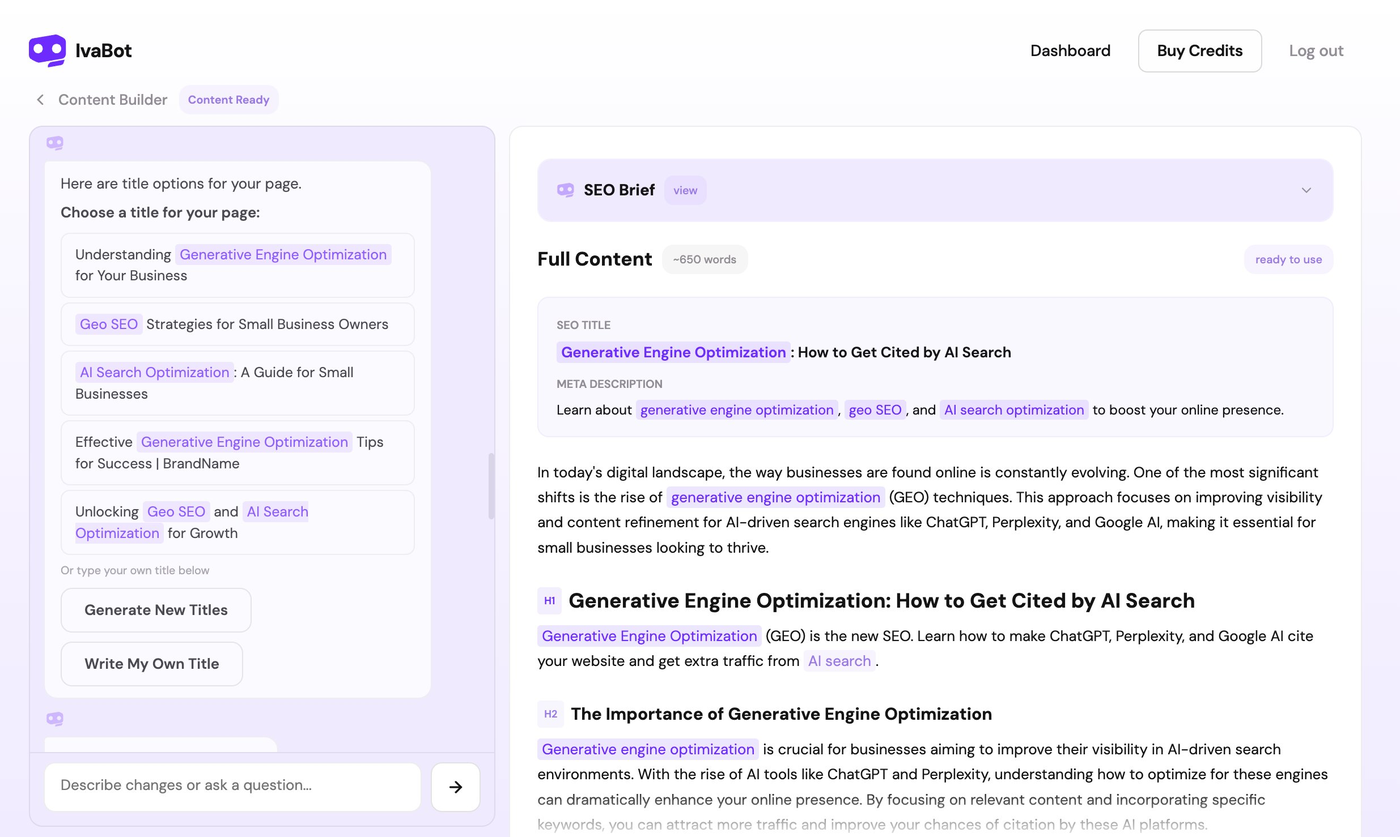
This article was written using IvaBot Content Builder for the structure and brief, then rewritten and edited based on real GEO research and experience. IvaBot (Core Audit, AI Readiness, Content Builder) is built for small businesses and content creators who want SEO insights without agency pricing. Try it free at ivabot.xyz.
 13 min read