This guide covers how to get backlinks for small business in 2026, both free and paid, with realistic prices, outreach templates, and a section on how backlinks now influence what AI search engines cite. Backlinks are links from other websites pointing to yours. They are still one of the strongest ranking signals in Google, and in 2026 they also shape what ChatGPT, Perplexity, and Google AI Overviews recommend when people ask for products and services like yours.
What works in 2026: relevant links from sites with real traffic, brand mentions across the web, and a few link-worthy pages on your own site. Free backlinks are still possible to build, paid ones still move rankings when chosen carefully. What does not work: link farms, Fiverr packages, mass directory submissions, and forum signatures. Backlinks are one piece of the broader picture; for the full overview see our honest founder's guide to SEO for small business.
TL;DR (Quick Summary)
- Backlinks are links from other websites to yours. They tell Google and AI engines that other people consider your site trustworthy.
- Quality beats quantity, always. One link from a relevant site with real traffic is worth more than 100 links from no-name blogs, forum signatures, or bio pages.
- The first 10 backlinks are the hardest. Realistic conversion on cold outreach is 2 to 5 percent of emails turning into actual links. Plan for 6 months of slow growth before backlinks start moving rankings consistently.
- Free methods that work in 2026: niche directories, HARO and Qwoted, targeted guest posts, unlinked mention reclamation, resource page outreach, community engagement, the Feedback Rebate model.
- Paid backlinks range from $30 to $2,500 per link depending on niche, region, and source quality. The mainstream range for small business is $100 to $500 per link.
- Social media links do not pass SEO weight directly, but quality mentions on LinkedIn, Reddit, YouTube, and Twitter feed AI training data and brand signals.
- Backlinks now drive AI citations. ChatGPT, Perplexity, and AI Overviews recommend brands they see linked and mentioned in trusted publications.
- Avoid: link farms, Fiverr blasts, PBNs, reciprocal link schemes at scale, bought bulk links. Penalty risk is real and recovery takes months.
"The fastest way to build a strong backlink profile is to make something genuinely worth linking to. Everything else is downstream of that."
Why backlinks matter for small business in 2026
A backlink is any link from another website to yours. When a reputable site links to your page, Google reads it as a vote of trust. The more relevant and authoritative the linking site, the stronger the vote. This system has not changed since PageRank was introduced in 1998, even with every algorithm update since.
What has changed in 2026 is that the way you build backlinks now influences two visibility systems at once: traditional Google search and AI-generated answers across Google AI Overviews, ChatGPT, Perplexity, and Gemini. All four use backlinks and brand mentions as signals to decide which sites and brands deserve to be cited.
Three reasons backlinks matter more than any other off-site signal for small business:
- Direct ranking impact. Studies from Ahrefs, Backlinko, and Semrush consistently find that referring domains correlate more strongly with rankings than any single on-page factor. In competitive niches, 30 to 40 percent of ranking position is attributed to the backlink profile. Backlinks work best when paired with good keyword targeting; see our guide on how to choose keywords for a new website for the on-page side of the equation.
- Trust transfer. A link from a recognized industry publication tells a customer "this brand is worth checking out" before they even visit your site. Backlinks build credibility that direct ads cannot buy at the same price.
- AI citation impact. AI search engines pull from public web data and prefer brands with consistent mentions across trusted sources. A site with strong content and zero backlinks rarely gets cited in AI answers, even when its content is technically better than the cited competitor.
Important to understand
Backlinks alone do not rank a site. They amplify what is already there. If your content is thin or your site is broken, no number of backlinks will save the rankings. Backlinks work when paired with content people genuinely want to read.
How backlinks change site growth over time
Backlinks compound. A site with no backlinks hits a ceiling around 100 to 200 monthly visits in moderately competitive niches. A site with 2 to 3 quality backlinks added each month grows past that ceiling because Google starts trusting it for harder keywords. The table below shows the typical pattern based on Ahrefs and Semrush case studies for small business sites.
Estimated monthly organic visits for a new small business site. The gap opens between months 4 and 6 and widens sharply after month 9.
Realistic timeline and milestones
The first three months show little difference whether you build links or not. Google needs time to crawl and trust a new site regardless. Real ranking movement happens between months 4 and 6, and the pattern follows clear thresholds tied to the number of referring domains (unique sites linking to you):
0 to 10 referring domains (months 1 to 3): starting out. Site barely ranks for anything competitive. Priority is getting the first 10 quality links. Brand searches start appearing.
10 to 25 referring domains (months 4 to 6): starting to rank. First ranking movement. Positions 5 to 20 for category searches in your area. Velocity becomes important: 2 to 3 new links per month signals an active site.
25 to 50 referring domains (months 7 to 12): competitive. First-page rankings realistic for moderate-competition keywords. Five strong links from relevant sites beat 30 weak ones.
50 to 100 referring domains (year 1 to 2): established. Top 3 positions achievable for main category. AI engines start citing the site in answers.
100+ referring domains (year 2+): dominant. Hard to displace. Diminishing returns set in.
Patience required
The most common reason link building "does not work" is impatience. People build 5 links, see no change in 3 weeks, and stop. Real results show between months 4 and 6 at the earliest. Velocity matters more than total count: a site with 30 referring domains and 3 new ones per month outranks one with 80 stagnant links.
What makes a link valuable: good links vs weak links
Not all backlinks count the same. A link from a 15-year-old industry publication with real readers is worth more than 1,000 links from new no-name blogs. Understanding the difference saves months of effort spent on links that do nothing.
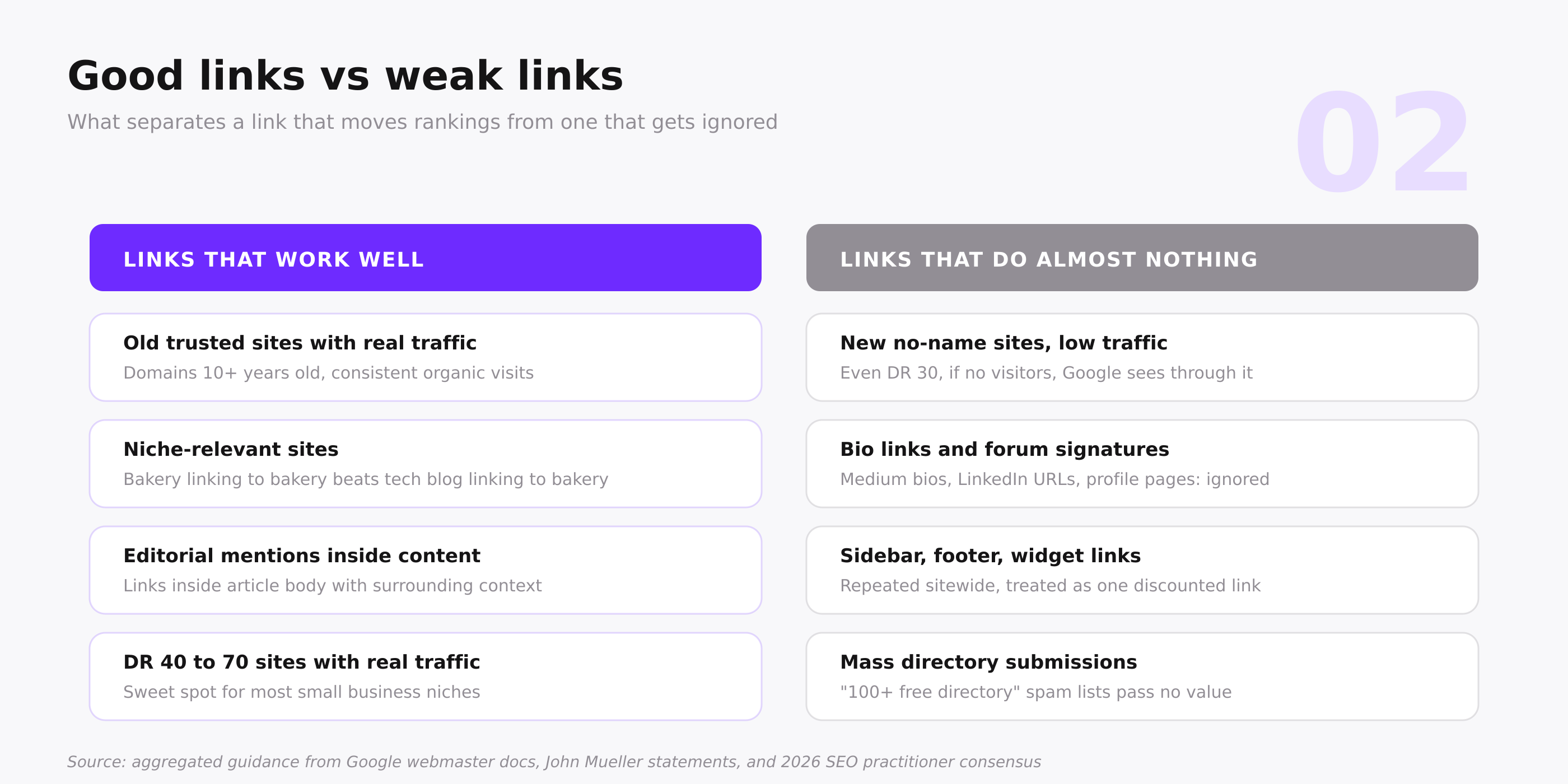
What separates a link that moves rankings from a link that gets ignored by Google.
Links that work well
- Old established sites with real traffic. Domains older than 10 years with consistent organic traffic carry trust that newer sites cannot match. A link from a 15-year-old industry blog beats a link from a 2-month-old DR 70 site every time.
- Sites relevant to your niche. A link from a small but on-topic site outweighs a link from a huge unrelated one. A bakery linking to your bakery means more than a tech blog linking to your bakery.
- Editorial mentions inside article content. Links placed inside the main body of a published article, with surrounding context, pass the most weight.
- Sites with DR 40 to 70 plus real traffic. The sweet spot for most small business niches. High enough to pass authority, accessible enough to actually get a link from.
- Dofollow links over nofollow, for direct SEO. Nofollow still helps brand signals and AI citations, just not link equity.
Links that do almost nothing
- New no-name sites with low traffic. Even at DR 30, a site with no real visitors does not move rankings. Google sees through inflated metrics.
- Bio links in profiles. Medium author bios, LinkedIn profile URLs, forum profile pages. Google explicitly ignores these. John Mueller has confirmed this publicly.
- Forum signatures. Same logic. Mass-produced, low intent, ignored by the algorithm.
- Sidebar, footer, and widget links. Repeated across thousands of pages on one site. Google treats these as a single sitewide link, often discounted heavily.
- Mass directory submissions. Spammy "100+ free directory" lists. They do not pass weight and sometimes flag your site for low-quality association.
- Over-optimized anchor text. Links pointing to your site with exact-match commercial anchors like "buy cheap pizza Bucharest" look like manipulation and trigger filters.
Rule of thumb
Before pursuing any link, ask one question: would I still want this link if Google did not exist? If the site has real readers who might click through, it is worth it. If the only reason to be there is the SEO, skip it.
Linkable assets: what people link to and why
A linkable asset is a piece of content on your site that other people want to reference without you having to ask. The fastest way to build a healthy backlink profile is not to chase links one by one, but to create one or two pieces of content that earn links for years.
Most blog posts are not linkable. They are just one more article among millions. Linkable assets are different. They are useful enough, original enough, or interesting enough that other writers, journalists, and bloggers cite them as a source. Here are the formats that work most often for small business.
01
Comprehensive guides on a narrow topic
A 4,000-word guide that covers one topic better than anyone else. Example: a plumber publishing "Complete Guide to Hard Water Problems in Bucharest Apartments" with photos, tests, and solutions. Other plumbing sites and home improvement bloggers link to it because it is the most thorough resource on the subject.
02
Original research or surveys with real numbers
Original data is the single most link-worthy format. Example: a local marketing agency publishing "Local SEO Pricing Survey 2026" based on responses from 50 agencies. Every blog post on local SEO pricing for the next two years will cite the data.
03
Free tools and calculators
Anything interactive that solves a small problem. Example: an HVAC company publishing a free "Air Conditioning Cost Calculator" that estimates installation cost by apartment size and region. Home blogs, real estate forums, and DIY sites link to it as a useful resource.
04
Templates and downloadables
Notion templates, Excel sheets, checklists, contract drafts. Example: a freelance accountant publishing a free "Romanian Freelancer Tax Calculator" template. Freelance forums, business blogs, and YouTube creators link to it.
05
Glossaries and definition pages
Pages that define industry terms. Example: an SEO agency creating a glossary of 100 SEO terms. Whenever a writer needs to define "anchor text" or "DR," they link to the glossary as a quick reference.
06
Visual content: infographics and data visualizations
Original visual explainers. Example: an electrician publishing an infographic "Electrical Panel Lifespan by Type." Home improvement blogs embed it and credit the source.
Practical takeaway
One strong linkable asset on your site can earn more backlinks over its lifetime than 50 outreach emails. The catch is that it has to genuinely solve a problem or fill a gap. Mediocre content marketed aggressively still does not get linked. Aim to build one or two real assets in the first year rather than spreading effort across 20 generic posts.
How to check your backlinks: free tools
Before building new links, it helps to know what you already have. A backlink check shows which sites link to you, what anchor text they use, and which pages on your site attract the most links. This is also where you spot toxic links that may need disavowing.
Tools that work in 2026:
- Google Search Console (free, fully unlimited). The most reliable source because the data comes directly from Google. Go to Search Console, click Links in the left menu. You see top linking sites, top linked pages, and top linking anchor text. The only downside: data is sampled and limited to roughly 1,000 referring domains, which is fine for any small business.
- Bing Webmaster Tools (free, fully unlimited). Often shows different backlinks than Google. Useful as a second opinion. Go to Reports & Data then Backlinks.
- Ahrefs Free Backlink Checker (limited free). Free version requires a 7-day trial signup and then becomes paid. Shows the top 100 backlinks of any domain. Useful for a one-time competitor check, not for ongoing monitoring.
- Semrush Backlink Analytics (limited free). Free account gives 10 reports per day with reduced data. Decent for occasional spot checks.
- IvaBot Core Audit (free tier). Includes a basic backlink overview alongside on-page and AI readiness checks. One free audit per tool for testing.
Google Search Console shows the list of sites linking to yours plus the anchor text they use. Free, fully unlimited, and the most reliable source because the data comes directly from Google.
What to look at in each report:
- Referring domains: number of unique websites linking to you. More important than total backlink count.
- Anchor text distribution: are most anchors your brand name, your URL, or commercial keywords? (See the next section for what this should look like.)
- Top linked pages: which pages on your site attract the most links. Useful for understanding what content earns links naturally.
- New and lost links: recent gains and losses. Sudden drops can mean the linking site removed your link or went offline.
Free ways to get backlinks
Free does not mean easy. Every approach to getting free backlinks for small business owners costs time instead of money. The methods below are the ones that still work in 2026, ranked roughly by accessibility for a small business owner with no agency budget.
Honest expectation setting
Free backlink building is a numbers game with low conversion. From my own work, out of 100 targeted outreach emails I expect roughly 2 to 7 links to actually land, depending on niche. Very competitive verticals like casino, finance, or expensive medical push it closer to 1 to 2 percent, where you can spend weeks per link. Plan for days of work per link in normal categories, weeks in hard ones.
1. Local and niche directories
Not the spam lists. Quality directories that real people use. The right ones for a small business: Google Business Profile, Yelp, Bing Places, Apple Maps, your local Chamber of Commerce, the Better Business Bureau, and 2 to 3 niche directories specific to your industry. For contractors: Houzz, Angi, HomeAdvisor. For restaurants: TripAdvisor, OpenTable. For lawyers: Avvo, Justia.
What to skip: bulk directory submission services, mass listing tools, and anything advertised as "submit to 500 directories." These are pure spam and Google ignores them at best, penalizes at worst.
2. HARO, Qwoted, and Featured.com
Platforms that connect journalists looking for expert quotes with people who can provide them. You sign up as a source, you get daily emails with journalist requests, you reply with a short expert quote when one matches your expertise. If the journalist uses it, you get cited in their article with a backlink.
HARO was relaunched in 2025 as Connectively and then again in 2026 under Featured.com. Free tier still works. Qwoted is paid but higher quality. Expect 5 to 15 percent of pitches to land. Quality of placement is high because these are real journalists at real publications.
3. Guest posts on relevant sites
Find blogs in your niche or adjacent to it. Pitch a useful article topic. If accepted, write a quality post with a contextual link back to your site. Two principles matter:
- Relevance over authority. A guest post on a small but on-topic blog beats one on a huge unrelated site. Aim for sites your target customer would actually read.
- Earn the spot. Write something the host actually wants. Generic ghostwritten content fails. Real expertise lands.
Find prospects by searching "your niche" + "write for us" or "your niche" + "guest post guidelines" in Google. Expect 2 to 8 percent response rate from cold outreach, higher if you already engage with the blog through comments and shares first.
4. Unlinked brand mentions
Someone wrote about your business but did not link to your site. You ask them to add a link. Conversion rate is the highest of any outreach method, often 30 to 50 percent, because the writer already knows your brand and just forgot to link.
Find unlinked mentions using Google Alerts for your brand name (fully free), or with a one-time check on the Ahrefs Free Backlink Checker (requires a 7-day trial signup). Then send a short email thanking them for the mention and asking if they can make your brand name a clickable link.
5. Resource page outreach
Many sites maintain "resources" or "useful links" pages for their readers. If you have a linkable asset that fits, you can ask to be added. Search for "your niche" + "resources" OR "useful links" OR "recommended tools" in Google.
This works best when you have a free tool or comprehensive guide to offer. "Add my product page" requests rarely get accepted.
6. Community engagement: Reddit, niche forums, Slack groups
Not link-dropping. Real participation. Find communities where your target customer hangs out. Spend a few weeks reading and helping people. Build a profile that signals real expertise. Then, when someone asks a question your content actually answers, you can link to it naturally.
Reddit and Quora links are nofollow and do not pass direct SEO weight, but they bring three other benefits: referral traffic from people clicking through, brand recognition in the community, and citation signals for AI engines that increasingly use Reddit and Quora as primary training sources.
An example of real community engagement on Reddit. The pattern that works: read what people are actually discussing, contribute useful experience from your own work, and only mention your project when it directly answers the question.
Do not
Do not register an account, drop a link, and disappear. Communities detect this pattern within days and ban accounts. Drop-and-run also signals spam to Google. If you cannot commit time to actually participate, skip this method.
7. The Feedback Rebate model
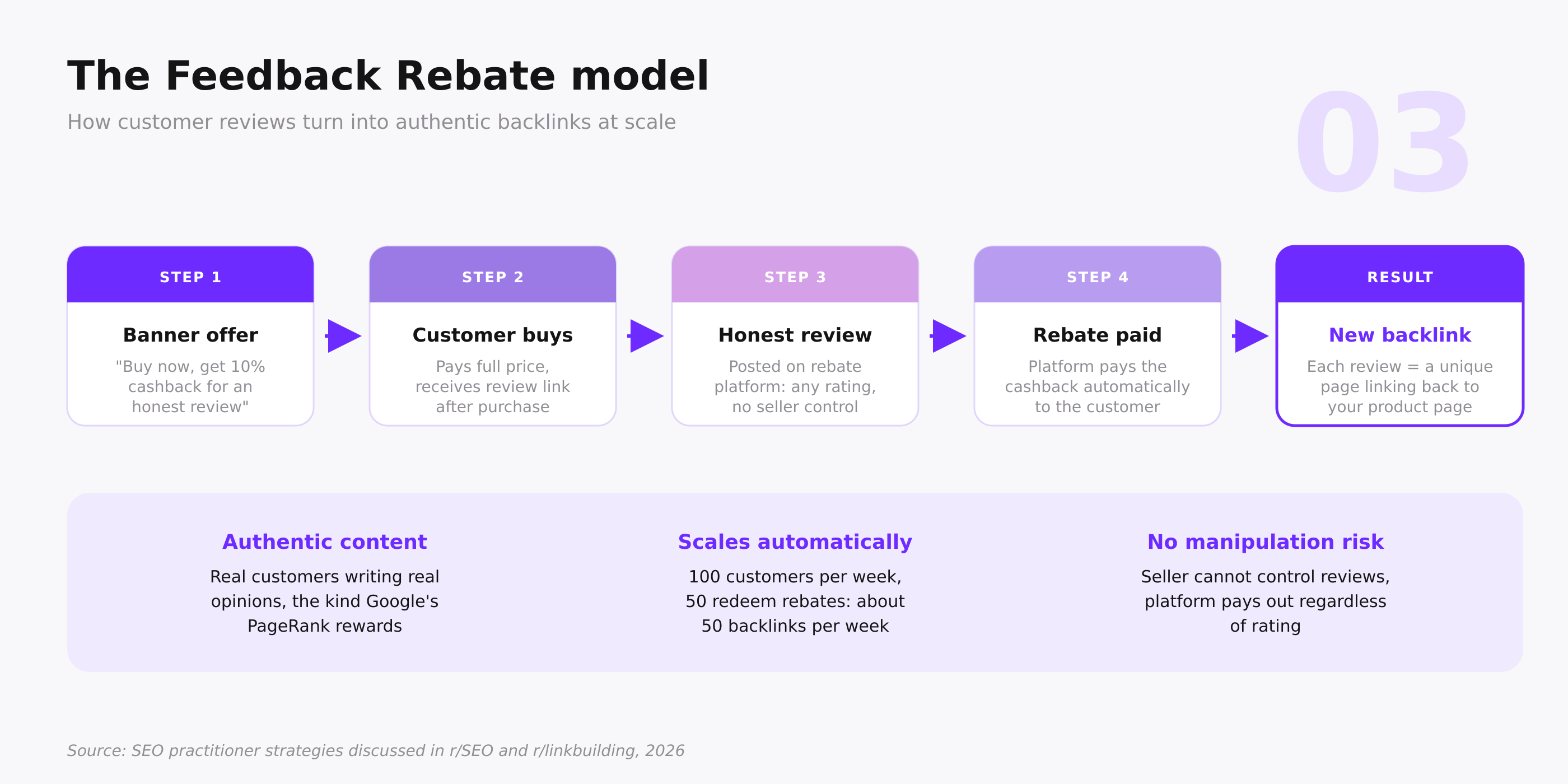
An unusual one that comes from product businesses but applies to small business broadly. The idea: instead of offering a "10 percent off" sale discount, offer a "10 percent cashback for an honest review" after purchase.
The customer buys at full price, leaves an honest review on a specialized review platform, and the platform issues the rebate automatically. Every review becomes a separate page on that platform with a link back to your product or business page. Reviews are guaranteed authentic because the platform processes payouts without the seller's involvement, regardless of whether the review is positive or negative.
The side effect: each redeemed rebate produces a new content page with a backlink. A small business with 50 to 100 transactions a month can generate dozens of authentic backlinks this way without any outreach effort.
The Feedback Rebate cycle. Each redeemed rebate produces one new authentic content page linking to your product.
This works because, from Google's perspective, real customers are publishing real content about a real product with a real link. Which is exactly what PageRank was designed to reward.
8. Broken link replacement (only if you happen to spot one)
If you are reading a blog in your niche and notice a broken outbound link, send the author a short email pointing out the broken link and suggesting your content as a replacement if it fits. Conversion is high (5 to 15 percent) because you are helping them fix something useful.
Do not spend your time actively hunting broken links across the web unless you have a lot of time to spare. The ROI for a small business owner is low compared to other methods.
Social signals: YouTube, LinkedIn, Twitter, Reddit, and others
Social media links almost always carry a nofollow attribute. They do not pass PageRank directly. But this does not mean they have zero SEO value in 2026. Three things are happening with social signals right now:
- AI search engines (ChatGPT, Perplexity, Google AI Overviews) pull heavily from social platforms when forming brand associations.
- Brand searches driven by social mentions become a ranking signal of their own. People searching for your brand name on Google is a strong trust signal.
- Social pages of your business often rank in Google search results for your brand name. They occupy SERP real estate that competitors cannot take.
How each platform works for backlinks and brand signals:
- YouTube descriptions and channel pages. Nofollow, but YouTube is one of the most heavily used training sources for AI. Video content with your brand mentioned in title, description, and transcript creates strong brand association for ChatGPT and Perplexity. One useful video can drive citations for months.
- LinkedIn posts and company pages. Nofollow, but LinkedIn pages rank well in Google for B2B brand searches. Active posting with brand mentions builds professional credibility that translates to AI citations in B2B contexts.
- Reddit comments and posts. Nofollow, but Reddit is a top source for ChatGPT and Google AI Overviews citations in 2026. Genuine participation in relevant subreddits drives both referral traffic and AI training data.
- Twitter / X mentions. Nofollow, but public tweets are indexed quickly. Tweets that get traction shape AI brand associations faster than almost any other channel.
- YouTube comments and Facebook posts. Minimal SEO value individually. Combined with consistent posting across platforms, they build the brand entity signals Google uses for E-E-A-T.
- TikTok, Instagram, Pinterest. Nofollow bio links. SEO impact is mostly indirect, through brand awareness and resulting brand searches. Pinterest occasionally drives referral traffic for visual niches.
The takeaway
No single social link will move your rankings. But consistent mentions across LinkedIn, Reddit, YouTube, and Twitter create the brand signals that both Google and AI engines read as trust. For a small business, picking 2 platforms and posting consistently is better than being on all of them inconsistently.
Paid ways to get backlinks
Buying links is against Google's official guidelines. In practice, a large part of the SEO industry has been doing it for over 20 years, and Google detects it only when the links are obvious spam. The honest framing for small business: paid links exist, they work when done carefully, and they carry real risk when done poorly.
Below is the realistic 2026 pricing landscape. Prices vary wildly by region and niche, so these are ranges, not fixed numbers.
Realistic 2026 pricing by link type. Lower end fits small business budgets in non-English regions and less competitive niches.
Niche edits (link insertions)
Adding your link inside an existing article on a third-party site. Often the fastest method because the page is already indexed.
Price range: $30 to $400 per link. Eastern European or local-language sites with modest DR start at $30 to $80. Mid-DR English-language sites run $150 to $400. Premium placements go higher.
Guest posts
You write an article, the host publishes it with your link inside.
Price range: $50 to $800 per link. Small niche blogs in non-English regions: $50 to $150. Mid-DR English blogs: $200 to $500. Premium publications (DR 70+): $500 to $800. Add $40 to $80 for content writing if you outsource it.
Digital PR campaigns
A pitch-based campaign run by an agency that earns editorial mentions in major publications.
Price range: $750 to $2,500 per link, agency-managed. Most expensive method, but also the safest (real editorial coverage, no manipulation flags) and the most impactful for AI citations.
Marketplaces
Platforms where you browse available link placements with transparent pricing and metrics. Established marketplaces in 2026: Adsy, Serpzilla, Collaborator, Linkscope, PressWhizz. Most start at $40 to $80 for the cheapest options and scale to several thousand for premium tiers.
Useful for self-service link buying with clear pricing. Verify each site individually before purchasing. Marketplaces do not vouch for the long-term quality of every listing.
What to avoid completely
- Fiverr "100 backlinks for $5" packages. Pure spam, sometimes harmful, never useful.
- PBN (private blog network) links. Networks of artificial sites built only to sell links. Google detects them at scale, and a PBN bust can wipe out your entire backlink profile in one update.
- $20 to $30 "high DR" links. If the price is too low for the claimed DR, the metrics are fake or the site is a link farm.
- Bulk packages from random sellers. 50 links for $200 looks tempting and almost always damages the site.
How to make paid links index faster
A bought link that does not get indexed by Google passes no value. Five tactics to speed up indexation:
Request indexing in Google Search Console. Use URL Inspection on the linking page, then click "Request indexing." Free, takes 1 to 7 days to process.
Ask for an internal link from an already-indexed page. If the host has older articles in the index, request that one of them adds a contextual link to the new page with your backlink. The crawler will reach the new page through the existing one.
Ping the page through Bing Webmaster Tools and IndexNow. Bing indexes faster than Google, and Bing's index feeds ChatGPT search.
Share the linking page on social media. LinkedIn or Twitter shares are crawled quickly and signal Google to revisit the URL.
Avoid orphan placements. Make sure the linking page has at least one internal link from another page on the same domain. Orphan pages take much longer to index.
If a paid link does not get indexed within 30 days, it likely never will. That usually means the host site is in poor health, and the link will not pass value anyway. Ask for a refund or replacement.
Outreach email templates
Copy, edit, send. Replace bracketed fields with your details. Keep emails short. Long pitches get ignored.
Quality over quantity
Generic outreach to 200 sites at once converts at under 1 percent. Personalized outreach to 20 carefully picked sites converts at 5 to 10 percent. Always reference something specific from the site you are pitching: a recent article, a section of their resources page, a topic they cover regularly.
Template 1: Guest post pitch
Subject: Guest post idea for [Blog Name]
Hi [Name],
I have been reading [Blog Name] for a while, and your recent post on [specific article] was useful, especially the part about [specific detail].
I run [Your business] and wanted to pitch a guest post idea that I think your readers would like: [Working title]. It would cover [2 to 3 sentence outline].
If this fits your editorial direction, I can have a draft ready within a week. Happy to write something else if this angle is not right.
Thanks,
[Your name]
Template 2: Unlinked mention claim
Subject: Small request about your [date] article
Hi [Name],
Thanks for mentioning [Your business] in your article on [topic]. Really appreciate the reference.
One small ask: would you be open to making the brand name a clickable link to our site? It would help readers find us directly. Here is the URL: [Your URL]
Either way, thanks for the mention.
Best,
[Your name]
Template 3: Resource page outreach
Subject: Suggestion for your resources page
Hi [Name],
I came across your resources page for [topic] while researching [related topic]. Useful collection.
I recently published [Your asset name], which I think would fit alongside the other resources on the page: [Your URL]. It covers [1 sentence summary] and would be free for your readers to use.
If it is not a fit, no problem. Either way, thanks for keeping that page maintained.
Thanks,
[Your name]
Backlinks and AI citations
The biggest change in 2026 is that backlinks now influence AI search visibility almost as much as they influence Google rankings. Every major AI engine (Google AI Overviews, ChatGPT, Perplexity, Gemini) uses public web signals to decide which brands to cite when answering user questions. Backlinks are one of the strongest of those signals. For the full picture of how to get cited by AI engines (Google AI Overviews, ChatGPT, Perplexity), see our guide on generative engine optimization.
How backlinks feed into AI citation systems. Mentions and links across trusted sites build the entity profile that AI engines reference.
Three mechanisms drive backlinks to AI citations:
- Brand co-citation. When your brand is mentioned alongside trusted competitors or alongside specific topics in reputable publications, AI models learn to associate your brand with that topic. Recent industry research found brand mentions correlate 3 times more strongly with AI visibility than raw backlink counts alone.
- Entity strength. AI engines build entity profiles for brands they see frequently across trusted sources. Strong entity profile means higher likelihood of citation when a user asks a relevant question.
- Source trust. AI engines prefer to cite sites with established trust signals, including backlinks. A site with no backlinks rarely gets cited even when its content is high quality.
Practical implication for small business: digital PR and high-quality editorial backlinks now serve a dual purpose. They build SEO authority for Google rankings, and they shape what AI engines say about your business when users search for your category. For more on the AI side, see how to get cited by AI.
Anchor text: what it is and how it works
Anchor text is the clickable part of a link. The words readers see and click on. It looks like this in HTML: <a href="https://ivabot.xyz">IvaBot</a>, where the bold part is the anchor.
Anchor text matters because Google reads it as a description of what the linked page is about. A page that gets many links with the anchor "best SEO tool" starts to rank for that phrase, even if the page itself does not use it heavily. This is also why anchor text is one of the easiest places to overdo it and trigger a penalty.
The six types of anchor text
- Branded anchor. Uses the brand or company name. Example: IvaBot or IvaBot SEO tool. Safest type of anchor and the most natural.
- Exact match anchor. Uses the exact keyword the linked page targets. Example: how to get backlinks for small business. Highest SEO value per link, also the highest penalty risk when overused.
- Partial match anchor. Uses some of the target keywords combined with other words. Example: this guide on getting backlinks. Lower risk than exact match, still passes topical relevance.
- Generic anchor. Uses non-descriptive words like click here, read more, this article, learn more. No SEO keyword value, but contributes to natural-looking variety.
- Naked URL anchor. The URL itself as the anchor. Example: https://ivabot.xyz. Common in forum posts and casual mentions. Looks natural to Google.
- Image anchor. When the linked element is an image, the image's alt text serves as the anchor. Important to fill in alt text for any linked images on your site and on others' sites.
What a natural anchor distribution looks like
A healthy backlink profile for a small business has a mix that looks something like this:
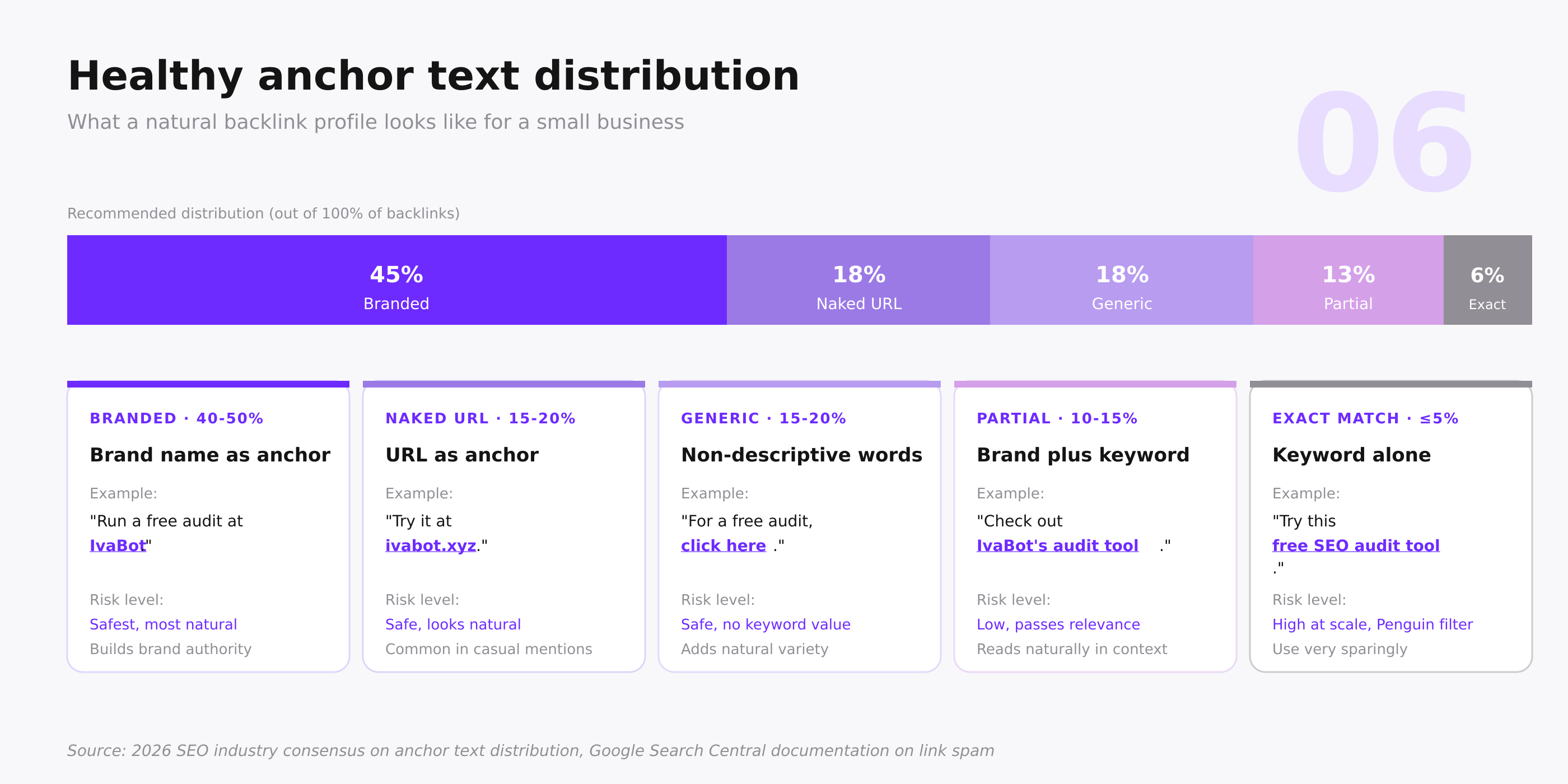
Healthy anchor distribution for a small business. Branded mentions make up almost half, exact match stays under 5 percent.
- Branded: 40 to 50 percent. The majority of natural mentions use the brand name. Example: IvaBot has a free SEO audit tool.
- Naked URL: 15 to 20 percent. Common in forum mentions, social shares, and casual references. Example: Check out ivabot.xyz for a quick site check.
- Generic: 15 to 20 percent. Comes from "read more" and "click here" links. Example: For a free SEO audit, click here.
- Partial match: 10 to 15 percent. Mixes brand and keyword. Example: IvaBot's SEO audit tool helps you find issues fast.
- Exact match: 5 percent or less. Use sparingly. Example: free SEO audit tool pointing to the audit page. Anything above 10 percent exact match starts to look manipulated.
Why this matters
If 60 percent of your backlinks point at your site with the same commercial anchor like buy red shoes online cheap, Google's Penguin filter will eventually flag the pattern as manipulation. Rankings drop, recovery takes months. The safer approach: when you control the anchor (guest posts, outreach), almost always pick branded or partial match. Reserve exact match for the rare placements where it reads completely naturally.
How to check your current anchor distribution
Open Google Search Console, click Links, then Top linking text. You see the anchors most commonly used by sites linking to you, with counts. If branded plus naked URL together make up less than 50 percent, the profile is starting to look unnatural. If exact match commercial anchors make up more than 10 percent, slow down on outreach with keyword anchors and focus on branded mentions until the ratio rebalances.
While reviewing the report, also check which pages on your site get linked. Natural profiles spread links across the homepage, blog posts, product pages, and resource pages. If 90 percent of links point only to the homepage, the profile looks artificial. Promote internal pages to outreach prospects, and link to specific articles or tools rather than the site root.
What gets you a Google penalty
Google has specific policies on link schemes. Breaking them can cause manual penalties, ranking drops, or full removal from the index. The four practices most likely to trigger action:
Reddit discussion of link exchanges. The pattern is common across the SEO industry, and Google treats it as a violation when done at scale.
Buying obvious low-quality bulk links. Fiverr packages, $20 high-DR links, mass directory submissions. Google detects these through pattern analysis and discounts or penalizes the receiving site.
Reciprocal link schemes at scale. Trading links one-on-one with a partner site occasionally is fine. Building a network of 20 sites that all link to each other is a recognizable pattern that triggers algorithmic filters.
PBN (Private Blog Network) usage. Owning or buying access to a network of artificial sites built only to point links at your money site. When detected, every site in the network gets deindexed, including yours.
Over-optimized anchor text. If 80 percent of your backlinks use exact-match commercial anchors like "buy red shoes online cheap," Google flags it as manipulation. Natural profiles have varied anchors: brand names, URLs, generic phrases, partial matches.
What to do if competitors are sabotaging you
Negative SEO (competitors pointing spam links at your site to trigger a penalty) is rare but real. If you notice a sudden flood of low-quality backlinks from unrelated foreign sites, casinos, or adult content, use the Google Disavow Tool in Search Console. Create a disavow.txt file listing the bad domains and upload it. Google then ignores those links when evaluating your profile. Use this carefully, since disavowing real links by mistake hurts more than the spam itself.
The Google Disavow Tool inside Search Console. Upload a disavow.txt file with the domains you want Google to ignore. Use only when there is clear evidence of toxic backlinks, since disavowing legitimate links is harder to undo than the spam was to receive.
Free:
- Google Search Console: top linking sites, pages, and anchor text. Fully free.
- Bing Webmaster Tools: second source of backlink data. Fully free.
- Google Alerts: notifies you about new brand mentions.
- HARO / Featured.com: free tier for journalist requests.
- IvaBot Core Audit: backlink overview plus on-page and AI readiness. Free tier at ivabot.xyz/app.
Limited free / paid:
- Ahrefs: 7-day trial for the Free Backlink Checker, full plan from $129/month.
- Semrush: 10 free reports per day, full plan from $139/month.
- Qwoted: paid journalist platform, $99/month.
- Adsy / Serpzilla / Collaborator: marketplaces, pay per link.
What to do this month to start getting backlinks
Three steps. Combined effort is about 6 to 8 hours over the next 4 weeks, and they produce results within 2 to 4 months.
Pick one linkable asset to build. A comprehensive guide, a free calculator, a checklist, or a small data study. One real asset earns more links over a year than 50 outreach emails. Plan it this week, write it next week.
Submit to 10 quality directories. Google Business Profile, Bing Places, Apple Maps, Chamber of Commerce, BBB, and 4 to 5 niche directories specific to your industry. One afternoon of work.
Sign up for HARO / Featured.com and send 5 pitches this week. Reply to journalist requests that match your expertise. Even one placement in a real publication is worth more than 50 directory links.
Two related guides on the same topic: how to get more Google reviews covers another off-site signal Google reads, and how to get cited by AI shows where backlinks now intersect with AI search.
Try IvaBot for your site
See what is hurting your SEO, including link issues, content gaps, and AI readiness, all in one report. Free to start, no credit card.
Run IvaBot →
IvaBot Content Builder generated the structure and SEO meta for this guide.
This article was drafted using IvaBot Content Builder for structure and brief, then rewritten and fact-checked manually. The IvaBot suite (Core Audit, Content Coverage, Content Builder) is built for small businesses and content creators who want SEO insights without agency pricing. Try it free at ivabot.xyz/app.
FAQ
How to get backlinks to your website for free?
The most effective free methods for a small business in 2026 are local and niche directories (Google Business Profile, Chamber of Commerce, industry-specific listings), journalist platforms like HARO and Featured.com, targeted guest posts on relevant blogs, claiming unlinked brand mentions, resource page outreach, and genuine community engagement on Reddit and niche forums. None of these are free in terms of effort, but all are free in terms of money. Expect first results in 2 to 4 months of consistent work.
How to create backlinks for my website?
Three steps in order. First, create at least one piece of content worth linking to (a comprehensive guide, free tool, calculator, or original data study). Second, get the basics right by submitting to 5 to 10 quality directories. Third, run targeted outreach: 20 personalized emails per week to relevant sites, pitching guest posts, suggesting your resource for their page, or claiming unlinked mentions. Avoid mass submissions and bulk packages, which damage more than they help.
Where can I get backlinks for my website?
Quality backlinks come from sites with real traffic and relevance to your business. Best places to start: local directories specific to your city or country, industry-specific directories (Houzz for contractors, Avvo for lawyers, TripAdvisor for restaurants), guest posts on niche blogs in your industry, journalist platforms like HARO and Featured.com for editorial mentions, and Reddit or LinkedIn engagement that earns natural mentions. Avoid generic "submit to 500 directories" lists, which have no value in 2026.
How many backlinks does a small business need to rank?
There is no fixed number, but realistic thresholds exist. Below 10 referring domains, a small business site barely ranks for anything competitive. At 25 to 50 quality referring domains with steady velocity, first-page rankings become realistic for moderate-competition keywords. At 100+, top 3 positions become achievable. Velocity matters more than total count: 2 to 3 new quality links per month outranks a stagnant profile with 100 links.
How long does it take for backlinks to work?
First ranking movement typically appears between months 4 and 6 of consistent link building, not before. Months 1 through 3 are mostly indexing and trust building. Compounding effects kick in between months 7 and 12. The most common reason link building "fails" is stopping at month 3 before any results have time to appear.
How to create backlinks in SEO without getting penalized?
Stick to relevance and quality. Pick sites your target customer actually reads, write content the host site genuinely wants, and use mostly branded or partial-match anchor text. Avoid bulk packages, PBN networks, reciprocal link schemes at scale, and over-optimized exact-match anchors. If you cannot tell whether a link is safe, ask yourself: would I still want this link if Google did not exist? If the answer is no, skip it.
Is it safe to buy backlinks in 2026?
Quality paid backlinks at $100 to $500 per link from relevant sites with real traffic can be a reasonable investment when done carefully. Digital PR ($750 to $2,500 per link) carries the lowest penalty risk and the highest impact on AI citations. Dangerous and likely to harm rankings: Fiverr packages, PBN links, $20 to $30 high-DR offers (fake metrics), and bulk packages from unknown sellers. Buying obviously low-quality links is one of the fastest ways to trigger a Google penalty.
What is a linkable asset?
A linkable asset is content on your site that other people want to reference without being asked. Common formats: comprehensive guides on narrow topics, original research with real numbers, free tools and calculators, downloadable templates, glossaries, and original infographics. One strong linkable asset can earn more backlinks over its lifetime than dozens of outreach emails.
What anchor text should I use for backlinks?
For a small business, a natural anchor profile looks roughly like this: 40 to 50 percent branded (your business name), 15 to 20 percent naked URL, 15 to 20 percent generic ("click here", "read more"), 10 to 15 percent partial match (brand plus keyword), and 5 percent or less exact match (the keyword alone). When you control the anchor in guest posts or outreach, almost always pick branded or partial match. Avoid using exact commercial keywords as anchors at scale: this is the fastest way to trigger Google's Penguin filter.
What is the best free backlink checker?
Google Search Console is the most accurate because data comes directly from Google. Open the Links report to see top linking sites, top linked pages, and top anchor text. Bing Webmaster Tools is a useful second source and often shows different backlinks. Ahrefs Free Backlink Checker and Semrush Backlink Analytics offer limited free reports but require account signups and have data caps in their free tiers.
Do social media links help SEO?
Social media links are almost always nofollow and do not pass PageRank directly. They help SEO indirectly through brand searches, social shares that lead to real backlinks, and brand signals that both Google and AI engines read as trust. LinkedIn, Reddit, YouTube, and Twitter mentions also feed AI training data, increasingly influencing what ChatGPT and Perplexity cite. Pinterest and TikTok have less SEO impact but still help brand awareness.
Can I get penalized for buying backlinks?
Yes, if the links are obviously low quality, mass-produced, or part of a recognizable network. Google detects link schemes through pattern analysis and discounts or penalizes the receiving site. Penalty risk is lowest with digital PR (genuine editorial coverage) and highest with PBN networks and Fiverr-style bulk packages. Recovery from a link penalty takes 3 to 12 months and requires disavowing the bad links and earning new clean ones.
What should I do if competitors are pointing spam links at my site?
Negative SEO is rare but real. If you see a sudden flood of low-quality links from unrelated foreign sites, casinos, or adult content, use the Google Disavow Tool in Search Console. Create a disavow.txt file listing the bad domains and upload it. Google then ignores those links when evaluating your site. Use it carefully: disavowing legitimate links by mistake causes more damage than the spam itself.
How do backlinks affect AI citations like ChatGPT and Perplexity?
AI engines use backlinks and brand mentions to build entity profiles for brands. When your brand is mentioned alongside trusted competitors or topics in reputable publications, AI models learn to associate your brand with that topic. Sites with strong backlink profiles get cited more often in AI-generated answers. Recent industry research found brand mentions correlate 3 times more strongly with AI visibility than raw backlink counts alone, making digital PR and high-quality editorial links increasingly valuable for AI search visibility.
 28 min read