Local SEO for Small Business: How to Show Up in Google Maps and the Local Pack
Galyna ArikhMay 13, 202622 min read
A practical guide to local SEO for small businesses with a physical address or service area. Covers Google Business Profile setup, reviews strategy, trust signals, NAP consistency, and realistic timelines for new sites.
Try IvaBot for your site
Find what's hurting your SEO and what to fix first. Free to start, no credit card.
Local SEO for small business is for businesses with a physical address or a defined service area: a cafe, a dental clinic, a photographer who shoots in one city, a plumber covering three towns. If your customer needs to come to you, or you go to them, this guide is for you. SEO for local business works differently than general SEO, and this guide covers exactly what that difference looks like in 2026.
The goal is showing up when someone nearby searches for what you sell. Three results appear in the Google Maps box at the top of the search page. Those three get most of the calls, bookings, and visits.
This guide covers how it actually works in 2026: what Google looks at, what you can do this week, realistic timelines, and the costs involved. For a new site or new domain, expect 3 to 6 months before Google starts ranking you for competitive local terms, longer in dense markets. During that time, social media, review platforms, and local directories carry your visibility while Google catches up.
Local SEO works only for businesses with a physical address or service area. Pure online businesses (SaaS, courses, global e-commerce) don't need it.
Google ranks local businesses by relevance, distance, and prominence. Relevance is how well you match the query, distance is how close you are to the searcher, prominence is how known and trusted your business looks online.
Most local search traffic converts at 2-5%. That means 100 visitors from a "near me" search typically produce 2 to 5 phone calls, bookings, or visits. Anything lower usually points to friction on your site, not a traffic problem.
Reviews start affecting rankings around 10 reviews. Below that, you compete on profile completeness and photos. Above 25 reviews with a steady stream of new ones, you start outranking older businesses with stale profiles.
For a new site, expect 3-6 months before Google ranks you for competitive local terms. Use social media, Yelp, TripAdvisor, and industry-specific directories in parallel during that time.
New in May 2026: Google now pulls Reddit threads into Google Business Profiles. Reddit mentions of your business are becoming a local reputation and ranking signal.
A practical local SEO checklist with 30 items (PDF at the end) takes 15 minutes a week to maintain once you've done the initial setup.
"For most local businesses, a complete Google Business Profile with accurate contact info and a few real attractive photos does more than any other single thing. Start there."
How Google decides who ranks locally
Short answer: Google uses three ranking factors to decide who shows up in local search, relevance, distance, and prominence. Each one is something you can influence.
Local SEO uses a different ranking system than regular Google search. Regular search ranks web pages in the blue links. Local SEO ranks businesses in Google Maps and the Local Pack, the box with three businesses at the top of the search page. Different signals matter for each.
The three ranking factors Google uses for local search. Relevance and prominence are where most of your work pays off.
Three ranking factors decide who appears in those three local pack spots, and your entire local SEO strategy comes down to working on these three:
01
Relevance
How well your business matches what someone is searching for. If a person types "vegan bakery sector 1 Bucharest," Google checks whether your business actually serves vegan baked goods in that area. Your category, services, description, and the language on your website all signal relevance.
02
Distance
How close your business is to the person searching. You cannot change your address, but you can make sure Google knows exactly where you are. Service-area businesses (plumbers, electricians, mobile photographers) define the geographic area they cover, which works the same way as a fixed address.
03
Prominence
How known and trusted your business looks online. This is where most of the work happens. Reviews, mentions on other websites, links from local sources, accurate listings across directories, and even your social media activity all feed into prominence. A 5-year-old business with 80 reviews will usually outrank a 6-month-old business with 4 reviews, all else being equal.
Everything else in this guide affects one of those three. When you optimize your Google Business Profile, you push relevance. When you confirm service areas, you push distance accuracy. When you ask for reviews, build citations, and stay active across platforms, you push prominence.
Why local signals matter more after the May 2026 core update
Short answer: Google's May 2026 core update strengthened local signals, so a business that matches a searcher's market and location now has a clearer advantage.
Google ran a core update that started rolling out on May 21, 2026 and continued for about two weeks. It rebalanced visibility toward local-market entities. For a business that serves a specific city or area, this reinforces the value of clear local signals: an accurate Google Business Profile, pages built around the area you serve, and content that reads as the local answer to the search. The goal is to be the default local result, not a general page that happens to mention a location.
Finding the right local keywords
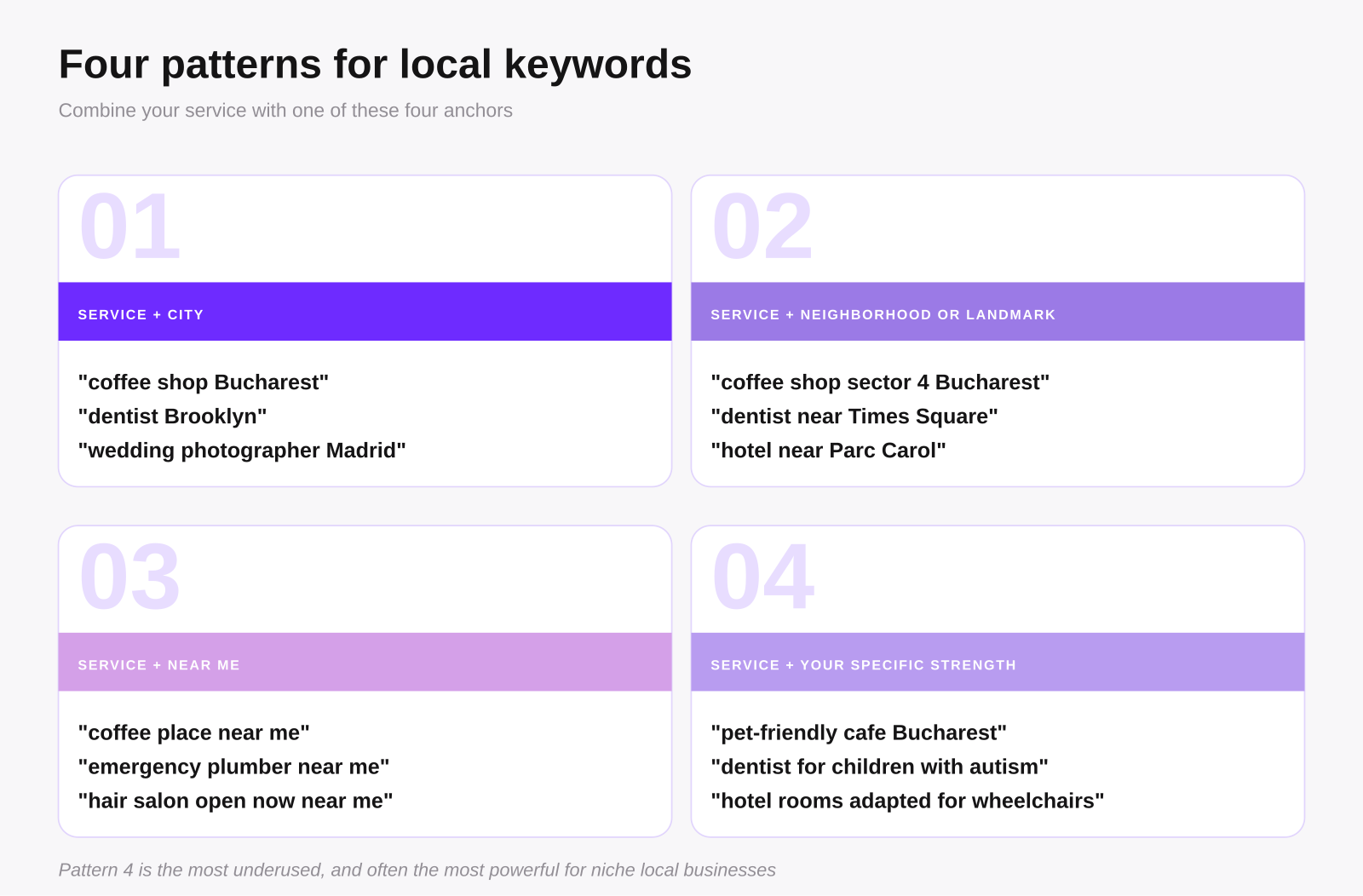
Local keywords are the phrases your customers actually type when looking for what you sell. The goal is to write them down the way you'd want to be found, combined with how people logically ask, plus your unique strength. These keywords are the foundation of your local search optimization, they go into your titles, meta descriptions, headers, and Google Business Profile description.
The four main patterns
Four ways to combine your service with a local anchor. Pattern 4 (specific strength) is the most underused.
Service + neighborhood or landmark: "coffee shop sector 4 Bucharest," "dentist near Times Square," "hotel near Parc Carol"
Service + near me: "coffee place near me," "emergency plumber near me," "hair salon open now near me"
Service + your specific strength: "pet-friendly cafe Bucharest," "wheelchair accessible restaurant sector 1," "dentist for children with autism," "hotel with rooms adapted for wheelchair users"
The fourth pattern is the most underused. If your business has something specific (Saturday hours, English-speaking staff, ground-floor access, a sensory-friendly waiting room, a menu in braille, a metro station 200 meters away), say so. Customers searching with these filters are already half-decided, they want a business that matches their exact need.
Weak vs. strong keyword choice
Weak example
"dentist Bucharest" - 50,000 other dentists are competing for this exact phrase. You will be invisible.
Strong example
"dentist for children with autism Bucharest sector 3" - fewer searches, but the family searching this is your ideal customer. You will rank, and you will get the booking.
The goal is not to chase the highest volume keyword you can find. It is to chase the keyword where your specific business is the obvious answer.
How to find and check your keywords
Three free methods, no paid tools needed:
Google autocomplete. Start typing your service in Google. The 5-10 suggestions that appear are real searches people have made. Try variations: "dentist for...", "best coffee in...", "hotel near...". Save every relevant suggestion.
Google Trends. Compare 2-3 keyword variations side by side and see which one is rising. It also shows you regional interest, so if you serve Bucharest, you can filter to Romania and check what's actually searched locally.
Google Keyword Planner. Free with a Google Ads account (you don't need to run ads). Type in your keywords, see monthly search volume and competition. Pick keywords with the highest volume that match your unique strength.
Google autocomplete shows the exact long-tail phrases real parents type. Every suggestion is a real search someone made.
Then check the bottom of any Google search results page: "Related searches" and "People also ask" show the same intent phrased differently. Open Google Maps and search for a competitor, read their reviews, the words customers use to describe what they liked are the words you should target on your own pages.
Save 20 to 30 of these phrases in a simple sheet. Use them in your page titles, meta descriptions, headers, image alt text, and Google Business Profile description.
Setting up your Google Business Profile properly
Short answer: complete every field, add real photos including one of the owner, write a description with your local keywords, and pick the most specific category that fits.
Your Google Business Profile (GBP, formerly Google My Business) is the single most important piece of local SEO. It is free, it takes a few hours to set up properly, and learning how to improve google business profile from scratch does more for local visibility than any other single thing you can do.
Every section of a complete GBP. Reviews and photos are the two biggest levers for local pack ranking.
Claim or verify your profile at business.google.com. Verification usually happens by postcard, phone, or email. Once verified, work through every section.
Business name
Use your exact legal or trading name. Do not stuff keywords ("Bucharest Best Pizza" if your business is called "Trattoria Roma"). Google penalizes this and competitors can report it. Real name only.
Category
Pick the most specific primary category that fits, then add up to 9 secondary categories. "Italian restaurant" is more specific than "restaurant" and will help you rank for more relevant searches. If you offer multiple distinct services, use secondary categories for each.
Description
Up to 750 characters. Write naturally, not as keyword stuffing. Include your main service, your location, and what makes your business specific. If you have unusual features (pet-friendly, wheelchair accessible, late hours, English-speaking staff), mention them.
Attributes
Google Business Profile has dozens of attributes you can mark: "Wheelchair accessible entrance," "Free Wi-Fi," "Dog-friendly," "Outdoor seating," "Wheelchair accessible parking," "Gender-neutral restroom," "Accepts reservations," "Vegan options," "Free parking," and many more. These are searchable. A person filtering for "wheelchair accessible restaurant near me" only sees businesses that have marked that attribute. Mark every attribute that genuinely applies.
Photos
Add at least 10 to 15 real photos to start. Cover three categories: exterior of your business (so people recognize it), interior (so they know what to expect), and the work itself (food, treatments, products, completed projects). Avoid stock photos. Google can detect them, and customers can tell.
One photo that disproportionately builds trust: a real photo of the owner, the chef, the lead photographer, the dentist. Not a corporate headshot. A real person in the real space. Businesses with owner photos and team photos tend to convert visitors at higher rates than businesses with only product or building photos. Customers want to know who they are dealing with.
Add 1 or 2 new photos a month. Active profiles show signs of life to both Google and customers.
Posts
Use the Posts feature to share updates, events, offers, and announcements. Profiles with weekly posts get about 19% more local search visibility on average. This is one of the easiest weekly habits to build.
Q&A
Customers can ask public questions on your profile. Anyone can answer, including competitors. Seed the section yourself with 5 to 10 frequent questions and answers, then monitor it weekly. Quick answers from the business owner build trust and prevent wrong information from competitors or random strangers.
Messaging
Turn on the Message button. Many customers prefer texting to calling, especially younger ones and anyone with phone anxiety. Set realistic expectations in your auto-reply ("We typically reply within 2 hours during business hours") and actually meet that response time. A profile with active messaging but slow responses is worse than one without the feature at all.
Trust signals on your website
Short answer: your contact info should be visible everywhere, you should offer a text option, and your real photos plus your owner's story matter more than design polish.
Google Business Profile brings people to your business listing. Your website is where they decide whether to call, book, or visit. The trust signals here are different from technical SEO. They are about answering one question quickly: is this a real, reliable business run by real people?
Make contact information impossible to miss
Phone number, address, and email should be:
In the page header (top right is the standard place)
In the footer (full address with map link)
On a dedicated Contact page
Phone numbers clickable on mobile (use tel: links so customers tap once to call)
If your customer has to scroll or click to find your phone number, you have lost some of them.
Offer a text option
Many customers will not call, especially first-time customers checking prices, asking general questions, or making appointments. Reasons include phone anxiety, calling from a noisy place, calling outside your hours, or simply preferring text. If your only contact option is a phone number, you lose this group.
Offer one or more of: a WhatsApp button (very common in Europe), SMS link (sms: on mobile), Facebook Messenger, Instagram DM, or a simple contact form. Make at least one of these as visible as the phone number.
Set a response-time promise and keep it
"We respond within 4 hours during business hours" tells customers exactly what to expect. It builds trust if you keep it. It destroys trust faster than no promise at all if you don't. Pick a number you can actually deliver, even on your busy days. If 4 hours is too aggressive, say "within 1 business day."
Show real people
Your About page needs at least one photo of you or your team. Not a stock photo of generic professionals. Not a logo. A real photo of the actual person who runs the business. If you are a one-person business, this is your photo. If you have a team, photograph the team in your actual space.
Add short text under each photo: name, role, one specific detail that makes the person real. "Maria, head pastry chef. Trained in Lyon for 6 years before opening here in 2019." Specifics build trust. Generic bios feel like every other website.
Show real work
Replace stock photos with real ones throughout your site. A cafe should show its own pastries, not stock images of croissants. A dentist should show their actual clinic, not stock images of teeth. A photographer should show their portfolio, not generic wedding photos. Customers can spot stock photos in 1 second, and stock photos signal "this could be any business" instead of "this is a specific business."
Quick check
Try IvaBot Content Coverage for free to check your page for these trust signals automatically.
IvaBot Content Coverage flags missing trust signals like real photos, owner attribution, and contact visibility.
Getting and managing reviews
Short answer: reviews are the second-biggest local ranking factor after profile completeness. Ask every satisfied customer, respond to every review, and never fake them.
Reviews affect rankings, click-through rate, and conversion. Businesses with more reviews and higher ratings consistently outrank competitors in the local pack. Customers read them before deciding, and 88% trust online reviews about as much as personal recommendations.
How to ask
The single most effective way to get more reviews is to ask. Most happy customers will leave a review if asked at the right moment. The right moment is when they have just experienced the value (after a meal, after a treatment, when they pick up an order). The wrong moment is two weeks later by email.
Practical ways to ask:
A small printed card at the table or checkout with a QR code linking directly to your Google review form
A line on the receipt or invoice ("Loved your visit? A short review really helps us")
A follow-up SMS or email the same day, with a direct review link
An in-person ask from the owner or staff member who served them
Get the direct review link from your Google Business Profile dashboard. Sending people to "search for us on Google" loses half of them along the way.
Friends and former customers
It is fine to ask friends, family, and former clients to leave a review, but only if they have genuinely used your service or product. A friend who has actually eaten at your cafe leaving an honest review is fine. A friend who has never been there leaving a fake positive review is not. Google can detect patterns of fake reviews (same IP addresses, new accounts, suspicious timing), and the penalty is suspension of your profile.
Responding to reviews
Respond to every review, positive and negative, within a week. For positive reviews, thank the customer by name and reference something specific they mentioned. This signals to Google that you are actively engaged. For negative reviews, respond calmly, acknowledge the issue, and offer to make it right offline. Other potential customers will see how you handle complaints, and that often matters more than the negative review itself.
How many reviews you actually need
Three review thresholds. Steady flow of 2-5 new reviews per month matters more than total count.
Below 10 reviews, you compete on profile completeness and photos. Around 10 to 25 reviews, you start being trusted by Google's algorithm. Above 25 reviews with steady new ones each month, you start ranking competitively against older businesses. The target is not a specific number, it is a steady flow: 2 to 5 new reviews per month is enough for most small businesses.
Other review platforms
Google reviews carry the most weight for local SEO, but other platforms matter too:
Yelp: still important in the US, especially for restaurants
TripAdvisor: essential for hotels, restaurants, and tourist-facing businesses
Facebook reviews: useful for social proof and matter to Google indirectly
Industry-specific platforms: Healthgrades for medical, Avvo for legal, The Knot for wedding services, ZocDoc for dental, Houzz for home services
Pick the 1 or 2 most relevant for your industry and build reviews there as well. Spread your effort, but Google reviews come first.
Keep your business info identical everywhere
Short answer: your business name, address, and phone number need to be exactly the same across every site that lists you. Inconsistency can reduce your local search visibility by up to 28%.
SEO professionals call this "NAP consistency" (Name, Address, Phone). In plain language: if your phone number appears as "021-234-5678" on your website, "+40 21 234 5678" on Google, and "(021) 234.5678" on Yelp, Google's algorithm cannot be sure these all refer to the same business. Pick one format and use it everywhere.
What needs to match
Business name spelling (no extra words like "LLC," "Bucharest," or descriptors)
Address format (street abbreviations, apartment notation, postal codes)
Phone number format (with or without country code, with or without parentheses)
Website URL (with or without "www," http vs https)
Where to list your business
Start with these universal directories:
Google Business Profile
Bing Places for Business
Apple Maps Connect
Facebook Business Page
Yelp
Yellow Pages (local equivalent in your country)
TripAdvisor (if relevant)
Foursquare
Then add 5 to 10 industry-specific directories. For restaurants: OpenTable, Zomato, MenuPages. For medical: Healthgrades, ZocDoc. For wedding services: The Knot, WeddingWire. For home services: Angie's List, HomeAdvisor, Houzz.
Skip cheap directory submission services on Fiverr. Many list you on spam directories that hurt rather than help. Submit manually or use a trusted tool like Whitespark or BrightLocal if you want to scale citation building.
On-page local SEO basics
Short answer: use your city and service in your page titles, add LocalBusiness schema markup, and create a page per location if you have more than one.
Page titles and meta descriptions
Each important page should include your service and your location in the title and meta description. "Dental Clinic in Bucharest Sector 1 | Sunshine Dental" is more useful than "Welcome to Sunshine Dental." Same for service pages: "Wedding Photography in Madrid | Maria Lopez Studio" beats "Photography Services."
LocalBusiness schema
Schema markup is hidden code that tells search engines specific facts about your business: name, address, phone, hours, accepted payments, ratings. It does not change how your page looks, but it helps Google understand and display your business correctly.
Use the LocalBusiness schema type, or a more specific subtype if it fits (Restaurant, DentalClinic, HairSalon, BeautySalon, Plumber, Electrician, Photograph, etc.).
Test your schema with Google's Rich Results Test. If it validates, you are done.
Location pages (if you have multiple)
If you serve more than one location or city, create one page per location. Each page should have:
Unique content about that specific location (not duplicate text with the city name swapped)
Local address, hours, and phone for that location
Embedded Google Map of that location
Photos specific to that location
Reviews or testimonials from customers in that area
Service-area businesses (plumbers, electricians, mobile services) should create pages for the main cities or neighborhoods they cover, with content about that specific area.
Off-site signals: links, mentions, social
Short answer: links from local websites count more than generic links. Mentions of your business name on local sites count too, even without a link.
Where local links come from
Chamber of commerce in your city or region
Local sponsorships (charity events, sports teams, school programs, festivals)
Industry associations (dental association, restaurant association, photography network)
Local press and blogs (your local newspaper, neighborhood blogs, food critics)
Collaborations with complementary local businesses (a pizzeria linking to a nearby craft beer pub, a wedding photographer linking to a local florist, a yoga studio linking to a nearby smoothie cafe)
The collaboration approach works particularly well. You partner with a non-competing local business, mention each other on relevant pages, and both benefit. It is not link exchange (Google penalizes that), it is genuine endorsement that helps real customers find related services.
Brand mentions without links
When your business name is mentioned on a local blog, news site, or forum, even without a hyperlink, Google notices. This is called "unlinked mentions" and it counts toward prominence. Local press coverage, community blog posts about your business, Reddit threads in city-specific subreddits, and forum discussions all contribute.
Social media as local signals
Social platforms themselves don't directly improve your Google rankings, but they help in two ways. First, social profiles often rank in Google search for your brand name, taking up real estate that would otherwise show competitors. Second, social signals (mentions, tags, check-ins) build prominence indirectly.
For local businesses, the most valuable platforms are:
Instagram for visual businesses (cafes, restaurants, salons, photographers): geotag every post with your location
Facebook for community-based businesses: keep an active page, encourage check-ins, post reviews
TikTok for businesses with younger audiences: location-based content gets local discovery
Cross-link your social profiles from your website and your Google Business Profile. Use the same business name, photos, and contact info as your GBP, so Google sees them as one consistent business.
How local search is changing in 2026
Short answer: most local searches happen on mobile, many are voice queries, and AI Overviews are starting to answer some local questions directly.
Mobile-first reality
76% of "near me" searches lead to a visit, call, or purchase within 24 hours, and almost all of them happen on phones. Your website must be fast, easy to read on small screens, and have tap-to-call buttons. If your site takes more than 3 seconds to load on mobile, you lose half your potential customers before they see anything.
Voice search
"Hey Siri, find a coffee shop open now near me." "OK Google, who is the best dentist in sector 4?" Voice queries are longer, more conversational, and often phrased as full questions. Optimize for them by writing your FAQ section with natural-language questions, including conversational phrases on key pages, and making sure your Google Business Profile has accurate hours (voice assistants rely on this heavily).
When AI assistants cite local businesses
AI Overviews and chatbots (ChatGPT, Perplexity, Gemini) cite local businesses when they need to give a specific recommendation. They typically cite businesses that have:
A complete Google Business Profile with category, hours, photos, and description
LocalBusiness schema markup on the website
Recent reviews (last 60 days), not just total count
Consistent information across Google, Yelp, and social profiles
Clear differentiators in the page text (pet-friendly, wheelchair-accessible, late hours, English-speaking staff)
Author or owner attribution on the website (real photo, real name, real story)
Content that answers specific questions ("Where can I find vegan options near sector 4?", "Which dentist sees children with autism in Bucharest?")
AI engines prefer businesses that look trustworthy to a human. The same trust signals that convert customers also signal AI engines to cite you. For a deeper look at AI search optimization, see our GEO guide and our AI citation tracking guide.
Reddit threads inside Google Business Profiles (new May 2026)
Short answer: Google has started pulling Reddit threads directly into a new "About this place" section on some Google Business Profiles. Reddit mentions of your business are becoming a local reputation and ranking signal.
In May 2026, local SEO specialists started spotting a new "About this place" section on desktop Google Business Profiles, mostly for food and drink businesses to start. The section pulls Reddit threads that mention the business or its category and location. Google is connecting business profiles to community discussions in real time, which is a meaningful change.
This matters for two reasons. First, Reddit is now a direct contributor to local search visibility, not just a generic ranking signal. Second, the threads Google surfaces are visible to people researching your business right before they decide whether to visit. A thread that says "their pizza is overrated" sits on your profile until Google rotates it out.
What to do this week
If your business is in a category Google is testing this on (food, drink, hospitality first), do four things in order: search Reddit for your business name in quotes, search for your category plus your city, look at what comes up on competitor profiles, and decide where it makes sense to participate.
The participation rules are simple but easy to get wrong:
Use a labeled business account, not a personal one. Reddit requires disclosure of business affiliation. Operating a stealth promotion account is a fast path to a ban.
Answer questions, do not advertise. If someone asks "best place for sourdough in Bucharest" and you run a bakery, recommend two or three places including yourself, with honest context. Pure self-promotion gets downvoted and removed.
Thank people who recommend you, briefly. A short, real reply like "thanks, glad you enjoyed it" is fine. Long marketing replies look fake.
Engage in relevant subreddits regularly. Your city subreddit, your industry subreddit, related interest communities. Goal is to be a useful regular, not a one-time promoter.
The rollout is narrow today but Google rarely keeps these tests narrow. Treating Reddit as part of your local presence in 2026 is the same kind of bet that treating Google Business Profile as critical was in 2018: most people are still ignoring it.
Converting local visitors into customers
Short answer: most local websites lose customers at the same friction points. Fix those points, and your conversion rate doubles without any extra traffic.
Local traffic is high-intent traffic. A person searching "coffee near me" is not browsing, they are about to spend money. Typical conversion rates for local websites are 2 to 5%, meaning 2 to 5 out of every 100 visitors from local search take an action (call, book, visit, order). If your rate is lower, the problem is usually not your traffic, it's your website.
Common friction points
Phone number not visible without scrolling
No text or message option (some customers will not call)
Unclear pricing or no pricing at all (customers leave to find someone who tells them upfront)
Booking process requires creating an account (one of the highest drop-off points)
Hours not visible on the homepage (customer has to dig to know if you are open)
No directions link to Google Maps
Slow mobile site (3-second rule, beyond that you lose half)
Highlight what makes your place specific
Local customers often pick based on small differentiators. "Pet-friendly," "wheelchair accessible," "menu in braille," "rooms adapted for people with disabilities," "5-minute walk from metro," "free parking," "outdoor seating with heaters," "open until midnight." If your business has any of these features, mention them clearly on the homepage and in your meta description. These features are searchable and often the deciding factor for someone choosing between you and a competitor.
Tell a small story
"Our head pizzaiolo trained in Naples for 12 years." "Maria, our pastry chef, won the regional sourdough competition in 2023." "Our dentist has been practicing in this neighborhood for 18 years." Specific stories build trust faster than generic claims. They give the customer a reason to choose you over the place down the street.
Do not run third-party ads on your site
If you run a local business website, do not put display ads on it. The extra few dollars per month from ad networks costs you visitor trust, slows down your site, and signals that your main business is not profitable enough. Your website is a conversion tool for your business, not a publishing platform.
Tracking your local SEO results
Google Business Profile dashboard shows you direct calls, direction requests, profile views, and which queries people used to find you. Google Search Console shows clicks, impressions, and ranking positions. Google Analytics 4 shows what happens after people land on your site. Check each weekly for 5 minutes. A more detailed tracking guide is coming in a separate article.
How much does local SEO cost?
Doing it yourself (DIY): $0 to $50 per month
Google Business Profile is free. Most of the work in this guide takes time, not money. Optional paid tools that can help: BrightLocal's citation finder, Whitespark for citation tracking, or a $5 IvaBot Content Coverage check. Realistic time investment: 10-20 hours for initial setup, then 15-30 minutes a week for maintenance.
Hiring a freelancer: $150 to $1,500 per project or $200-800 per month
A freelance local SEO specialist can do the initial setup (GBP optimization, citation building, schema markup, on-page SEO) for a one-time project fee, or work monthly on reviews, content, and ongoing optimization. Quality varies. Ask for examples of small businesses they have worked with, and check the GBP profiles of those clients to see actual results.
Hiring an agency: $500 to $5,000+ per month
Local SEO agencies handle everything: setup, monthly reporting, citation building, content, reviews monitoring, paid ads if you want them. Cheaper agencies (under $1,000/month) often automate citation building and provide little real strategy. Premium agencies (above $2,000/month) provide custom strategy, content production, and competitive analysis. Most small businesses do not need this level of investment in the first year.
Realistic recommendation for most small businesses
Start with DIY for the first 3-6 months. Most of the high-impact work (claiming GBP, getting initial reviews, fixing NAP, basic schema) is something you can do yourself. Once you've done the basics and want to compete in a denser market, hire a freelancer for specific tasks or add paid tools. Move to an agency only when your business has the revenue to justify $500+/month and the volume of work to need it.
Tools for local SEO
Short answer: free tools from Google cover most of what a small business needs.
Free tools
Google Business Profile: the main control panel for your local visibility
Google Search Console: search performance for your website
Google Analytics 4: visitor behavior on your site
Bing Webmaster Tools: matters for ChatGPT search visibility
Google's Rich Results Test: validates your schema markup
Schema.org documentation: reference for markup types
Paid tools (optional)
BrightLocal: from $39/month, citation auditing and building
Whitespark: from $30/month, citation finder and rank tracking
Moz Local: from $14/month per location, automated citation management
IvaBot
Try IvaBot Content Coverage for free to check your page for trust signals, schema markup, and AI readiness in one go. Pay-as-you-go from $5 if you want deeper checks. Useful for a quick local SEO audit checklist without committing to a monthly subscription.
Common mistakes that hurt local rankings
Short answer: most local SEO problems come from a few preventable mistakes. All fixable.
Inconsistent business info across sites. Your name, address, or phone number differs between your website, Google Business Profile, Yelp, and Facebook. Pick one format and update everywhere.
Empty or barely-filled Google Business Profile. Missing categories, no description, generic photos, no posts. Google rarely shows incomplete profiles in the local pack.
Stock photos everywhere. Google can detect them, and they signal "could be any business" instead of "this specific business." Customers spot them in a second.
Ignoring reviews or only responding to negative ones. Respond to every review, positive and negative, within a week. Active response signals an engaged business.
Keyword stuffing in business name. "Best Bucharest Pizza Italian Restaurant" is not a name, it is spam. Use your real business name only.
No mobile optimization. Slow load, hard-to-tap phone numbers, text too small to read. Most local searches happen on mobile, and this is where conversions are lost.
Skipping schema markup. It takes 30 minutes to add LocalBusiness schema to your site. It helps Google understand your business correctly and qualifies you for richer search results.
What to prioritize by business type
Short answer: every local business needs the basics (GBP, reviews, NAP), but different industries get higher returns from different additions.
Business type
Highest-impact additions
Cafe / Restaurant
Daily real photos of food, menu visible online with prices, OpenTable / TripAdvisor presence, reservation widget on homepage
Dental / Medical clinic
Detailed Q&A on GBP, schema for medical services, owner/doctor bio with credentials, online booking option, before/after photos (with consent)
Photographer / Creative
Portfolio pages by service type, city-specific landing pages, Instagram with geotags, image alt text and filenames, Pinterest presence
Plumber / Electrician / Service area
Service-area definition in GBP, separate page per city covered, emergency / same-day availability flagged, Google Reviews with quick responses
Hair / Beauty salon
Online booking visible everywhere, real photos of stylists and treatments, Instagram with consistent posting, treatment menu with prices
Lawyer / Consultant
Bio with credentials, case studies or testimonials, schema for specific practice areas, free consultation booking
FAQ: local SEO for small business
How long does local SEO take to show results?
For a new website on a new domain, expect 3 to 6 months before you start ranking for competitive local terms. Google Business Profile improvements can show up faster (sometimes within weeks), but website ranking takes time as Google evaluates your authority and trust. Plan for the long game.
How much does local SEO cost?
Doing it yourself costs $0 to $50 per month in tools, plus 15-30 minutes a week of your time. A freelancer typically charges $200-800 per month. An agency runs $500 to $5,000+ per month. Most small businesses can start DIY and only hire help once they've completed the basics and need to scale.
Do I need local SEO if I don't have a physical store?
If you serve customers in a specific geographic area (plumber, electrician, mobile photographer, in-home tutor, consultant who travels to clients), yes. Define your service area in Google Business Profile instead of an address. Pure online businesses with no geographic component (SaaS, online courses, global e-commerce) do not need local SEO.
How do I improve my Google Business Profile?
Complete every field, add 10-15 real photos including the owner, pick the most specific primary category, write a description with your main local keywords, post weekly updates, respond to every review, and enable messaging. Profiles with weekly posts get about 19% more local search visibility.
How many reviews do I need?
Below 10 reviews, you compete mostly on profile completeness. Around 10-25 reviews, Google starts treating you as established. Above 25 reviews with a steady flow of new ones each month, you start outranking older businesses with stale profiles. Aim for 2-5 new reviews per month rather than a one-time push.
Can I rank without a website?
You can rank in the local pack with just a Google Business Profile, no website. But your conversion drops significantly without a website where customers can see your menu, prices, services, or book directly. A simple one-page site with your offerings, contact info, and a few photos is enough to start.
What is NAP consistency and why does it matter?
NAP stands for Name, Address, Phone. Inconsistent NAP across directories (different spellings, formats, or punctuation) confuses Google and can reduce your local visibility by up to 28%. Pick one exact format and use it identically on your website, Google Business Profile, Yelp, Facebook, and every directory you appear in.
Should I worry about AI Overviews for local searches?
Yes, but the same things that help you rank in the local pack also help you appear in AI Overviews. Complete profile, schema markup, recent reviews, consistent information. AI Overviews favor businesses with strong on-page signals, which is what local SEO produces. See our GEO guide for more.
How does Google use Reddit threads inside Business Profiles?
In May 2026, Google started showing a new "About this place" section on some desktop Google Business Profiles, mostly for food and drink businesses, that surfaces Reddit threads mentioning the business or its category. This makes Reddit discussions visible to people researching your business directly on the profile. Monitor Reddit for mentions of your business name and category, engage honestly when it makes sense, and use a labeled business account rather than a stealth one.
How do I track if my local SEO is working?
Three free tools cover it: Google Business Profile insights (calls, direction requests, profile views), Google Search Console (impressions and clicks from search), Google Analytics 4 (visitor behavior on your site). Check each weekly for 5 minutes. A detailed tracking guide is coming in a separate article.
Can I do local SEO myself or do I need an expert?
You can do 80% of it yourself. The work that matters most (claiming Google Business Profile, getting reviews, fixing NAP consistency, basic schema markup) requires time and attention, not advanced expertise. Hire an expert only if you have multiple locations, work in a very competitive market, or simply have more money than time.
What's next
If you have a Google Business Profile, open it now and check three things: every field is filled out, you have at least 10 real photos, and your contact info matches your website exactly. If anything is missing or inconsistent, fix that first. It will do more for your local visibility than anything else.
Then ask 3 customers from this week for a Google review. Send them the direct review link from your dashboard. Review momentum compounds: businesses that get 2-5 new reviews each month outrank businesses with more total reviews but no recent activity.
If you've done the foundation in this guide (Google Business Profile, reviews, NAP) and want the next layer of tactics, see Local SEO Tips for Small Businesses: 9 Tactics Worth Trying After the Basics. It covers nine specific tactics including review velocity, secondary GBP categories, and AI-ready FAQ formatting, each with realistic timing and traffic lift.
The point is to act on this, not only read it: work through the checklist and run the free IvaBot Content Coverage check to see which trust and local signals your pages are missing.
This article was structured with IvaBot Content Builder, then rewritten and fact-checked manually.
This article was written using IvaBot Content Builder for the structure and brief, then rewritten and fact-checked manually. IvaBot Content Coverage was used to verify trust signals and schema requirements before publishing. The IvaBot suite is built for small businesses and content creators who want SEO insights without agency pricing. Try it free at ivabot.xyz.
 22 min read