How to Rank in ChatGPT Search Results: A Step-by-Step Guide for Small Businesses (2026)
Galyna ArikhMay 27, 20269 min read
A practical step-by-step plan for small businesses to rank in ChatGPT search results. Actions, timelines, and free tools, no marketing background needed.
Try IvaBot for your site
Find what's hurting your SEO and what to fix first. Free to start, no credit card.
ChatGPT search now answers business questions for 800 million weekly users. When someone asks ChatGPT a category question in your niche, your business either shows up as a cited source, or you quietly disappear from the conversation.
This guide gives small businesses a step-by-step plan to rank in ChatGPT search results, with no marketing background required. Seven concrete actions, ordered by impact, with realistic timelines and free tools.
By the end, you will know which steps matter most, how long each takes, what to expect at week one versus month three, and how to tell whether it is working.
TL;DR (Quick Summary)
To rank in ChatGPT search results, content quality matters more than everything else. The model will not cite the 1500th generic article. It picks pages that say something competing pages do not.
Your site needs to be in the Bing index. ChatGPT search uses Bing's index for live retrieval. If you are not in Bing, you are invisible to ChatGPT in real time.
Pages need to be quote-ready. The model lifts standalone sentences word-for-word. Pages with 5+ quotable sentences are cited 3.2 times more often.
Reddit and Wikipedia matter more than you think. Reddit accounts for 12 to 13% of all ChatGPT citations. Wikipedia is the most-cited domain across most categories.
Timeline is realistic, not instant. First signs in Perplexity at week 2. ChatGPT search at week 6 to 8. Stable presence at month 3 to 4. Training-data inclusion at month 6 to 12, out of your direct control.
SEO gets you clicked. GEO gets you quoted. ChatGPT SEO is GEO with a Bing index.
How ChatGPT picks businesses to mention
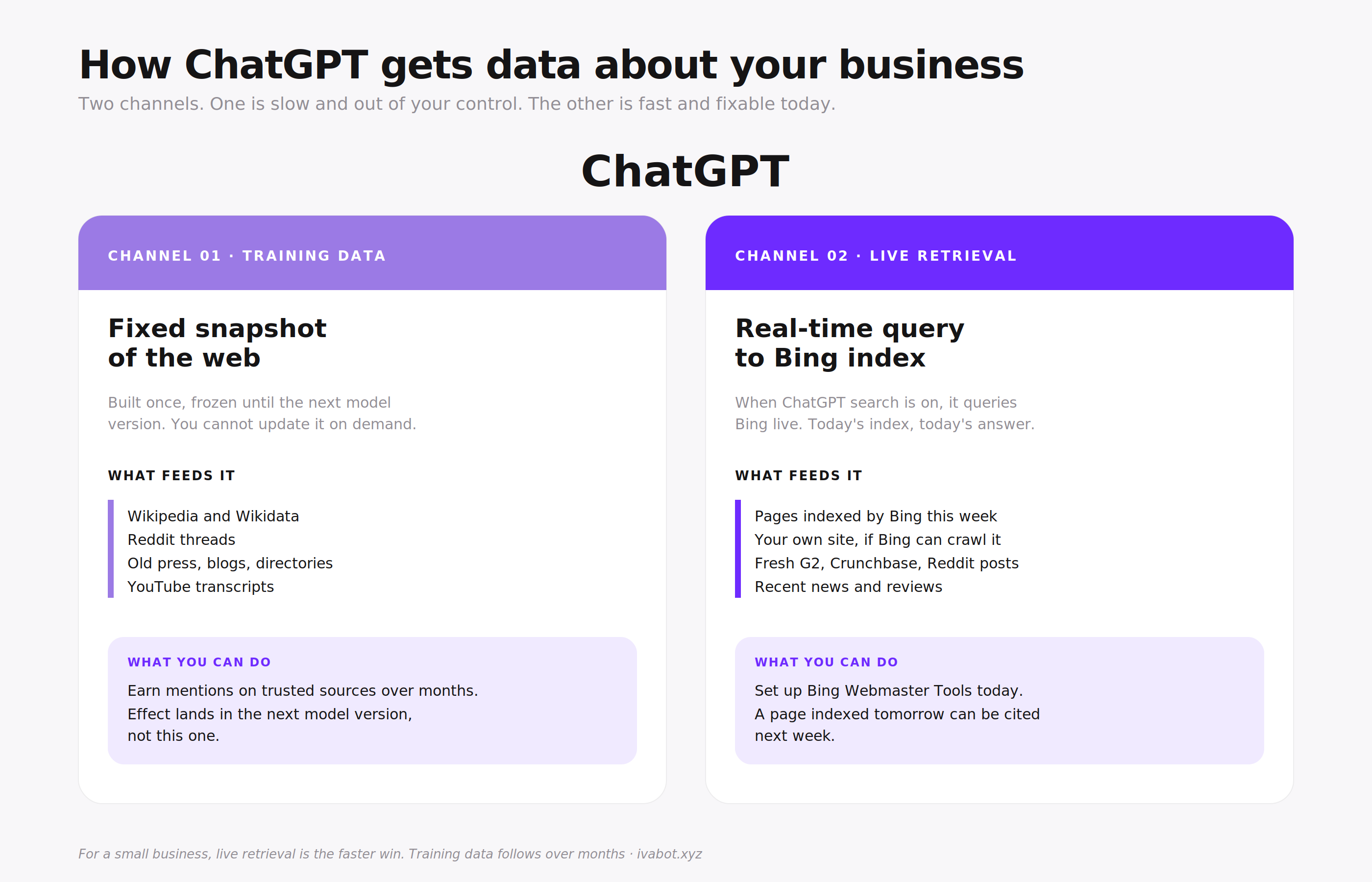
Short answer: ChatGPT pulls information from two channels. Training data is a fixed snapshot you cannot update on demand. Live retrieval queries the Bing index in real time, which is the channel you can affect quickly.
Training data is a fixed snapshot of the web from a past date. Once trained, the model holds that knowledge until the next version. To be in training data, your business needs consistent mentions across the web before the snapshot date.
Live retrieval happens when ChatGPT search is on and the model queries the Bing index in real time. A page indexed by Bing today can be cited tomorrow.
ChatGPT search answering a category question. The cited sources below the answer are what you compete for.Training data and live retrieval are two different channels. Live retrieval is the faster win for small businesses.
Short answer: three free checks before any optimization work. The first tells you if you exist for ChatGPT at all. The second tells you what is broken on your site. The third gives you a baseline to measure against in 8 weeks.
Three free checks, in order.
Bing Webmaster Tools — confirms your site is in the Bing index. If you are not in Bing, ChatGPT cannot find you through live retrieval. bing.com/webmasters
IvaBot AI Readiness check — runs the on-page checks for ChatGPT-specific signals: GPTBot and OAI-SearchBot access, extractable passages, schema, TL;DR blocks, comparison tables, HowTo schema. New accounts get three free credits, no card. ivabot.xyz
Manual prompt test — open ChatGPT, ask "best [your category] for [your audience]" five times in new chats. If your business never appears, you are at zero. This becomes your baseline.
Do all three before Step 1. Without these, you will not know what changed when something starts moving in three months.
Step 1: Have content actually worth citing
01
Content quality (ongoing)
Problem: ChatGPT will not cite the 1500th generic article about how to do SEO. If your content is rewritten from the top 10 Google results, no schema, no Bing setup, and no third-party listings will save it.
Fix: Every important page needs an angle nobody else has. Original research, specific examples from your own work, a contrarian take, real numbers from real cases.
If you cannot answer "what does this page have that nobody else has" in one sentence, the page is not worth the model's attention. Rewrite it or remove it.
Three rules that matter most:
Have a specific angle. The model picks pages with original data or genuine expertise. Specialists outrank generalists.
Go deep, not wide. A site with 20 deep pages on one narrow topic outperforms a site with 200 generic pages on many topics.
Write in your own voice. Generic content copied across sites gives the model no reason to pick you. Specific details, real cases, opinionated takes get picked first.
Step 1 matters more than steps 2 to 7 combined. Everything else is optimization on top of content that is actually worth quoting.
Step 2: Get your site into the Bing index
02
Bing index setup (30 minutes once, 1-2 weeks to index)
Problem: ChatGPT search uses Bing's index for live retrieval. Most small businesses only set up Google Search Console and never realize Bing is a separate index that ChatGPT depends on.
Fix: Sign up for Bing Webmaster Tools, submit your sitemap, allow AI crawlers in robots.txt.
Add your domain. Bing pulls verification from Google Search Console if you already use it.
Submit your sitemap (yourdomain.com/sitemap.xml).
Check the "Site Explorer" tab to confirm Bing has indexed your pages. If pages are missing, click "Submit URL" manually.
Open your robots.txt file. Allow these crawlers: GPTBot, OAI-SearchBot, ChatGPT-User, PerplexityBot, ClaudeBot. If your file blocks User-agent: *, add explicit Allow lines for these bots.
Bing Webmaster Tools confirms which pages of your site are in the index. If this list is empty, ChatGPT cannot find you through live retrieval.
Important
This is the single most-skipped step. Even sites that do everything else right often miss Bing setup, and then wonder why ChatGPT never cites them.
Step 3: Make content quote-ready
03
Quote-ready writing (4-8 hours per top page)
Problem: ChatGPT lifts standalone sentences word-for-word. Long buried paragraphs get skipped, even if the information is there.
Fix: Restructure your top pages so key insights stand alone as quotable sentences.
Pages with 5+ quote-ready sentences are cited 3.2 times more often, based on tracking across 200+ pages by one SEO consultant (Reddit case study).
Six concrete actions:
Add a TL;DR at the top of every important page. 2-4 sentences answering the page's main question directly.
Use the BLUF method, Bottom Line Up Front. Lead each section with the answer, then explain. Bad: "There are many factors that influence pricing, including..." Good: "Our pricing starts at $5 per audit. The factors below explain why."
Add answer capsules of 120-150 characters right after each H2 question. The model lifts these directly.
Add 3-5 statistics per 1000 words. Specific numbers with sources. Example: "Bing handles 12% of US desktop search traffic (StatCounter, April 2026)." Not "Bing has significant market share."
Break long paragraphs into standalone sentences. Each sentence should make sense on its own when copy-pasted.
Add comparison tables and lists. The model lifts table rows and list items directly.
One more thing that moves the needle: author credentials with specifics. Not "By John Smith" but "By John Smith, 12 years in B2B SaaS marketing, worked with 50+ companies." One Reddit case study showed citation rate going from 28% to 43% after adding specific author bios to 15 articles. Real photo, real LinkedIn link, real past work.
If your content is not quotable, no amount of technical SEO will save it. The model cannot lift what you have not made liftable.
Step 4: Add the right schema markup
04
Schema markup (1-2 hours total)
Problem: Schema helps the model understand what your page is about, but most guides recommend every schema type, including ones that do nothing for AI citations.
Fix: Add only the four schema types that move the needle. Skip Speakable.
Add these:
FAQPage schema on pages with Q&A sections. Lifted directly into answers.
HowTo schema on step-by-step pages. Pages with HowTo schema are cited 1.7 times more for instructional queries.
Product schema if you sell a product. Include name, description, offers, aggregateRating.
Organization schema on your homepage. Include name, description, sameAs (links to LinkedIn, G2, Crunchbase profiles).
What's normal
Speakable schema gets recommended in many AI SEO guides, but tracking studies show no measurable impact on ChatGPT citations. Skip it.
Validation: Google's Rich Results Test. Free. In Webflow, schema goes into the page's Custom Code section.
Step 5: Get listed on the sites ChatGPT trusts
05
Third-party listings (2-4 weeks per listing)
Problem: ChatGPT trusts what other sites say about you more than what you say about yourself. If your business is invisible on the domains ChatGPT cites most, you are invisible to ChatGPT.
Fix: Get listed on the small number of domains the model pulls from for your category.
Backlinko's analysis of AI citations found Wikipedia, Reddit, G2, Crunchbase, and YouTube transcripts among the top sources.
The sources panel under a ChatGPT answer shows which domains the model used. These are the sites to get listed on.
For SaaS or software businesses
Wikipedia / Wikidata. Almost every Reddit thread about AI citations names Wikipedia as a top source. Full Wikipedia entries require real notability, but Wikidata has a much lower bar and feeds structured facts to ChatGPT directly. wikidata.org
G2, submit your product. Approval: 5-10 business days. g2.com
Industry-specific directories, for an accountant Clutch; for a plumber Yelp; for a clinic Healthgrades.
Reddit, the highest-leverage single channel
Reddit accounts for 12 to 13% of ChatGPT citations across categories (Backlinko AI citations study). It is one of the most cited domains for "best X for Y" type queries.
Important
You cannot post spam, and you cannot create a brand account to self-promote. Both get removed and reduce trust. The model also learns to discount obviously promotional Reddit threads.
What works instead:
Find 3-5 subreddits where your audience asks questions. For SEO tools: r/SEO, r/SEO_for_AI, r/SmallBusiness, r/marketing.
Read each subreddit's rules. Most ban self-promotion outright.
Comment helpfully on 10-15 posts before mentioning your business once.
Aim for 3-5 organic mentions across different threads over 2-3 months.
Step 6: Build comparison content and keep your description consistent
06
Comparison content + entity consistency (4-8 hours per page)
Problem: When ChatGPT recommends tools for a category, it pulls from honest comparison pages. Sites with no comparison content get skipped for category queries entirely.
Fix: Build comparison pages naming your top 3 competitors honestly, and keep your business description consistent everywhere the model can find it.
One Reddit case study called comparison content "the single highest-leverage piece" of their AI citation work. An honest comparison page naming your top 3 competitors, with a fair assessment of where each one wins, gets cited any time someone asks ChatGPT for category recommendations.
The trick is being genuinely fair. Pages that read like sales pitches for the writer's product get filtered out at retrieval. Write the page you would want to read if you were choosing between options. Our own version of that page, comparing nine AI visibility tools including our own, is here, and it names a competitor as the better pick for one of the jobs.
Entity consistency
ChatGPT builds a picture of your business by combining mentions from many sources. If the descriptions conflict, the model hedges instead of citing you confidently.
Write one sentence that describes your business in plain language. Example: "IvaBot is an SEO tool for small business websites with pay-as-you-go pricing from $5."
Use that exact sentence (or close paraphrases with the same key facts) on your homepage hero, LinkedIn company description, G2 / Capterra / Crunchbase profile, Product Hunt tagline, and About page.
Check every 2-3 months that no profile has drifted into different wording.
Step 7: Refresh content quarterly
07
Quarterly refresh (2-3 hours per quarter)
Problem: Content from the last few months is cited noticeably more than older content, even when the older content ranks better on Google. Stale pages slowly drop out of citations.
Fix: Every 90 days, refresh your top pages with fresh data and a visible "last updated" date.
The routine:
Every 90 days, open your top 5 pages.
Update statistics with newer data.
Add a fresh example or case from the past quarter.
Update the visible "last updated" date.
Re-submit to Bing through Bing Webmaster Tools after the refresh.
Timeline: what to expect
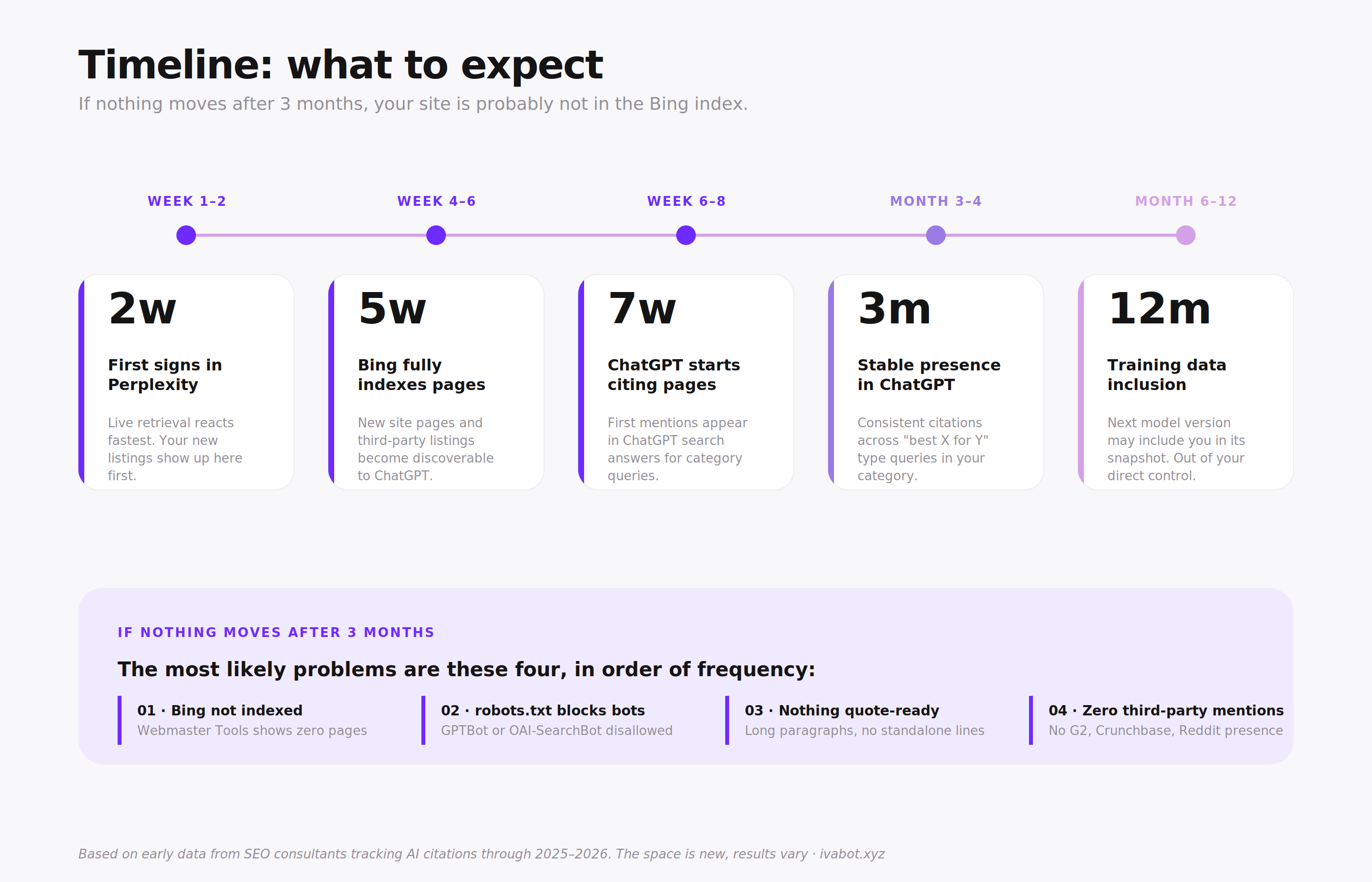
Short answer: first signs in Perplexity at week 2. ChatGPT search at week 6 to 8. Stable presence at month 3 to 4. Training-data inclusion at month 6 to 12, out of your direct control.
These numbers are based on early data from SEO consultants tracking AI citations through 2025-2026. The space is new and results vary by industry and starting position.
Week 1-2: First signs in Perplexity (live retrieval, fastest to react)
Week 4-6: Bing fully indexes new pages and listings
Month 3-4: Stable presence in ChatGPT for category queries
Month 6-12: Training-data inclusion in the next model version (out of your direct control)
What to expect, week by week. If nothing moves after 3 months, the cause is almost always one of four things.
If nothing moves after 3 months
The most likely problems are: Bing has not indexed your site, your robots.txt blocks AI crawlers, your content has no quote-ready sentences, or you have no third-party mentions outside your own domain. Re-run the pre-check from the start.
How to check if it's working
Short answer: a 15-minute weekly routine with free tools is enough to see the trend. Manual prompt test in ChatGPT, Bing Search Console for impressions, GA4 for referral traffic.
Manual prompt test (free): Every 2 weeks, run the same 5 prompts you set up at the start. Record how often your business appears in cited sources.
Bing Search Console: Watch for impressions and clicks growth. Bing growth precedes ChatGPT growth by 2-4 weeks.
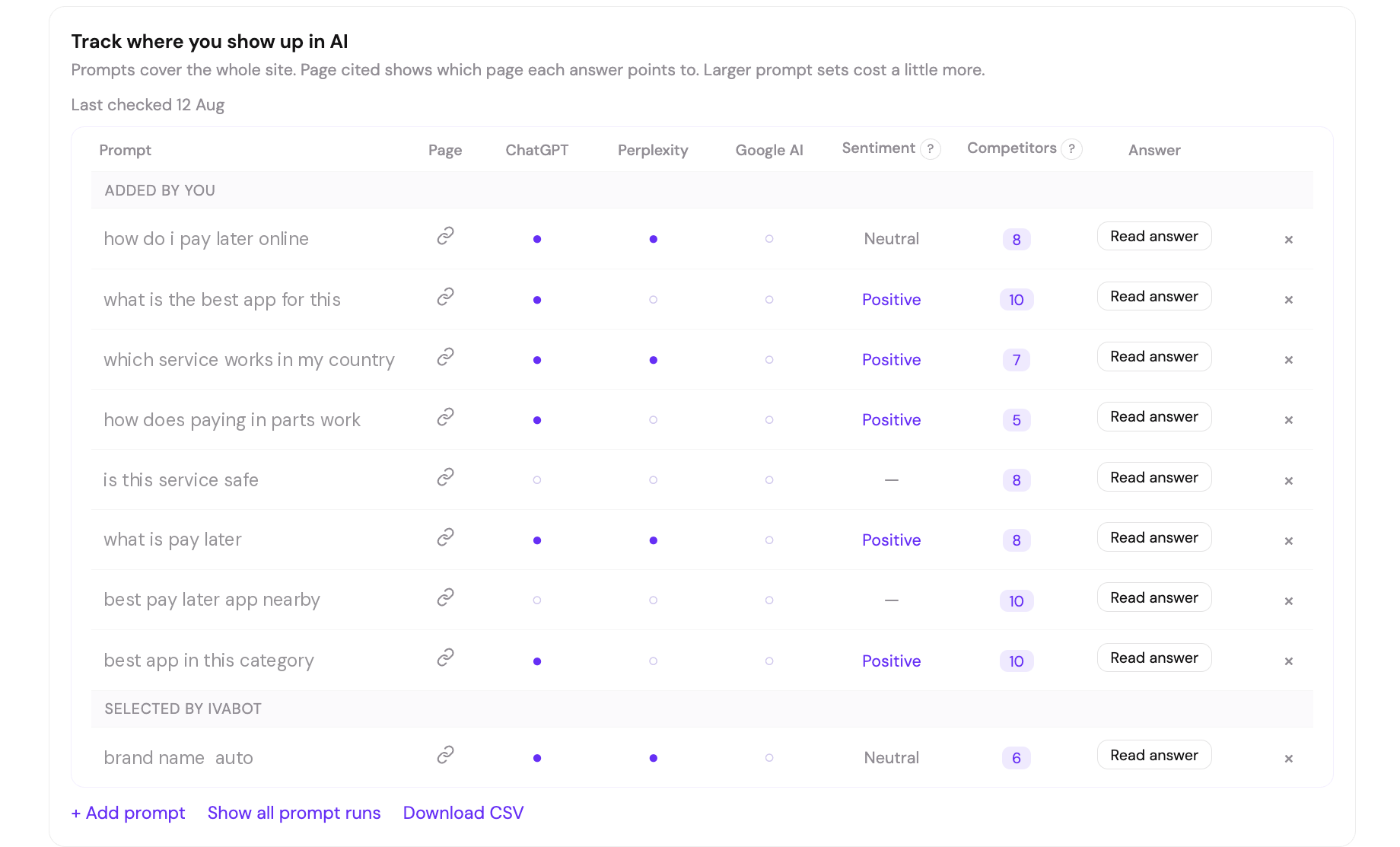
The manual test answers whether you appeared. It does not tell you why, and by next month you will not remember what the answer said. IvaBot keeps that part: it runs your prompt list across ChatGPT, Perplexity and Google AI and records, for each one, whether the brand was mentioned, whether a page was cited and which page, the sentiment of the mention, the competitors named in the same answer, and the full answer text. Fifty prompts a month costs about five dollars, and new accounts get three free credits with no card. Run it on your page.
The five-prompt baseline from the pre-check, kept automatically, with the model's answer behind the button.
How does ChatGPT pull information about my business?
Two ways. Training data is a fixed snapshot of the web from a past date, you cannot update it on demand, only earn presence over months. Live retrieval queries the Bing index in real time, this is the channel you can affect quickly. Both matter, live retrieval is the faster win.
How to get mentioned in ChatGPT?
Four things in order: get into the Bing index, make your content quote-ready, get listed on Wikipedia / Wikidata / G2 / Crunchbase / Reddit, and keep your business description consistent across all those profiles. Realistic timeline to first mentions: 6 to 8 weeks.
How to appear in ChatGPT search results?
The same seven steps in this guide. There is no shortcut. ChatGPT search uses the Bing index, so Bing Webmaster Tools is step zero. After that, content quality is the highest-leverage step. Everything else is optimization on top of those two.
Does ChatGPT use Wikipedia, structured data, or something else?
All three. The top sources cited by ChatGPT across most categories: Wikipedia, Reddit, G2 / Crunchbase / similar directories, the Bing index, and YouTube transcripts. Structured data (schema markup, Wikidata) helps the model understand facts about your business and quote them confidently.
How long does it take to show up in ChatGPT?
Realistic: 2 weeks for Perplexity, 6 to 8 weeks for ChatGPT search (live retrieval channel), 3 to 4 months for stable presence, 6 to 12 months for inclusion in the next training data snapshot. If you see nothing after 3 months, your site is probably not in the Bing index.
How to rank higher in ChatGPT search results?
Once you are appearing at all, the way to rank higher is to deepen what got you in: more quote-ready sentences, more third-party mentions of your brand, more comparison content for your category, and quarterly content refreshes. ChatGPT visibility compounds slowly.
How do I know which prompts I already appear for?
Write down five to ten questions a customer would ask before they know your name, then run them yourself and record the result per engine. Once the list grows past ten, automate it: a tracker runs the same prompts on a schedule and keeps the answer text, which is what lets you see why you appeared or dropped out. Dedicated trackers start around $20 a month, and a pay-per-run tool costs about five dollars for fifty prompts.
Should I publish an llms.txt file?
It will not hurt. Some claim it helps, others call it useless. There is no strong evidence either way as of 2026. Spend time on the seven steps above first. If you have an hour left over, deploy llms.txt, it takes 15 minutes.
Is ChatGPT the same as ChatGPT search?
No. Standard ChatGPT answers from training data only. ChatGPT search (with web access) uses live retrieval through Bing. Different fixes apply: standard ChatGPT needs long-term presence work, ChatGPT search needs Bing index plus quote-ready pages.
Can I pay to appear in ChatGPT answers?
ChatGPT launched paid ads in the US in 2026, self-serve through ads.openai.com. Ads appear as labeled sponsored boxes below the answer, not inside it. Industry-wide CTR is around 1.3%. For most small businesses, the math does not work yet. Earning organic citation inside the answer is the better target.
Why does ChatGPT recommend my competitors but not me?
Three common reasons: your site is not in the Bing index, your business has fewer third-party mentions (G2, Reddit, directories), or your description is inconsistent across the web. Run the pre-check, then prioritize Step 2 and Step 5.
Does this work the same way for Claude, Gemini, and Perplexity?
No. Each engine cites different sources. Perplexity does the most live retrieval, so it reacts fastest. Claude leans more on training data. Gemini blends Google search results with model knowledge. The seven steps above help across all of them, but expect each engine to behave differently when you measure.
Is ChatGPT SEO the same as regular SEO?
Mostly yes, with two additions. ChatGPT SEO needs Bing index setup (regular SEO often skips Bing), and it needs quote-ready content (regular SEO does not care about standalone sentences). Everything else, schema, author credentials, third-party mentions, applies to both.
What's Next
The numbers will be small for the first few weeks, and that is normal. Few citations on ChatGPT, few mentions in Perplexity sources, a thin trickle of referral traffic. These numbers grow only if you have done the work behind them: content worth quoting, site in Bing, quote-ready pages, schema, listings, consistent brand description, quarterly refreshes.
Block out one focused afternoon this week. Run the three pre-checks. Set up Bing Webmaster Tools. Pick your top page and make it quote-ready. That alone moves you ahead of most small business sites in your category.
 9 min read