How to Get Perplexity to Cite Your Website (2026 Guide)
Galyna ArikhMay 28, 202610 min read
Perplexity does not show ranked links. It writes one answer and names a few sources inside it. Here is how it picks those sources, the signals that earn a citation, and what to fix on your pages first.
Try IvaBot for your site
Find what's hurting your SEO and what to fix first. Free to start, no credit card.
If you want Perplexity to cite your website, you are not aiming for a spot in a list of search results. Perplexity does not show ranked links. It writes one answer and names a few sources inside it, and your goal is to be one of those sources. Getting cited means your page was easy to reach, easy to extract, and trustworthy enough that the engine was willing to put your name next to a claim. This guide covers how that selection works, the signals that move it, and a concrete checklist for a small site, including how long it takes and what your site needs to have first.
One thing up front, stated plainly: Perplexity has not published its source-selection algorithm. Everything below is drawn from my own testing on IvaBot and a few client sites, plus public 2026 studies, reverse-engineering write-ups, and discussions on Reddit and other community boards. Treat it as a well-supported working model, not a statement from the company.
Perplexity is an answer engine. A user asks a question, the engine runs a live web search, reads the candidate pages, and writes a synthesized answer with inline citations linking back to the sources it used. There is no list of ten blue links and no fixed position to hold. A typical answer cites somewhere between three and eight sources, drawn from a larger pool of pages the engine evaluated for that query.
So "ranking in Perplexity" translates to a different question: how do I get my page selected and cited as one of those sources? You are not trying to be number one. You are trying to be one of the handful of pages the engine trusts enough to quote for a specific question. That reframing changes what you optimize for, and it is the thing most people get wrong when they apply a classic SEO mindset to Perplexity.
This guide is about the action: making Perplexity cite your page. If you want the background on where each engine pulls its sources and why their citations barely overlap, that is covered separately in where ChatGPT, Perplexity, Claude, and Google AI get their information. Here the focus is narrow and practical.
How Perplexity picks the sources it cites
The most useful way to think about Perplexity citations is as two separate gates. Your page has to clear both, and most pages that fail are failing at only one of them. Getting one right and ignoring the other is the most common reason a good page never gets cited.
A page has to clear both gates. Most pages that fail are failing at only one.
1
Retrieval: your page has to be found
Every Perplexity query triggers a real-time web search across its index and crawler. Before anything else can happen, your page has to be reachable, indexed, and relevant enough to be pulled into the candidate set for that query. If Perplexity's crawler is blocked, if your text only appears after JavaScript runs, or if the page is too thin to match the query, you never enter the pool. Nothing downstream matters.
2
Absorption: a passage has to make it into the answer
Being in the candidate pool is not the same as being cited. After retrieval, the engine reads the candidates and decides which passages to use in the answer it writes. This is where extractability matters: a clear, self-contained sentence that directly answers the question is far easier to absorb than the same fact buried in a long paragraph. A page can be retrieved and still lose this gate because nothing on it was quotable.
Independent reverse-engineering studies describe the machinery behind these gates as a multi-layer reranking pipeline: a broad initial retrieval, then progressively stricter quality and authority filters before sources are selected. The exact layers are inferred, not confirmed by Perplexity, so I would not over-index on the specifics. The two-gate model is what actually changes how you work: fix crawlability and relevance first, then fix extractability. In that order.
The core idea
Perplexity citation is two problems, not one. Retrieval decides whether you are in the room. Absorption decides whether you get quoted. Optimize both, in that sequence.
Which engines are worth optimizing for, and where Perplexity fits
A reasonable question before you spend any time on this: is Perplexity even the engine to start with? It depends on what you sell and how your customers research. The table below compares the four major engines from the point of view of a site owner trying to get cited, not from the point of view of someone choosing which chatbot to pay for. The numbers come from 2026 cross-platform citation studies and are directional, since methodologies differ.
Perplexity cites the most sources per answer of the major engines. Directional figures from 2026 citation studies.
Read across the rows and a pattern shows up. Perplexity cites the most sources per answer, roughly four times what Claude does, which means more open slots and a better chance for a newer domain to break in. It also retrieves live on every query, so a page you publish or update today can be cited within days rather than waiting on a training cycle. The trade-off is that Perplexity is the most freshness-sensitive engine of the four, so a citation you earn will decay if you let the page go stale.
The practical conclusion for most small sites: Perplexity is the best first engine to optimize for. High citation volume, fast feedback, and a source pool that rewards specific, recent content rather than only large established brands. ChatGPT is harder to move because it leans on stable reference sites and partly on training data. Claude rewards long, deep explainers and is worth it if you write that way. Google AI is the most signal-driven and overlaps most with classic SEO. If you only have time for one, start where the feedback is fastest, which is Perplexity.
Engine
Sources per answer
Freshness sensitivity
Leans toward
Difficulty for a small site
Worth optimizing for if
Perplexity
High (around 20+)
Very high
Fresh, specific, structured content; Reddit
Lower; many slots, fast feedback
You can publish and refresh regularly
ChatGPT
Low (around 3 to 5)
Low to medium
Wikipedia, authoritative reference sites
Higher; few slots, training-data inertia
You have strong entity presence and listings
Claude
Low (around 5 to 6)
Low to medium
Long-form explainers and documentation
Higher per slot, but converts well
You write deep 2000+ word guides
Google AI
Medium (around 8)
Medium
YouTube, Reddit, schema-rich pages
Medium; overlaps with classic SEO
You already rank and use structured data
The signals that earn a Perplexity citation
Across the public studies and my own testing, a consistent shortlist of signals shows up. These are the levers that move retrieval and absorption. None of them is a secret, and none of them is officially confirmed by Perplexity, but they line up well enough across independent sources that I am comfortable treating them as the working set.
The working set of signals. Drawn from independent studies and testing, not confirmed by Perplexity.
Freshness, weighted more heavily than anywhere else
Freshness is the single strongest differentiator for Perplexity. One 2026 analysis found Perplexity cited content published within the last 30 days at an 82% rate. Other studies report citations dropping roughly 40% after 30 days and 65% after 90 days, with citation rates falling sharply past six months. The numbers vary by study, but the direction is unanimous: recent content wins, and old content decays fast. The practical move is to show a visible publication and last-updated date, keep the date accurate in your schema's dateModified field, and refresh strategic pages at least quarterly. A quarterly update cycle is close to mandatory if Perplexity is your target.
Citation likelihood by content age. Figures vary by study; the decay direction is consistent.A freshness-sensitive query: Perplexity pulls recent, dated sources for trend and news questions.
Extractable, self-contained answers
This is the absorption gate in practice. Open each important section with a one or two sentence answer to the question that section addresses, before any context or backstory. If someone could copy that sentence and use it as a standalone answer, you have made it easy to quote. Princeton's GEO research found that focused passages in roughly the 130 to 170 word range have the highest chance of being extracted by AI engines, so aim for tight, complete units rather than sprawling paragraphs.
Structured data that mirrors the page
Schema markup helps the engine understand what your page is and trust its freshness. The most useful types are Article (with author, datePublished, and dateModified), FAQPage for question-and-answer content, and HowTo for step-by-step guides. Pages with FAQ markup are reported to be meaningfully more likely to appear in AI answers. One firm rule: the schema must match the visible content exactly. Markup that describes things not on the page is treated as deceptive and can hurt you.
Specific numbers, named sources, and methodology
Perplexity favors content that looks verifiable. A claim with a number, a date, and a linked source is more citable than a vague assertion, because the engine is assembling a factual answer and prefers passages it can stand behind. Cite your own sources, include real data where you have it, and explain how you know what you are claiming.
Entity clarity and consistency
The engine does entity resolution to decide whether a source is credible. Keep your business name, description, author names, and category consistent across your site and across external listings. Add Organization and Person schema so the engine can connect your brand and your authors. Inconsistent metadata lowers the confidence the engine has in citing you.
Domain authority and off-site mentions
Perplexity does not cite just any blog. Recognized sources are favored, and its retrieval layer tends to reinforce sites that already appear for your category's queries. Quality backlinks still help, but the higher-leverage signal for AI citations is breadth of independent mention: your name appearing across pages Perplexity already trusts. The places that move the needle most are the ones the engine cites heavily for commercial and research queries: Reddit threads, review platforms like G2, Capterra, and Trustpilot, business directories like Crunchbase, and industry write-ups or news coverage. A mention on any of these is worth more for citation odds than a generic backlink, because it puts your name inside the source pool Perplexity is already pulling from. Brand mentions correlate with AI citation frequency more strongly than raw backlink counts in several 2026 analyses.
Reddit presence
Reddit is Perplexity's single largest citation source, accounting for close to 47% of its top citations in 2026 benchmarks. This does not mean posting promotional links. It means contributing genuine, useful answers in relevant subreddits over time. For a small business, one well-researched answer that gets upvoted in a subreddit like r/SEO or r/SmallBusiness can produce more Perplexity exposure than a month of blog posts, because the engine pulls that thread into answers for related questions.
What your site needs first, and how long it takes
Signals only matter if the foundations are in place. Before chasing citations, a site needs to clear a baseline. Here is the honest version of what that baseline looks like and how long the whole thing takes, based on what I have seen rather than what sounds encouraging.
What the site should have
A crawlable site where the main text exists in the HTML, not only after JavaScript runs. AI crawlers, specifically PerplexityBot, must not be blocked in robots.txt. Real authorship on important pages, with a name, a photo, and a short bio with credentials. Visible publication and last-updated dates. At least a handful of genuinely useful, focused pages rather than one giant catch-all page; in practice, somewhere around five to ten solid, specific articles on your core topics is enough to start being treated as a real source on those topics. Schema markup on those pages. And enough topical consistency that the engine can tell what you are an authority on.
Domain age and authority
Domain age helps but is not a hard gate. Perplexity's heavy freshness weighting is what makes it the most accessible of the four engines for newer sites, because a recent, specific, well-structured page can outcompete an older, staler page on the same query. That said, a brand-new domain with no external mentions and three thin pages will struggle, because the authority and entity signals are not there yet. A realistic floor is a site that has been published for a few months, has a small body of quality content, and has started to pick up a few independent mentions.
How long it takes
Because Perplexity retrieves live, the feedback loop is fast compared to Google. Sites with existing SEO authority often see citation lift within two to three weeks of putting the structural foundations in place. For most small sites starting closer to zero, expect first measurable citations in the 30 to 45 day range after fixing crawlability, adding question-format content, and getting the freshness signals right. The compounding part, where you are cited regularly across a set of related queries, takes a few months of consistent publishing and refreshing. None of this is instant, but it is faster than waiting on Google rankings.
A realistic timeline. Faster than Google because Perplexity retrieves live, but not instant.
Realistic timeline
Foundations in week one. First citations in roughly 30 to 45 days for a newer site, sooner if you already have authority. Regular citations across related queries after a few months of consistent updates.
The fix-this-first checklist
Ordered by impact and effort. Start at the top and do what you can. The first three are foundations; skip them and the rest will not help.
The six steps at a glance, ordered by impact. Details below.
1
Unblock PerplexityBot and confirm your text is in the HTML
Open yoursite.com/robots.txt and look for any block on PerplexityBot, GPTBot, or a blanket Disallow. Remove blocks if you want to be cited. Then right-click an important page, choose View Page Source, and confirm your main text is actually there rather than loaded only by script. This is the retrieval gate, and it is the most common silent failure.
2
Add visible dates and keep them honest
Show a publication date and a last-updated date on every important page, and make sure dateModified in your schema matches. When you genuinely revise a page, update the date. Stale dates on a freshness-driven engine are a direct disadvantage.
3
Front-load a clear answer in every section
Rewrite the first sentence or two of each section so it answers that section's question on its own. This is the single highest-leverage edit for the absorption gate, and it costs nothing but time.
4
Add Article and FAQ schema that mirrors the page
Use Article schema with author, datePublished, and dateModified, and FAQPage schema for any question-and-answer sections. Validate it, and make sure it describes only what is actually visible on the page.
5
Add real authorship and a few external mentions
Put a real author name, photo, and short bio on your key pages. Then spend some of your time off-site: answer genuine questions in one or two relevant subreddits, and look for chances to be mentioned in industry write-ups. Breadth of mention moves AI citations more than backlink count alone.
6
Set a quarterly refresh cycle on strategic pages
Pick your handful of most important pages and refresh them at least every quarter with new data, examples, or a clear update. On Perplexity this is not optional maintenance, it is what keeps a citation alive.
Common mistakes that keep you out of answers
Most pages that fail to get cited are failing for boring, fixable reasons. These are the ones I see most often.
Watch for these
Blocking PerplexityBot in robots.txt without realizing it. Text that only appears after JavaScript runs, so the crawler sees an empty page. No visible dates, or dates that never change. One giant page trying to cover everything instead of focused pages per topic. Generic content that reads like every competitor's, giving the engine no reason to pick you. Claims with no source or numbers, which a fact-assembling engine has no reason to trust. Schema that describes content not actually on the page, which is treated as deceptive. And publishing once then never refreshing, which on Perplexity means the citation fades.
How to check whether Perplexity already cites you
You do not need a paid tool to start. Open Perplexity, keep the default Web focus, and ask three to five questions a real customer would ask before they have heard of you. Not your brand name, the actual problem they want solved. For each answer, look at the Sources panel below it and note whether your domain appears, which competitors appear, and how current the cited content is. Perplexity is the most transparent engine for this, since every answer shows its full source list and the order reflects weighting.
A live Perplexity answer citing IvaBot in its source list. This is what being cited looks like.
Reuse the same queries each week so you are comparing like with like. If you are not cited at all yet, that is still useful: it tells you who currently owns the answer space and what kind of content is winning it. For a full weekly routine across engines, see how to track AI citations in 15 minutes a week.
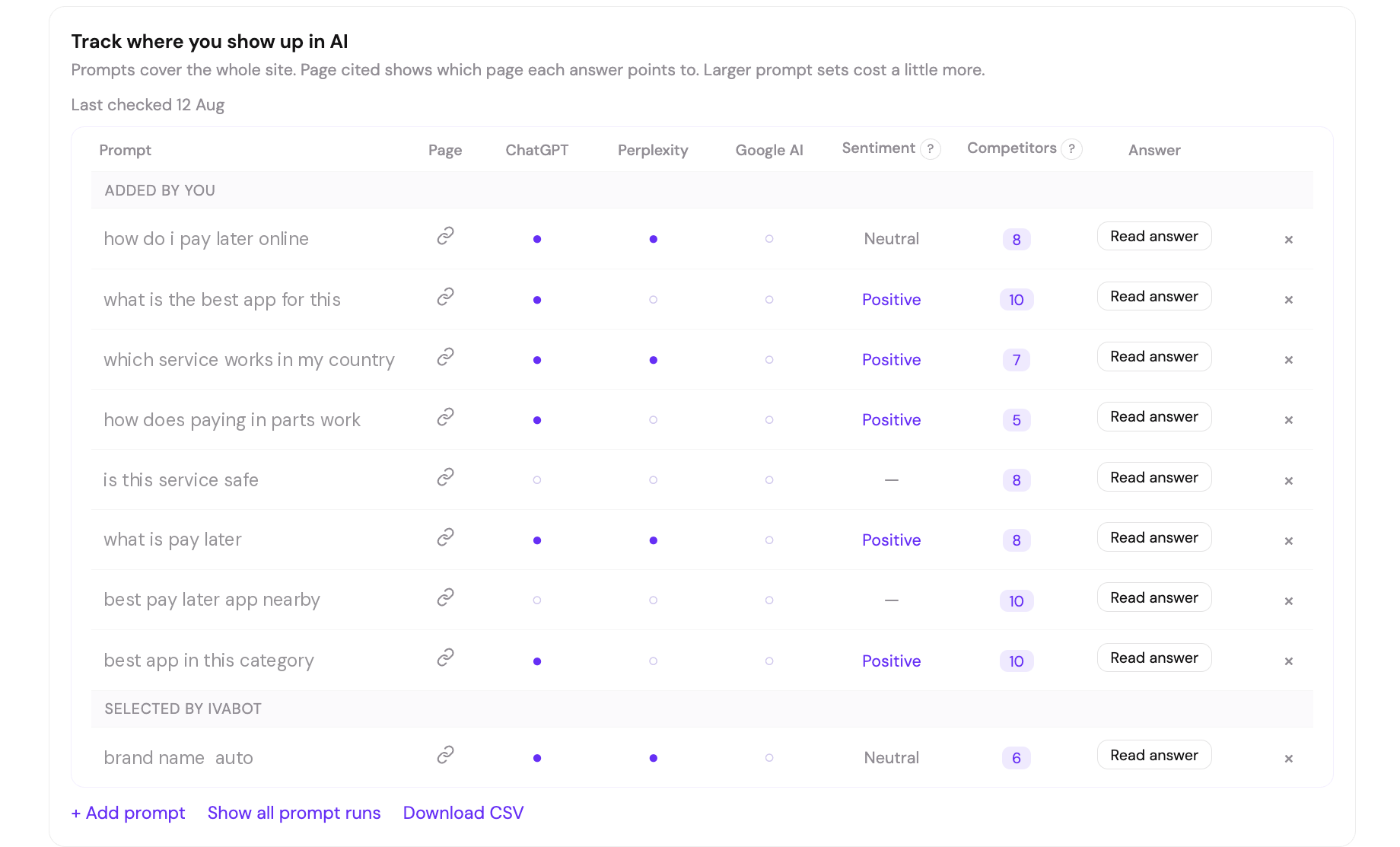
Manual probing works, and it stops working once the prompt list grows. IvaBot runs the same questions across Perplexity, ChatGPT and Google AI on your schedule and records, for each one, whether the brand was mentioned, whether a page was cited and which page, the sentiment of the mention, the competitors named in the same answer, and the full answer text so you can read what the model actually said. Fifty prompts a month costs about five dollars, and new accounts get three free credits with no card. Run it on your page.
The weekly probe, kept: one row per prompt, one column per engine, and the answer behind the button.
These patterns come from public 2026 studies and reverse-engineering write-ups, cross-checked against my own testing on IvaBot and a few client sites. Perplexity has not published its source-selection algorithm, so treat the specifics as a well-supported working model rather than confirmed mechanics. Where studies disagree on exact numbers, the direction is consistent across all of them. Verify it yourself by running your own queries and watching which sources Perplexity actually cites.
Sources referenced or cross-checked for this article:
AuthorityTech 2026, on Perplexity's source-selection pipeline and the retrieval-versus-absorption distinction
Otterly AI 2026, on optimizing for Perplexity citations rather than rankings
Stackmatix 2026, on Perplexity ranking-factor weighting and the Reddit citation share
OutpaceSEO 2026, on content freshness decay and schema citation lift
BlogPros 2026, on the 82% under-30-days citation rate and content structure
Whitehat SEO 2026, on freshness sensitivity compared across engines
Community discussion on Reddit (r/perplexity_ai, r/SEO) on how citations behave in practice
FAQ
Does Perplexity cite sources?
Yes. Perplexity cites sources in every answer, on both the free and paid tiers, as clickable inline links plus a full source list below the answer. A typical answer cites roughly three to eight sources, though it can be more for research-style queries. This is the engine's core design, which is why it is the most source-transparent of the major AI search tools.
How do Perplexity citations work?
For each query, Perplexity runs a live web search, retrieves a set of candidate pages, reads them, and selects a few to quote in the answer it generates. Each claim in the answer is linked to the source it came from. Selection comes down to two gates: whether your page is retrieved at all, and whether a passage from it is clear enough to be absorbed into the answer. The internal ranking machinery has not been published by Perplexity, so the working model here is based on independent testing and studies.
Does Perplexity give real references?
Yes, the citations link to real pages that the engine actually retrieved during the search, which is different from a model answering from memory and inventing references. Because it searches live, the links are generally to current, reachable pages. Always sensible to click through and confirm a cited page actually supports the claim, but the references themselves are real sources, not fabricated ones.
Is Perplexity good for citations?
For getting your own site cited, yes, it is the most accessible of the major engines. It cites the most sources per answer, retrieves live so new content can appear within days, and rewards specific, recent, well-structured content rather than only large established brands. The cost of that accessibility is its heavy freshness weighting, which means you have to keep pages updated to stay cited.
How many sources does a Perplexity answer cite?
Usually three to eight for a standard question, drawn from a larger set the engine evaluated. Research-style and deep queries can pull many more. Across all answer types Perplexity averages well above the other major engines, which is part of why there is more room for a new domain to be included.
How do I track whether Perplexity keeps citing me?
Ask the same three to five customer questions every week and record which sources appear, or automate it. A tracker runs your prompt list across engines on a schedule and keeps the answer text, which is the part that lets you see why a citation appeared or disappeared. Prices for dedicated trackers start around $20 a month, and a pay-per-run tool costs about five dollars for fifty prompts.
How do I cite Perplexity in APA or an academic paper?
That is a different question from this guide. If you need to reference a Perplexity answer in an academic paper, treat it like a software or AI-generated source: cite Perplexity AI as the author, the date you ran the query, and the prompt, following your style guide's format for generative AI. This guide is about the opposite direction: getting Perplexity to cite your website as one of its sources.
What's Next
Start with the retrieval gate this week. Open your robots.txt, confirm PerplexityBot is not blocked, and check that your main text is in the page source. Then rewrite the opening sentence of your most important page so it answers the question on its own, and add a visible last-updated date. Those three edits move you ahead of most sites in your niche and cost nothing but an afternoon.
After that it is consistency: keep your strategic pages fresh on a quarterly cycle, contribute genuine answers where your customers actually discuss their problems, and probe Perplexity weekly to watch the trend. Related guides on IvaBot:
 10 min read