How to Get More Google Reviews Without Spamming or Buying Them
Galyna ArikhMay 14, 202614 min read
Practical guide on how to get more Google reviews for small business in 2026. What to do, what not to do, how to reply, and how AI search uses reviews now.
Try IvaBot for your site
Find what's hurting your SEO and what to fix first. Free to start, no credit card.
This guide covers how to get more Google reviews for small business in 2026, without spamming customers or buying them. Google reviews are the customer ratings and written feedback that appear on a Google Business Profile, visible in Google Search, Google Maps, and increasingly in AI Overviews. They are one of the three strongest local ranking signals, alongside profile completeness and proximity. They are also one of the easiest signals to influence, and one of the easiest to ruin if you do it wrong.
What works in 2026: how to ask without spamming, how to reply to every star rating, what gets a profile suspended, and how Google's AI surfaces review content in summaries and recommendations.
TL;DR
Google reviews are public customer ratings and feedback on a Google Business Profile. They influence local pack ranking, Maps visibility, and AI Overview summaries.
You start seeing ranking impact around 10 reviews. Real visibility in the local pack typically needs 25+ with a steady inflow of 2-5 per month.
Timeline: first ranking movement in 4-8 weeks, stable local pack position in 3-6 months if reviews come in consistently.
The five highest-impact methods to get reviews: a direct review link, a QR code at the point of sale, a same-day SMS, a follow-up email, and an in-person ask. Combined they get 5-15% of customers leaving a review.
Never buy reviews, incentivize them, or filter feedback before sending it to Google. All three are FTC violations in the US and Google Terms of Service violations everywhere. Penalty: review removal, profile suspension, or FTC fines up to $50,000 per fake review.
Reply to every review within 48 hours, positive and negative. Reply rate is now a ranking factor and a public trust signal.
AI search engines (ChatGPT, Perplexity, Google AI Overviews) extract phrases from review text when recommending businesses. Reviews with specific words ("friendly staff", "vegan options", "open late") get cited more than generic 5-star reviews without text.
"The fastest way to ruin a Google Business Profile is to buy reviews. The second fastest is to ignore the real ones."
What Google reviews are and why they matter in 2026
A Google review is a 1-to-5 star rating and an optional text comment, posted publicly on a Google Business Profile by anyone with a Google account. Reviews show up in three places: on the profile itself, in the local pack at the top of search results, and in Google Maps. As of 2026, they also feed into AI Overview summaries and AI search citations.
Three reasons reviews matter more than other signals:
Direct ranking impact. Google has confirmed that review quantity, recency, and rating are part of the local pack algorithm. Profiles with 25+ reviews consistently outrank profiles with under 10, all else being equal.
Conversion impact. A profile with 50+ reviews and a 4.5+ rating gets 2-3x more profile clicks than a profile with 5 reviews and a 4.9 rating. Volume matters more than perfection above a certain threshold.
AI citation impact. AI Overviews now pull review snippets directly into search results. A business with detailed text reviews mentioning specific attributes ("pet-friendly", "open Sundays", "good for groups") gets cited in AI answers for those queries.
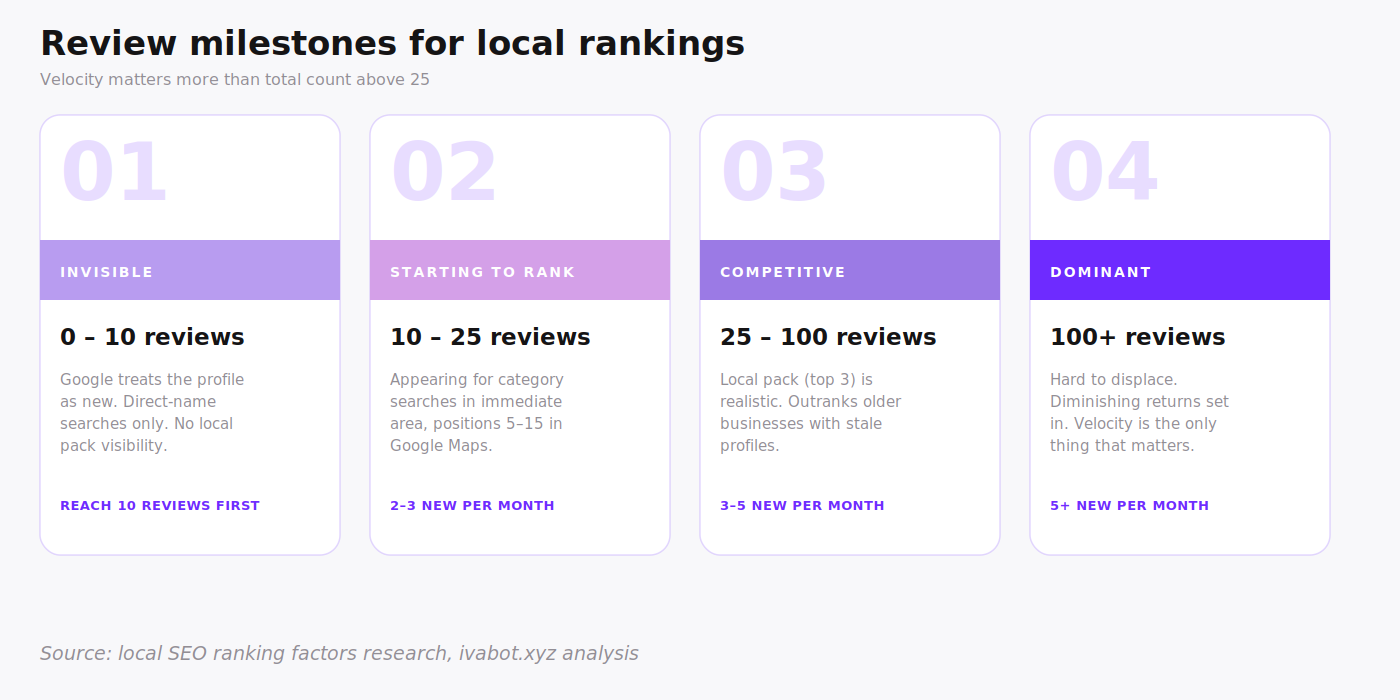
There is no magic number, but there are clear thresholds where things change.
The four review thresholds. Velocity matters more than total count above 25.
01
0 to 10 reviews: invisible
Below 10 reviews, Google treats the profile as new. You rank only for direct-name searches and very low-competition category searches. Your priority is reaching 10 with real customer reviews.
02
10 to 25 reviews: starting to rank
First ranking movement happens here. You start appearing for category searches in your immediate area, usually positions 5-15 in Google Maps. Velocity becomes more important than count. 2-3 new reviews per month signal an active business.
03
25 to 100 reviews: competitive in the local pack
You can outrank older businesses with stale profiles. The local pack (top 3 results) is realistic for your main category. Rating matters now: a 4.5+ at this stage is stronger than a 4.9 with only 10 reviews.
04
100+ reviews with steady velocity: dominant
Above 100 reviews with 5+ new ones per month, you are hard to displace. Diminishing returns set in. A jump from 100 to 200 reviews has less ranking impact than the jump from 10 to 50.
The real target is velocity, not total. A business with 30 reviews and 4 new ones per month outranks a business with 80 reviews and nothing new in 6 months. Google's algorithm penalizes stale profiles. Five reviews this month beats fifty reviews from two years ago.
When rankings start moving
Realistic timeline for a small business starting from a complete but unestablished Google Business Profile:
Week 1-2: First few reviews come in. No ranking change yet. Profile becomes visible for direct-name searches.
Week 3-6: Reach 10-15 reviews. First impressions and clicks for category searches show up in the Business Profile dashboard.
Month 2-3: Reach 25 reviews with steady velocity. Profile starts appearing in the local pack for your category in your immediate area.
Month 4-6: Stable local pack position for main category if velocity continues. Ranking expansion to secondary categories.
Month 6 onward: Compounding effect. Each new review extends ranking to longer-tail searches.
Faster timelines happen in low-competition categories or small towns. Slower timelines happen in major cities and saturated categories. The pattern of stability after month 6 is consistent regardless.
Be patient
Changes to a Google Business Profile can take up to 2 weeks to reflect. A new review does not move rankings the same day. If nothing happens in the first week, do not panic and do not switch tactics. Two weeks of consistent activity is the minimum signal.
How to get more Google reviews
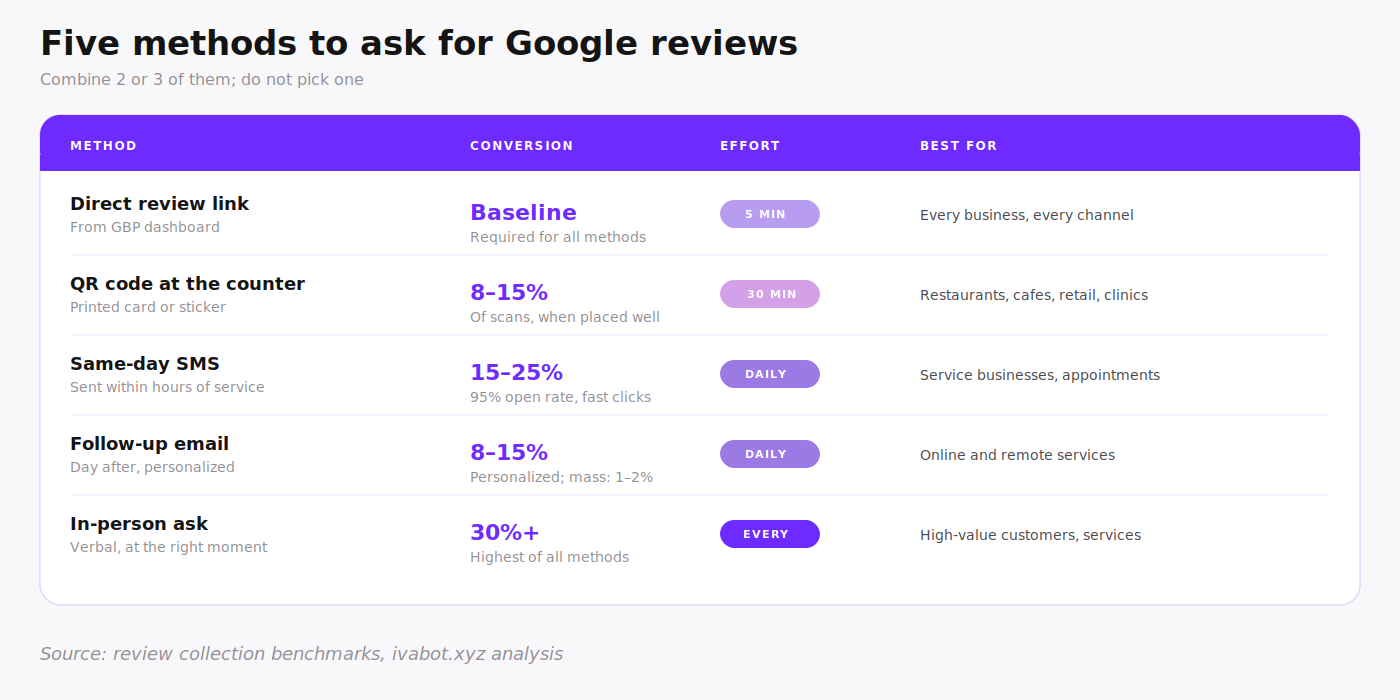
Five methods cover almost all the cases. Combine 2-3 of them, do not pick one. Combined, they typically convert 5-15% of customers into reviewers.
Five methods compared by conversion rate, effort, and business type fit.
1. Direct review link from Google Business Profile
The single most important thing to do. Sending people to "search for us on Google" loses half of them along the way. A direct link drops them on the review form immediately.
How to get the link: sign in to business.google.com, open your profile, click Read reviews, click Get more reviews, copy the short link. It looks like g.page/r/abc123/review. Save it. You will use it everywhere.
This is the Google review form a customer sees after clicking the direct review link.
2. QR code at the point of sale
A printed QR code on a small card at the checkout, the table, the reception desk, or the invoice. Customer scans, lands on the review form. The QR code converts the post-purchase moment into a review when motivation is highest.
Free QR generators: qr-code-generator.com, qrcode-monkey.com. Paste your direct review link, download, print at any print shop for around $5-10 for 100 cards.
3. Same-day SMS with the direct link
Sent within hours of the service. Short message, one link, one ask. SMS open rates are 95%+, click rates around 20-30%. This is the highest-yield method for service businesses where you have the customer's phone number.
4. Follow-up email with the direct link
Sent the next day or two days later. Works best when you can personalize at least one detail (the service they bought, the date, the staff member). Generic mass emails convert at 1-2%; personalized ones convert at 8-15%.
5. In-person ask
The owner, the technician, or the server directly asks at the end of the visit. "If you have 30 seconds, a quick review on Google really helps us." Highest conversion rate of all methods (often 30%+), lowest scale. Use for high-value customers and high-touch services.
What works best by business type
Restaurants and cafes: QR code on receipts and table cards. Service businesses (plumbers, electricians, contractors): SMS same day, in-person ask at job completion. Salons and clinics: SMS at checkout, follow-up email next day. Online services with local delivery: follow-up email with the direct link.
Encourage keywords and location in the review text
When you ask, nudge customers to mention what they did and where. A simple line works: "If you mention what we fixed and the neighborhood you live in, it helps others find us." Reviews that contain your category + city ("the best gluten-free pizza in Sector 2", "plumber in Bucharest") feed both the local pack algorithm and AI Overview citations. Do not script the wording, just suggest the angle.
The best moment to ask for Google reviews
Timing matters more than method. Asking at the wrong moment converts at 1-2%; asking at the right moment converts at 15-30%.
The right moment is when the customer has just experienced the value. After the meal, after the haircut, when they pick up the order, when the job is finished and they are satisfied. Their emotional peak is now, not in three days.
The wrong moment is two weeks later by mass email. By then they have moved on, the emotional peak is gone, and a generic email feels like spam.
Two more specific tips:
Do not ask if the customer was unhappy. Read the room. Asking an unhappy customer for a review produces a 1-star public review that will hurt for years. If you sense dissatisfaction, ask for direct feedback instead and try to resolve it.
Do not ask twice for the same transaction. One ask, one reminder if needed (after 7 days), then stop. Repeat asks read as harassment.
What gets your profile banned
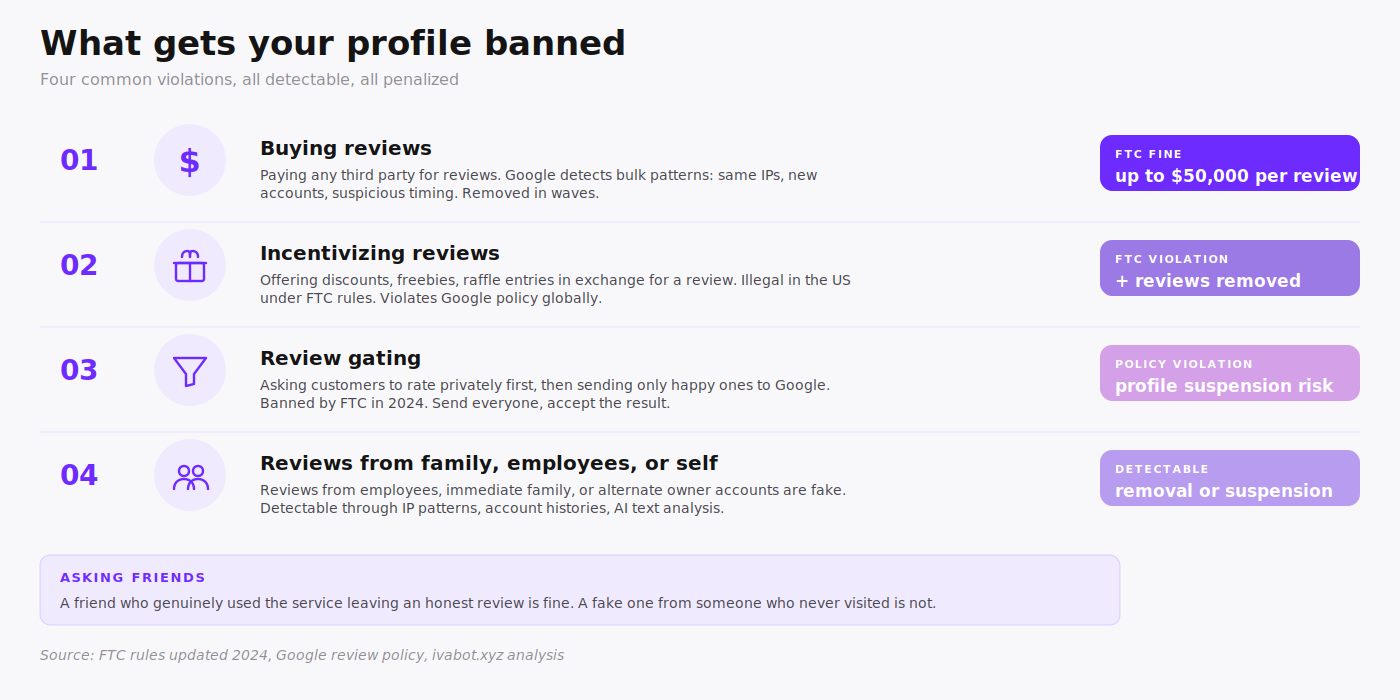
Google and the FTC have specific rules. Breaking them risks review removal, profile suspension, or fines. The four most common violations:
The four review violations Google and the FTC actively penalize.
Buying reviews. Paying any third party for reviews violates Google's Terms of Service and is illegal under FTC rules in the US. The FTC has fined businesses up to $50,000 per fake review since 2024. Google detects patterns (same IPs, new accounts, suspicious timing) and removes reviews in bulk.
Incentivizing reviews. Offering a discount, freebie, raffle entry, or any benefit in exchange for a review is illegal in the US (FTC) and against Google's policy globally. This includes "leave a review and get 10% off your next order." It is also illegal to incentivize reviews only when they are 5-star (called review filtering).
Review gating. Asking customers to rate you privately first, then sending only the happy ones to Google, is a Google policy violation. The FTC banned it explicitly in 2024. Send everyone to Google, accept the result.
Fake reviews from family, employees, or self. Reviews from employees, immediate family members, or alternate accounts of the owner are fake reviews. They are detectable through IP patterns, account histories, and increasingly through AI text analysis. Penalty: removal at minimum, profile suspension at worst.
Asking friends
Asking a friend who genuinely used your service to leave an honest review is fine. Asking a friend who has never been there to leave a fake positive review is not. The difference is whether they were a real customer.
How to ask for Google reviews: email and SMS templates
Copy, edit, use. Replace [Name], [Business], and [Link] with your details.
SMS, same day
Hi [Name], thanks for visiting [Business] today. If you have 30 seconds, a Google review really helps a small business like ours: [Link]. No pressure either way.
Email, day after
Subject: Quick favor from [Business]
Hi [Name],
Hope you enjoyed [the service / your meal / your visit] yesterday. If you have a couple of minutes, a short Google review would mean a lot. Direct link: [Link]. It takes about 30 seconds.
If anything was not quite right, reply to this email and we will make it right.
Thanks, [Business name]
In-person script
"By the way, if you have 30 seconds at some point, a quick Google review really helps us. Here is the link (or QR code). No pressure, just appreciated."
Reminder, 7 days later (one time only)
Hi [Name], gentle reminder in case you missed it. If you would still like to leave that review: [Link]. After this we will stop asking, promise.
How to reply to reviews
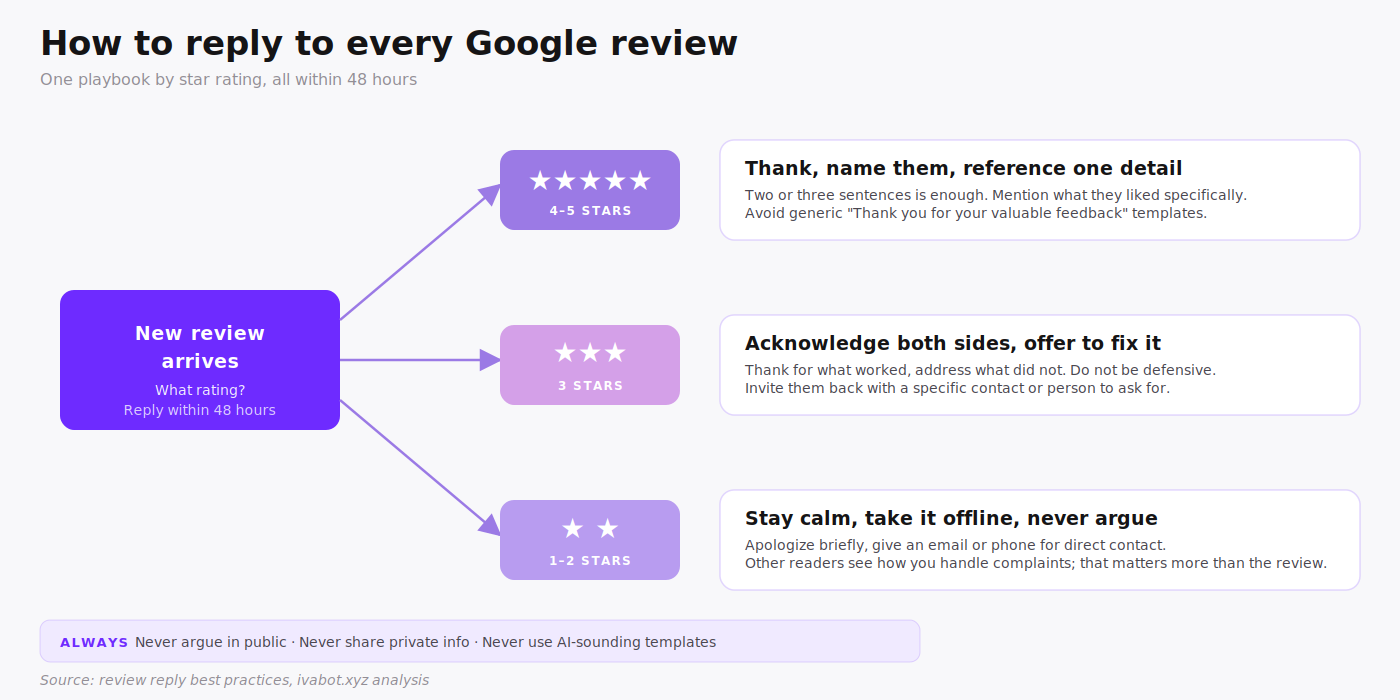
Reply to every review, positive and negative, within 48 hours. Reply rate is now a ranking signal and a public trust signal. A profile with zero replies looks abandoned.
One playbook by star rating, all within 48 hours.
Positive reviews (4-5 star)
Short, specific, named. Reference something the reviewer mentioned. Two or three sentences is enough.
Example, positive reply
Customer: "Maria was amazing with my haircut, I love the cut and color combination. Will definitely come back."
Reply: "Thank you [Name]. Maria will be glad to hear it. The color you chose looks great with the cut, see you next time."
Mixed reviews (3-star)
Acknowledge what was good, address what was not. Do not be defensive. Offer to follow up offline.
Example, 3-star reply
Customer: "Food was great but service was slow. We waited 30 minutes for our mains."
Reply: "Thank you for the honest feedback. We are glad you enjoyed the food. The wait time was longer than we would like; we have been short on Friday evenings and are adding staff. We would like to make it up next time, please ask for [Name] when you book."
Negative reviews (1-2 star)
Stay calm, never argue, offer to take it offline. Other potential customers will see how you handle complaints, and that often matters more than the negative review itself.
Example, 1-star reply
Customer: "Terrible experience. Rude staff and the worst pasta I have had."
Reply: "We are sorry your visit fell short. We take feedback seriously and would like to understand what happened. Could you email us at [email] with the date and any details? We will look into it directly."
Three rules across all reply types:
Never argue in public. A defensive reply hurts more than a bad review.
Never share private information. Do not confirm someone was a customer, do not reveal order details, do not mention staff names without consent.
Never use AI-generated replies that all sound the same. Google can detect them, and so can readers. Generic "Thank you for your feedback, your business is important to us" replies signal an abandoned profile.
How to respond to negative reviews and fake reviews
Handling a legitimate negative review
Reply within 48 hours. Acknowledge the issue. Take it offline. Try to resolve. If the issue is resolved, the customer often updates the review themselves. If they do not, a calm public reply still works for the next prospect reading.
One bad review out of 30 is normal and actually credible. A profile with 100% 5-star reviews looks suspicious to both Google and readers.
Reporting and removing fake reviews
Google removes reviews that violate their content policy: spam, off-topic, promotional, illegal content, conflicts of interest, impersonation, hate speech. Reviews that are simply negative but truthful cannot be removed.
Common reasons that get reviews removed: review from a competitor pretending to be a customer, review with profanity or hate speech, review that mentions a completely different business, review posted by someone who never visited.
If you have zero reviews
The hardest stretch. Below 10 reviews, Google barely shows the profile, and customers hesitate when there are none. Three steps to get out of zero fast and legitimately:
Ask your last 20 happy customers. Send each one a personal SMS or email with the direct link. Personal beats automated 5x at this stage. Expect 4-8 to respond within a week.
Add the QR code physically. Print 20 small cards with your QR code and the line "30 seconds helps a lot". Hand them out at the counter or include with deliveries.
Use every transaction for the next 30 days. Every customer who walks out happy gets asked, either verbally or by SMS. The goal is 10 reviews in 30 days; once you cross that, the profile becomes self-sustaining.
Do not buy reviews to bootstrap. Even a small batch of fake reviews triggers Google's pattern detection on new profiles, and the suspension is harder to recover from than starting at zero.
Google reviews and AI search
In 2026, Google reviews feed directly into three AI systems: Google AI Overviews, ChatGPT search (via Bing's index), and Perplexity. All three quote and summarize review content when answering local queries.
Six elements that make a single review work for ranking and AI citations.
What this changes for small business:
Review text matters more than ever. AI engines extract specific phrases ("friendly staff", "vegan options", "open late", "wheelchair accessible"). Reviews without text only contribute to the average rating, not to AI citations.
Recency weighs heavier. AI summaries prefer reviews from the last 90 days. A profile with 50 old reviews and nothing recent gets cited less than a profile with 25 reviews from the last quarter.
Sentiment is extracted, not just averaged. A profile with 80% positive sentiment on "service speed" gets cited in queries about fast service. Generic praise does less than specific praise.
Negative review handling becomes visible. AI engines now sometimes mention how a business responds to complaints. A profile with thoughtful replies to negative reviews gets cited as "responsive" in AI summaries.
Practical takeaway
When you ask for a review, encourage the customer to mention specifics. "Anything you particularly liked about today's visit" prompts text-rich reviews that AI engines can cite. Do not script the content; just nudge toward specifics.
Canva: design printable review request cards with the QR code embedded. Free tier is enough.
Paid, useful for multi-location or service businesses
Podium: from $399/month. SMS review requests, reply automation, integration with most POS systems. Worth it if you do 100+ transactions per week.
NiceJob: from $75/month. Automated review requests by email and SMS, reminder sequences, reply dashboard.
BirdEye, Trustpilot Local, Reputation.com: enterprise tools, $300-2000/month. Overkill for under 5 locations.
IvaBot does not currently include a review management module; the free Google Business Profile dashboard is enough for review collection, and the paid tools only make sense when transaction volume outgrows manual handling.
Common mistakes
Sending people to "search for us on Google" instead of a direct link. Half of them give up. Always use the direct review link from the dashboard.
Mass email a week later instead of a real-time ask. Conversion drops from 15% to 1-2%. Ask while the experience is fresh.
Asking only happy customers. This is review gating, an FTC violation and a Google policy violation. Send everyone to Google.
Replying to positive reviews but not negative ones. Negative reviews without a reply look worse than the reviews themselves.
Generic AI-sounding replies to every review. "Thank you for your valuable feedback" repeated 50 times signals an abandoned profile.
Buying a batch of reviews to bootstrap a new profile. Google's pattern detection flags new profiles with sudden volume. Recovery from a suspension is harder than starting from zero.
Asking the same customer twice for the same transaction. One ask, one reminder, then stop. More than that reads as harassment.
What to do this week to get more Google reviews
Three steps. They take a combined 45 minutes and produce results within 2-4 weeks.
Get the direct review link. Sign in at business.google.com, open Read reviews, click Get more reviews, copy the link. Save it where it can be found in 10 seconds.
Print 20 QR code cards. Use the link above, generate a QR code, design a small card in Canva, print at a local shop. Hand them out starting tomorrow.
Message the last 20 happy customers personally. Use the SMS template above. Expect 4-8 replies within a week. That is enough to move from invisible to starting to rank.
IvaBot Content Builder generated the structure and SEO meta for this guide.
This article was drafted using IvaBot Content Builder for structure and brief, then rewritten and fact-checked manually. The IvaBot suite (Core Audit, Content Coverage, Content Builder) is built for small businesses and content creators who want SEO insights without agency pricing. Try it free at ivabot.xyz/app.
FAQ
Is it legal to buy Google reviews?
No. Buying reviews violates Google's Terms of Service and is illegal under FTC rules in the US since 2024. Penalties include review removal, profile suspension, and FTC fines of up to $50,000 per fake review. Google detects bought reviews through IP patterns, account histories, and AI text analysis.
How do I get 100 Google reviews?
Use 3-4 of the proven methods together: a direct review link in every transaction, a QR code at the point of sale, same-day SMS, follow-up email, and an in-person ask for high-value customers. Expect 5-15% of customers to leave a review when asked at the right moment. At 100 transactions per week, that is 5-15 reviews per week, reaching 100 in 10-20 weeks.
How do I get a 4.9 Google rating?
The rating is the average of all reviews. Above 4.5, every 1-star review pulls the rating down measurably. Focus on the operational basics that cause negative reviews (slow service, miscommunication, expectations mismatch) rather than the review collection process. A 4.7-4.8 with 100 reviews is more credible to customers and AI engines than a 4.9 with 20 reviews.
Is it illegal to incentivize reviews?
Yes in the US, under FTC rules updated in 2024. Offering discounts, freebies, raffle entries, or any benefit in exchange for a review is illegal. Globally, it also violates Google's policy and triggers review removal. The one exception is asking for honest feedback without conditions.
How long does it take for Google reviews to affect rankings?
First impressions and clicks for category searches typically show up at 10-15 reviews, around 4-6 weeks of consistent collection. Stable local pack ranking for the main category usually takes 3-6 months with steady velocity of 2-5 new reviews per month.
How do I get a Google review link?
Sign in to business.google.com, open the profile, click Read reviews, then click Get more reviews. Copy the short link (looks like g.page/r/abc123/review). Use that link in SMS, email, QR codes, and any place where reviews are requested. Sending people to search Google by name loses half of them along the way.
How do AI search engines use Google reviews?
Google AI Overviews, ChatGPT search (via Bing's index), and Perplexity extract specific phrases and sentiment from review text when answering local queries. Reviews mentioning specific attributes ("pet-friendly", "open late", "wheelchair accessible") get cited in queries about those attributes. Recent reviews (last 90 days) weigh heavier than older ones. Generic 5-star reviews without text only contribute to the average rating, not to AI citations.
Can I remove a fake Google review?
Yes, if it violates Google's content policy (spam, off-topic, conflicts of interest, impersonation, hate speech, mentions a different business). Click the three-dot menu on the review, select "Flag as inappropriate", choose the violation category. If not removed in 3-5 days, escalate through Google Business Profile support. Reviews that are simply negative but truthful cannot be removed.
Should I respond to all Google reviews?
Yes, positive and negative, within 48 hours. Reply rate is a ranking signal and a public trust signal. A profile with zero replies looks abandoned. Keep replies short, specific, and personalized. Never use the same template repeatedly; AI-sounding replies hurt more than help.
What's Next
Reviews are one ranking lever, but the wider local SEO picture has more. Once the review habit is in place, the next layer is tactical optimizations like secondary GBP categories, AI-ready FAQ formatting, and neighborhood-level pages. See Local SEO Tips for Small Businesses: 9 Tactics Worth Trying After the Basics for nine specific tactics with realistic timing and traffic lift for each.
 14 min read