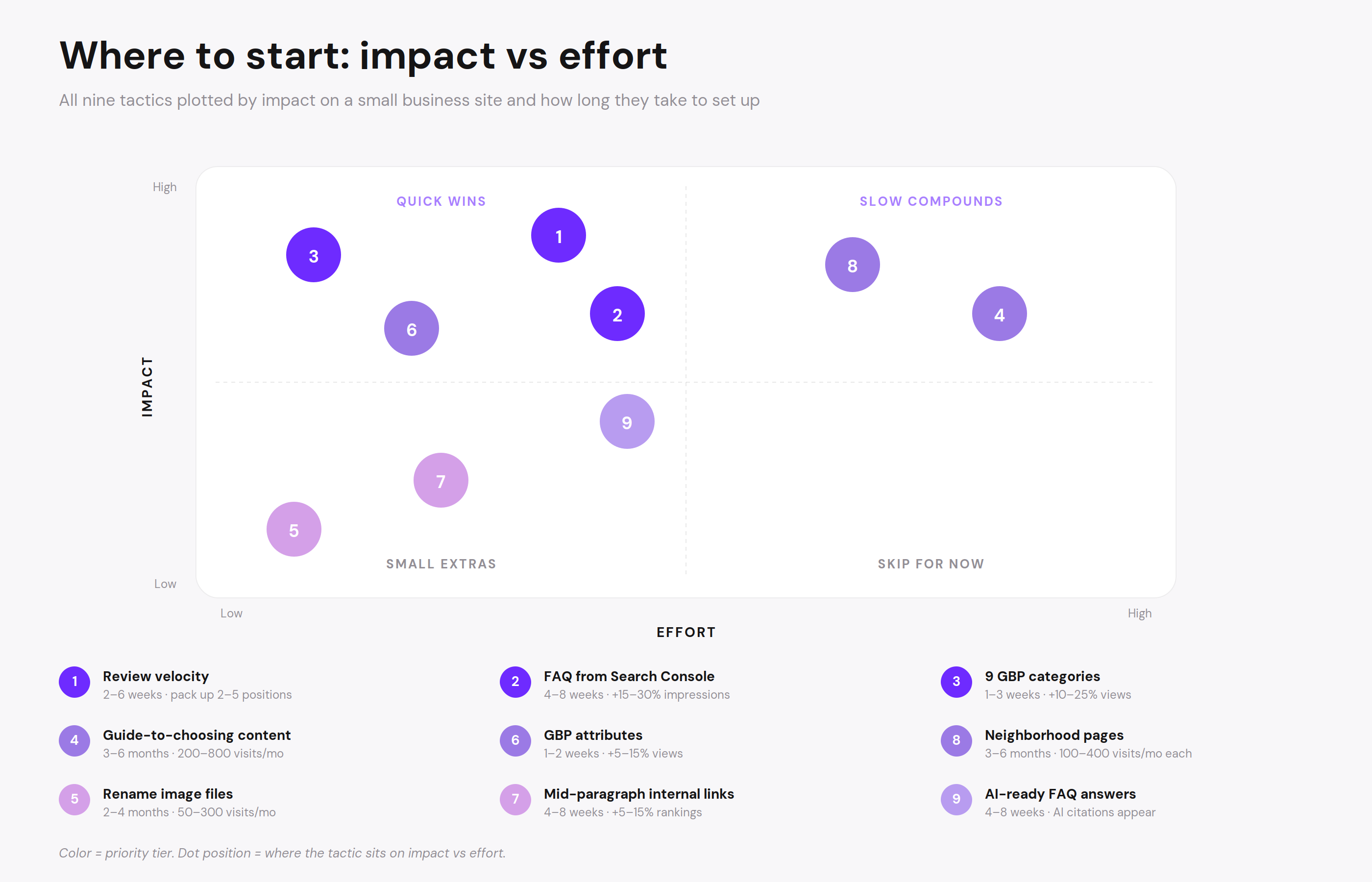
Local SEO tips for small businesses follow a set of established rules: claim your Google Business Profile, ask for reviews, keep your business name, address, and phone number (NAP) consistent across the web. Beyond these rules, there are niche tactics that move local rankings further. This article covers nine of them, with realistic timing and traffic lift for each.
Every tactic assumes you already have a complete Google Business Profile, a real address or service area, and a website that loads. If any of those is missing, read the Local SEO for Small Business guide first and come back.
TL;DR
- Local SEO tips for small businesses follow two layers: the foundation (Google Business Profile, reviews, NAP) and niche tactics that build on it. This guide covers the second layer.
- Each tactic includes time to first signal, expected lift, and a priority tier, calibrated for a small business site with 50 to 200 Google Business Profile views and 20 to 100 organic clicks per month at baseline.
- Three tactics produce visible movement in 1 to 6 weeks: review velocity, secondary GBP categories, and Search Console FAQ.
- Two tactics show up over 3 to 6 months and compound: neighborhood pages and the guide-to-choosing content pattern.
- Tactic 9 covers AI search formatting for ChatGPT, Perplexity, and Google AI Overviews.
- These tactics assume your Google Business Profile is already complete. If it is not, start with the full local SEO guide first.
What to expect from each tactic
Each tactic is rated on three dimensions. Time to first signal is how long before you see movement in Google Business Profile insights, Search Console, or local pack ranking. Realistic lift is the range observed for a small business site with modest baseline traffic (50 to 200 monthly profile views, 20 to 100 monthly organic clicks). Priority tells you what to do first.
The ranges below are conservative. A site with stronger baseline traffic or in a less competitive niche can do better. A site competing against established chains in a dense market will do less. The ranges assume normal effort and an existing local business.
1. Treat review velocity as a ranking signal
Time to first signal: 2 to 6 weeks | Realistic lift: local pack up 2 to 5 positions, plus 20 to 40 percent more direction requests | Priority: High
Short answer: how often new reviews come in matters more than total review count, once you pass about 10 reviews.
Google's local algorithm weighs review recency and steadiness alongside total count. Local SEO practitioners tracking ranking patterns in 2026 report businesses moving from outside the local pack into the top three within six to eight weeks after shifting from quarterly review cadence to weekly, with no other changes to the site or profile.
What to do: pick one day and one staff member each week. When a customer has just experienced the value (after a meal, treatment, completed job), hand them a printed card with a QR code linking to your Google review form, or send a same-day SMS with the link. Target one new review per week, every week. The pattern matters more than the push.
2. Pull FAQ questions from Search Console
Time to first signal: 4 to 8 weeks | Realistic lift: 15 to 30 percent more impressions on the treated page | Priority: High
Short answer: open Google Search Console, find the queries people already use to land on your site, and turn the top ten into FAQ items with verbatim answers.
Open Search Console, go to Performance, filter by "Queries containing question words" (who, what, where, when, why, how, do, can), and sort by impressions. Copy the top ten. Add them to the bottom of your most relevant page, each followed by a clear two-to-four sentence answer using the same wording the searcher used.
The page gains two things from this: it converts existing impressions better, and it gives AI assistants a clean question-and-answer structure to extract. Local SEO practitioners report 15 to 30 percent impression growth in two to three months for pages that get this treatment.
3. Add up to 9 secondary Google Business Profile categories
Time to first signal: 1 to 3 weeks | Realistic lift: 10 to 25 percent more profile views from new query types | Priority: High
Short answer: Google Business Profile allows 1 primary plus 9 secondary categories. Each one opens a different set of local pack queries.
Your primary Google Business Profile category should be the most specific description of what you do ("Italian restaurant," not "restaurant"). Google Business Profile also allows up to 9 secondary categories alongside the primary one, and each makes your business eligible for a different set of local pack queries.
A pizzeria can use: takeaway restaurant, delivery restaurant, gluten-free restaurant, family restaurant, late-night restaurant, catering service. A dentist can use: cosmetic dentist, dental implants provider, pediatric dentist, emergency dentist. The category list is searchable inside Google Business Profile when you edit your profile. The pillar guide section on GBP setup covers choosing the primary one.
4. Use the "guide to choosing the best [service] in [city]" content pattern
Time to first signal: 3 to 6 months | Realistic lift: 200 to 800 new organic visits per month per published guide | Priority: Medium
Short answer: write one buyer-education guide that ranks for general-intent searches earlier in the decision funnel.
Customers search "how to choose a [service] in [city]" before they shortlist any specific business. A guide that ranks for this query reaches them at that stage.
Structure: list the criteria a customer should evaluate (qualifications, hours, location, pricing model, specific features), explain what to ask, and give a comparison framework. Include your own business inside the framework as an example of how the criteria look in practice. Pages with this pattern pick up AI Overview citations because they answer a category-level question rather than a transactional one.
5. Rename image files before uploading them
Time to first signal: 2 to 4 months | Realistic lift: 50 to 300 visits per month from image search | Priority: Low
Short answer: dentist-bucharest-sector-1.jpg is eligible to rank in Google image search. IMG_4827.jpg is not.
Image search competition for local terms stays low compared to text search. A photo renamed from IMG_4827.jpg to dentist-bucharest-sector-1.jpg before upload, with the same descriptive text in the alt attribute, becomes eligible to rank for that query. Twenty well-named images on a photographer or restaurant site can produce a meaningful discovery channel from image search in the first six months.
6. Mark every Google Business Profile attribute that applies
Time to first signal: 1 to 2 weeks | Realistic lift: 5 to 15 percent more profile views from filtered searches | Priority: Medium
Short answer: customers filter on attributes. Only businesses that have marked the relevant attribute appear in filtered results.
Google Business Profile has dozens of attributes available: wheelchair accessible entrance, free wifi, dog-friendly, outdoor seating, accepts reservations, vegan options, gender-neutral restroom, free parking, late hours, English-speaking staff. Customers filter local searches on these attributes. Marking the ones that apply takes about ten minutes inside the profile editor. The pillar guide section on attributes lists which categories to scan through.
7. Place internal links inside paragraphs
Time to first signal: 4 to 8 weeks | Realistic lift: 5 to 15 percent more on linked-to page rankings | Priority: Medium
Short answer: a contextual link inside a paragraph carries more weight than the same link in a related-posts widget.
Internal link weight depends on where the link sits on the page. A link inside a paragraph, with anchor text describing the destination, passes more weight than a link in a related-posts widget at the bottom or in the sidebar. Pick your three most important service or location pages and link to each one from inside a relevant paragraph on your homepage and your about page. Anchor text should describe what the linked page is about: "our pricing for dental cleanings" rather than "click here."
Among local SEO tips and tricks, this one helps both local pack rankings and standard organic rankings.
8. Write one page per neighborhood or landmark you serve
Time to first signal: 3 to 6 months | Realistic lift: 100 to 400 visits per month per neighborhood page | Priority: Medium
Short answer: one page per neighborhood ranks for neighborhood-level searches. A generic city page does not.
If your business serves more than one neighborhood, create one page per neighborhood. Each page needs unique content (not a templated swap of the area name), an embedded map of the specific area, photos from that location if you have a physical presence, and one customer story or testimonial from a client there.
Service-area businesses (plumbers, electricians, mobile photographers, in-home tutors) follow the same pattern, with one page per city or major district covered. A photographer in Bucharest serving sector 1, sector 4, and Otopeni airport for arrivals shoots would create three pages. The on-page local SEO section of the pillar covers what each page needs.
9. Format your FAQ answers so AI assistants can extract them
Time to first signal: 4 to 8 weeks | Realistic lift: AI Overview and ChatGPT citations start appearing | Priority: High
Short answer: AI search engines cite businesses whose pages give clean, question-shaped answers. Reformatting an existing FAQ for that pattern takes about an hour.
AI assistants like ChatGPT, Perplexity, and Google AI Overviews cite pages that contain a question phrased naturally and an answer right after it. When someone asks "where can I find a vegan-friendly cafe in sector 4 Bucharest," the AI looks for a page with that exact question structure and an extractable answer.
Three formatting rules for AI extraction:
- Write each question the way a customer would say it out loud: "Do you take walk-ins on weekends?" rather than "Walk-in policy."
- Put the direct answer in the first sentence after the question.
- If you use an accordion, make sure the question and answer are both in the page HTML rather than loaded by JavaScript on click.
A deeper version of this approach, including specific content patterns AI engines favor, is in the GEO and AI search guide.
Quick checklist: what to do this month
Four tactics with the fastest time to signal, ordered by week:
- Week 1: Add 9 secondary Google Business Profile categories (tactic 3) and mark every applicable attribute (tactic 6)
- Week 2: Start the weekly review request habit (tactic 1)
- Week 3: Pull ten queries from Search Console and rebuild your FAQ (tactic 2), reformat for AI extraction at the same time (tactic 9)
- Week 4: Place internal links inside paragraphs on your homepage (tactic 7)
Three remaining tactics (guide-to-choosing content, neighborhood pages, image filenames) compound over 3 to 6 months. Schedule them in.
Mistakes that cancel these tips out
- Stuffing keywords into your business name. Google penalizes this. Competitors can report it.
- Asking only happy customers for reviews via filtered link. Google detects review gating and can suspend your profile.
- Adding secondary GBP categories that do not apply. Wrong categories hurt more than they help.
- Writing neighborhood pages with duplicate content and only the area name swapped. Google treats these as low-quality duplicates.
- Building accordion FAQ sections that load content with JavaScript on click. Some crawlers do not see content that is not in the initial HTML.
FAQ
How do I get more local SEO traffic without building backlinks?
The local SEO tips in this guide work without new backlinks. Review velocity, Google Business Profile attributes, secondary categories, image file names, and internal linking all move local rankings on their own. Backlinks become important once you compete against businesses that have already done all of the above. For a new local site in its first six to twelve months, these on-page and profile tactics produce more visible movement than link building.
How can businesses optimize for local voice search?
Voice queries are longer and more conversational than typed ones, so voice search SEO tips for local business work best when you write your FAQ in full natural questions ("Where can I find a dentist open on Sunday in sector 4?") rather than keyword fragments, keep your Google Business Profile hours accurate, and put a clear extractable answer in the first sentence after each question. Tip 9 covers the formatting in detail.
What is the difference between local SEO tips and general SEO tips?
General SEO ranks web pages in the standard blue links. Local SEO ranks businesses in Google Maps and the local pack, the three-result box at the top of the search page. Local SEO weighs Google Business Profile completeness, review velocity, distance to the searcher, and citations from local directories. General SEO weighs backlinks, content depth, and topical authority. Local businesses with a physical address or service area benefit from both, with local SEO usually producing faster results.
How long until these local SEO tips show results?
Review velocity and Google Business Profile changes (categories, attributes) move local pack rankings within two to six weeks. FAQ rewrites and AI-ready formatting appear in AI Overviews within four to eight weeks. Neighborhood pages and internal linking show up in organic rankings within three to six months. Image file renaming compounds slowly, with most visible results between months two and four.
Do I still need a website if my Google Business Profile is complete?
A complete Google Business Profile is enough to rank in the local pack. Conversion is much lower without a website, because customers want to see your menu, prices, services, or booking options before they call. A one-page site with your offering, contact info, and a few real photos closes most of the conversion gap.
What's Next
Pick the two tactics that match your current bottleneck. For businesses with plenty of profile views but few calls, conversion-side fixes help most: FAQ from Search Console, mid-paragraph links, AI-ready answers. For businesses with a complete profile but low visibility, visibility-side fixes help most: review velocity, secondary categories, neighborhood pages.
For the full strategic picture, including how Google ranks local businesses, what a complete Google Business Profile looks like, and how much local SEO costs, see Local SEO for Small Business: How to Show Up in Google Maps. For how AI search is changing local visibility, see the GEO and AI search guide.
To check your own pages for the trust signals and FAQ structure covered here, run a free IvaBot Content Coverage check. It flags missing schema, weak FAQ structure, and AI-readiness gaps in one report.
This article was written using IvaBot Content Builder for the structure and brief, then rewritten and fact-checked manually. The IvaBot suite is built for small businesses and content creators who want SEO insights without agency pricing. Try it free at ivabot.xyz.
 9 min read