Backlink Strategies That Are Actually Working in 2026
Galyna ArikhAugust 18, 20268 min read
One motion instead of five, links pointed at pages already in positions 7 to 20, donors checked before you write, and every placement re-checked at 90 days.
Try IvaBot for your site
Find what's hurting your SEO and what to fix first. Free to start, no credit card.
A backlink strategy that works in 2026 has five parts: choose one way of earning links instead of five, point those links at pages that already rank between positions 7 and 20, qualify each donor page by both domain rating and whether the page itself gets traffic, build the pace gradually rather than to a target number, and re-check every placement at 30, 60 and 90 days. Backlink strategies fail far more often from spreading effort thinly than from picking the wrong tactic.
That sequence is what this guide covers. The catalogue of where links come from, along with outreach templates and anchor text, is in the separate guide on how to get backlinks for a small business, and this one does not repeat it.
TL;DR
Run one link motion for eight to twelve weeks instead of five motions for two weeks each.
Send links to pages sitting in positions 7 to 20, where authority is the missing piece.
Check the donor page, not just the domain. A link nobody clicks passes very little.
For a new site, publish 10 to 15 solid pages first, then build the pace month by month.
Count referring domains rather than backlinks. Seven language versions of one page are one link.
Re-check every placement at 30, 60 and 90 days, because placements disappear.
Are backlinks still important for SEO in 2026, or are they becoming outdated?
Short answer: still important, with one correction that changes how you pick targets.
A link does its work when people actually follow it. A link on a page nobody visits passes very little, whatever the domain rating of the site hosting it.
That correction is the practical difference between a backlink SEO strategy that moves rankings and one that produces a nice-looking report. Two links can look identical in a backlink tool and be worth entirely different amounts, because one sits on a page that ranks and gets clicked, and the other sits on a page that has never ranked for anything.
Pick one backlink strategy and run it for at least eight weeks
Short answer: one motion, eight to twelve weeks, then judge it.
The most common mistake is running five approaches at once, badly. Guest posts, directories, digital PR, community engagement and broken link replacement all get two weeks of attention, none of them gets enough to produce a result, and at the end of the quarter there is nothing to judge.
Pick one. Run it for eight to twelve weeks as a minimum, and longer if it is producing placements. That is long enough to build a target list, send outreach, follow up, get placements live, and see whether rankings responded.
The best backlink strategy is the one that fits what you already have. If you have original data or a tool, lead with the asset. If you have a recognisable client list, lead with partner and customer pages. If you have neither yet, lead with the places where your brand is simply missing, which is the fastest starting point for a new site.
Point links at pages that already have a position
Short answer: positions 7 to 20 respond to links. Pages with no position respond to something else.
This is the single change that produces the fastest visible result, and most link building ignores it entirely by sending everything to the homepage.
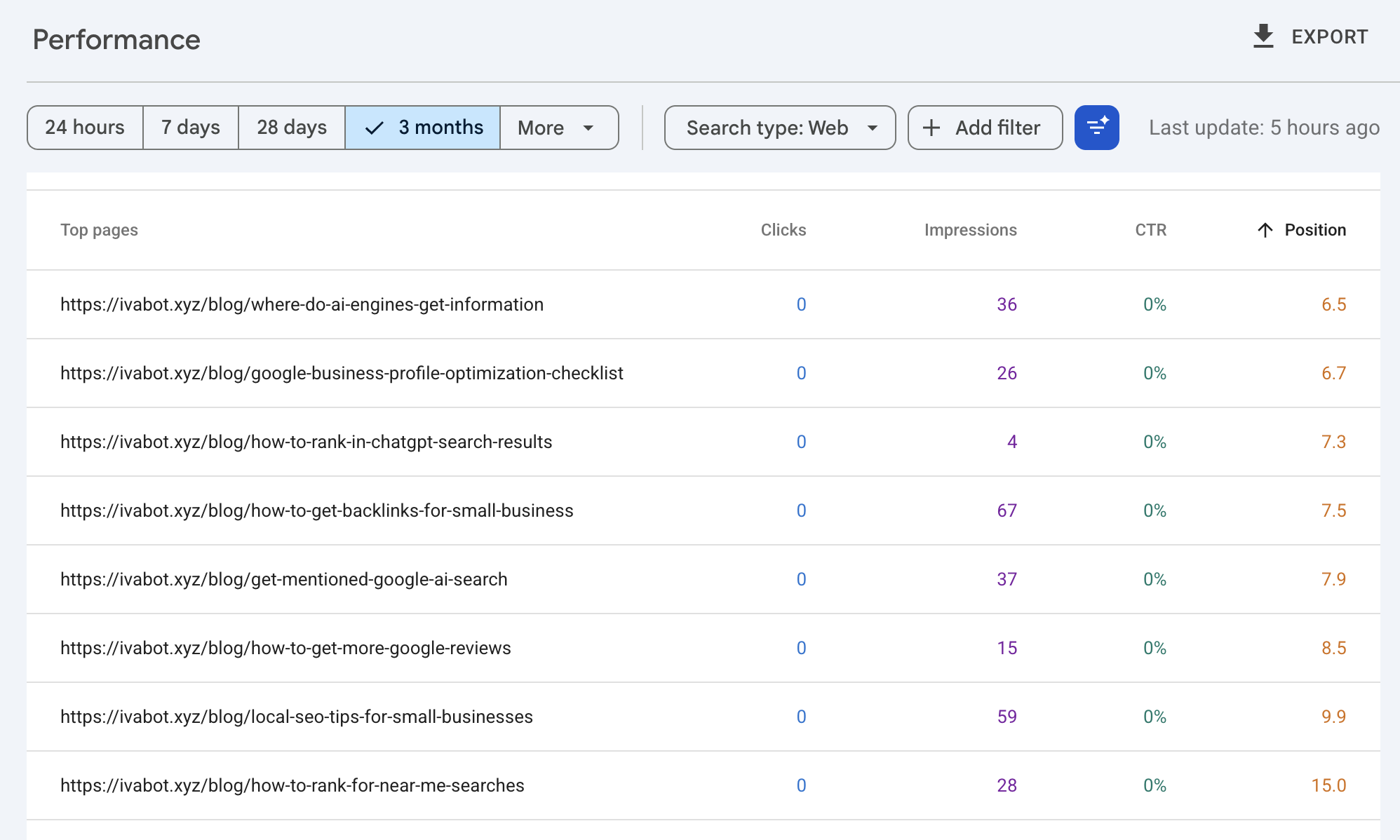
Open Search Console, go to Performance, then the Pages tab, and sort by average position. Look for pages sitting between 7 and 20. Those are pages Google already understands and already considers relevant, held back by authority rather than by relevance. A handful of links to a page at position nine can move it into the top three, and the traffic difference between those two positions is enormous.
The Pages tab in Search Console, sorted by position. This report is the target list. Build the donor search around these specific URLs rather than around the homepage.
A page with no position at all is a different problem. It does not rank because of intent mismatch, thin content, indexing or competition, and links will not fix any of those. If that describes most of your site, start with the guides on impressions without clicks and why a site is not getting traffic before spending a single email on outreach.
Qualify the donor before you write to it
Short answer: check the domain and the page separately, because they answer different questions.
Domain rating tells you about the site as a whole and is worth knowing, because a link from an established domain in your field carries more than one from a domain nobody links to. Page traffic tells you whether anyone will ever see the link, which is what determines whether it does anything beyond existing.
Three free checks that take about a minute each:
Run the domain through the free website authority checker at Ahrefs, which needs no signup, to get the domain rating. It also shows a sample of the site's own backlinks with their anchors, which is enough to see whether the profile looks earned or bought.
Search Google for the exact title of the target page in quotation marks. If it does not come up, or comes up buried, that page is not ranking, and a link on it will be decorative.
Run a site: query on the domain to see roughly how large the site is, and open two or three recent posts to see whether anything on the site reads like it was written for readers.
If the page fails the second check, skip it, even when the domain rating looks good. That single filter removes most of the placements people later describe as having done nothing.
How to find quality backlink opportunities: start with competitor links
Short answer: find the pages that already link to companies like yours.
Take three competitors, pull their referring domains, and sort for pages that mention several companies in your category at once. Roundups, comparison posts, resource pages and industry lists are all pages whose author has already decided that listing options is useful. Being added to one of those is a much smaller ask than persuading someone to write about you from scratch.
Free ways to see this data: Bing Webmaster Tools reports backlinks for sites you have verified, and the free backlink checker at Ahrefs shows a capped sample of referring pages with their anchors for any domain, which is usually enough to spot the pattern. Paid tools add the full index, the history of links gained and lost, and filters worth having once outreach is running weekly.
How to get quality backlinks without buying them
Short answer: give people something worth referencing, then tell the right people it exists.
Every approach above assumes there is something worth linking to. Outreach for a page that says what fifty other pages already say is asking a stranger for a favour.
Original numbers you collected yourself, a calculator, a template someone can use today, or a genuinely complete answer to a narrow question are what make the rest of the work easy. This is the part that cannot be shortcut, and it is why the strongest link builders spend most of their time on the asset rather than on the emails.
What backlink strategies are working for new websites
Short answer: publish first, then grow the pace month by month.
Publish ten to fifteen solid pages before starting outreach. Before that, outreach fails for a simple reason: there is nothing on the site that a stranger would want to send readers to.
Then grow the pace gradually. Five real placements in the first month, ten in the second, twenty in the third is a backlink strategy example that holds up, provided each one came from a conversation with a real site. Placements bought in bulk from a database do not follow this logic at all, because the pace of adding worthless links is not a meaningful number.
Expect the first placements to be slow and the rate to improve as you get better at picking targets and writing the email.
Should you buy backlinks for your SEO strategy?
Short answer: judge the site, not the payment. These six categories are worth nothing whether they are paid or free.
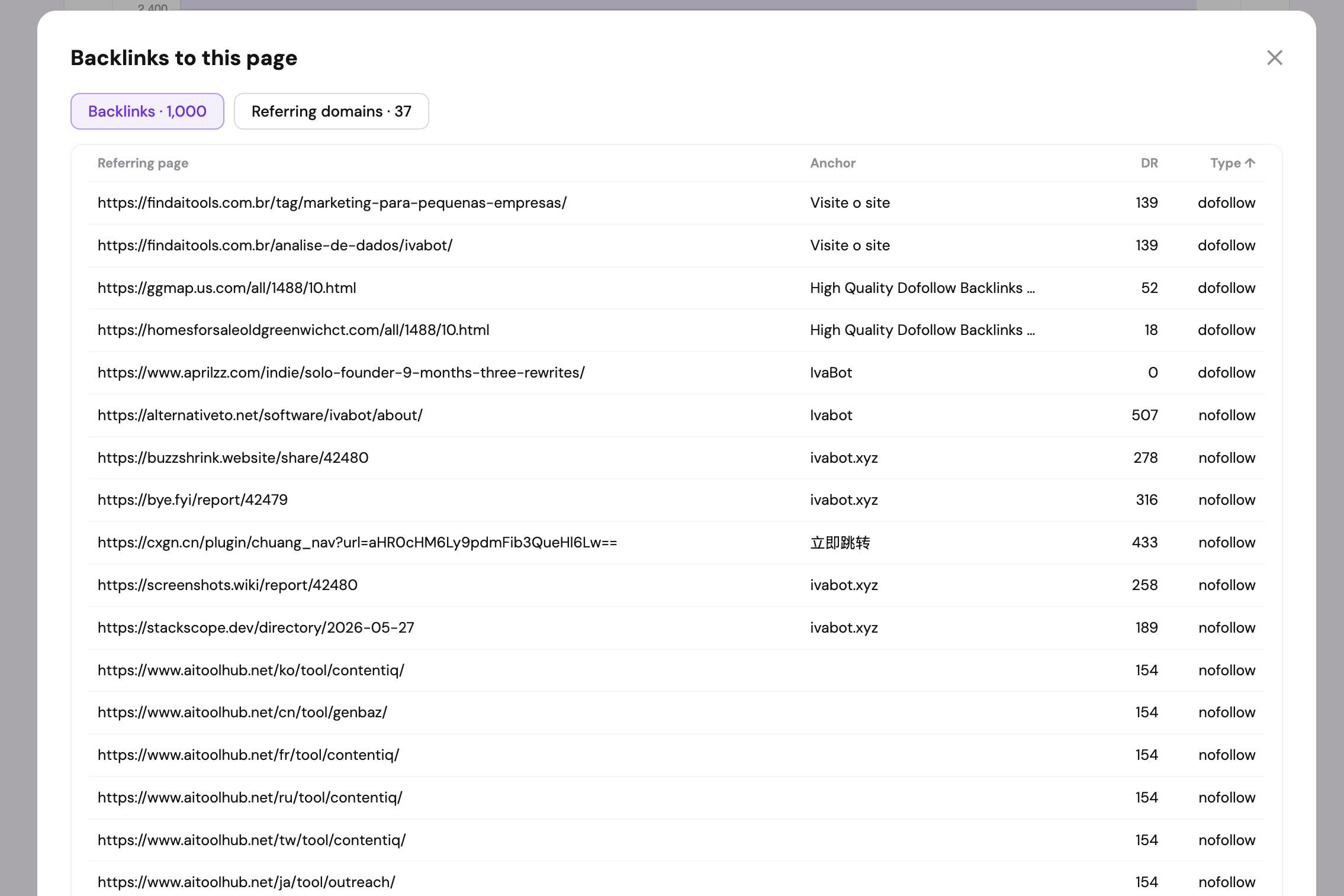
Here is my own backlink profile, and it makes the point better than any explanation.
A thousand backlinks from thirty-seven domains. Seven of those rows are the same directory page in seven languages, and two carry the anchor High Quality Dofollow Backlinks. None of this moved anything.
Count referring domains, not backlinks. One aggregator publishing your listing in seven languages is one endorsement, not seven, and a tool that reports the larger number is measuring duplication.
Six categories to leave alone:
Link farms and private blog networks. Sites that exist to host links, recognisable by having no real audience and publishing on every topic at once.
Bulk packages promising a number of links per month on autopilot. These place you in a shared pool of sites used by everyone else buying the same package, which is a footprint rather than a strategy.
Generic directory submissions. Hundreds of unrelated directories do nothing. Niche and local directories relevant to your field are a different thing and remain worth doing.
Web 2.0 profile links. Profiles on large platforms created purely to hold a link do not transfer authority, whatever the platform's own rating suggests.
Reciprocal link exchanges at scale. A single exchange with a genuine partner is normal. Systematic exchanges, including the three-way version, are visible.
Comment and forum signature links. Posting to place a link produces nothing and damages your standing in the community you were posting in.
Paid placements are not automatically in this list. A paid post on a real site with real readers in your field is a different transaction from a package of a hundred links. The risk sits in the site rather than in the payment, so judge it with the same three checks as any other donor.
Local links
Short answer: they matter in local SEO the same way they matter everywhere, and the local ones are the ones that count.
The argument that links can be skipped for local clients does not match what I see in practice. What changes is which links count.
For a local business the strongest links are local: the chamber of commerce, suppliers and partners in the same town, local news and community blogs, sponsorship of events and clubs, and directories tied to the region. Point them at the relevant service or city page rather than the homepage, for the same reason as above. There is more on the surrounding work in the local SEO guide.
Broken link replacement, honestly
Short answer: it works, and it costs more hours than it returns on a small site.
The method is real: find a dead link on a resource page, suggest your page as the replacement. Finding a broken link that points at something you actually have a substitute for takes a lot of searching, and the reply rate is no better than ordinary outreach.
If you have a large content library and time, it is worth a pass. On a small site with limited hours, the same hours spent on category roundups will produce more.
Brand mentions compound with links
Short answer: being discussed brings links, and the mentions you already have are the easiest links to get.
Ahrefs studied 75,000 brands and found branded web mentions correlating with visibility in AI answers at 0.664, against 0.218 for backlinks. Read it as a direction rather than a law, since correlation is not causation and the sample was brands already established with a domain rating above 40. The direction still points somewhere useful: consistent marketing that makes a brand recognisable is what produces both the mentions and the links.
The practical consequence for link building is that mentions you already have without a link are the shortest path to a new one. Someone who has already written your name has already decided you are worth naming, so asking for the link is a much smaller request than a cold pitch.
Check the links again at 30, 60 and 90 days
Short answer: placements disappear, and a report counting dead links is worse than no report.
Posts get rewritten, links get removed in a redesign, and some are switched to nofollow or the whole page set to noindex after the fact.
Put three dates in the calendar for every batch and check that the link is still on the page, still followed, and that the page is still indexed. A live link that vanished in month two is worse than no link, because you are counting it in a report that no longer reflects anything.
Best practices for backlink building: the eight-week plan
Week
What happens
1
Pull the ranking report, list pages in positions 7 to 20, choose the pages to push
2
Pull competitor referring domains, build a target list of 40 to 60 pages
3
Qualify every target with the three checks, expect to cut the list roughly in half
4
Finish the linkable asset if the chosen motion needs one
5 to 6
Send outreach in batches, one follow-up per contact after seven days
7 to 8
Confirm placements are live, record date, URL, anchor and target page
Later
Re-check every placement at 30, 60 and 90 days, then judge whether the target pages moved
That table is also the backlink strategy template: one motion, one target page set, one list, one review date.
FAQ
Are backlinks still important for SEO in 2026?
Yes, but the version where more links equals better rankings is over. Relevance and whether the linking page actually gets traffic matter more than the count.
How many backlinks does a new website need?
There is no number that transfers between niches. A workable pace is five real placements in the first month, ten in the second and twenty in the third, after the site has ten to fifteen solid pages.
Should I buy backlinks?
Bulk packages and link networks create a problem to clean up later. A paid placement on a real site with real readers in your field is a different transaction, and the risk depends entirely on the site rather than on whether money changed hands.
How do I build backlinks without guest posting?
Roundups and comparison pages that already list competitors, niche directories, partner and customer pages, podcasts, and journalist request platforms all work without writing a guest article.
Do backlinks matter for local SEO?
Yes. Local links from the chamber of commerce, partners, community sites and regional directories are the ones that count, pointed at service or city pages rather than the homepage.
What anchor text should I use?
The distribution across your whole profile matters more than any single choice. Exact-match anchors on every link are the pattern to avoid, and a mix weighted towards brand and natural phrasing is what occurs on its own.
Is it better to have more backlinks or more referring domains?
Referring domains. One site linking to you fifty times is closer to one endorsement than to fifty, which is why a large backlink count next to a small domain count usually means duplication rather than authority.
Open Search Console, sort your pages by average position, and write down every page between 7 and 20. That list is where the next eight weeks of link building should point. It takes about ten minutes and it changes what you go looking for.
IvaBot tracks keyword positions and referring domains in the same place, so the target list and the donor list sit side by side. Three free credits, no card. Check your site.
 8 min read