This is the article I wish I had read when I started in SEO. A practical breakdown built on real experience, with the steps that actually move rankings for a small business website, and the ones you can safely ignore.
If you run a small business or work as a small business owner, a bakery, a salon, a freelance practice, a small online store, you've probably been told that SEO is either too expensive, too slow, too technical for you, or that SEO is dead and not worth doing anymore. None of that is true. SEO for small business is a set of habits that make your website easier to find. The catch is that nobody tells you which habits actually matter for small business owners, and which ones exist to sell agency hours.
This guide covers what works, what doesn't, what costs money, and what's free. By the end, you'll know exactly what to do this month, this quarter, and what to ignore entirely.
TL;DR (Quick Summary)
- SEO for small business works, but results take 3 to 6 months minimum. The more competition in your niche, the longer it takes and the more work it requires. The only exception is when you've created something truly new that nobody else is offering.
- 70% of what you need is free. Google Search Console, a clear sitemap, well-written titles, and pages that answer specific questions cost nothing and outperform most paid services. The other 30% is paid work: keyword research tools, competitor analysis, paid ads to test demand, audit tools that find issues you'd otherwise miss. Most people skip this part, and it shows.
- Indexing and content quality come first. Make sure Google can read your pages, your site loads fast, works on mobile, and doesn't hide content behind popups or aggressive ads. Once that's solid, the real winner is content: if you write about something people search for, and you cover it better than anyone else, you'll rank.
- Specificity beats volume. One page that answers a real, narrow question outperforms ten generic pages on a broad topic. Pick the exact phrasing your customer would type, and answer it fully.
- SEO drives sustainable business growth. Don't hire an agency for too little. SEO agency pricing varies a lot by country, anywhere from a few hundred to several thousand dollars per month. The bottom of the market is filled with templated reports nobody reads. If your budget is limited, DIY or hire a freelancer for specific tasks instead.
"70% of what you need is free"
What Is Your Small Business Website Actually For?
Short answer: before optimizing your site for SEO, decide what role it plays in your business. There are four scenarios, and the right SEO strategy depends entirely on which one applies to you.
Most small business owners skip this step, and end up optimizing the wrong thing.
The four common scenarios:
- The site is your main sales channel. Customers find you through Google, browse, and buy or book. SEO matters most here. You need a fast, clear, well-structured site with pages that target specific search queries.
- The site supports social media sales. You sell mostly through Instagram, TikTok, or Facebook, and the site exists to back you up: people check it before they buy to see if you're real. Here, SEO is secondary. Focus on trust signals: clear About page, real photos, contact info visible everywhere, customer reviews. A few well-optimized pages are enough.
- The site is for upsell and customer retention. Existing customers come back to read updates, book follow-up services, or order more. SEO matters less than user experience. Make sure repeat visits are smooth.
- The site is for trust and credibility only. You sell offline (physical store, network, referrals), and the website exists so people who Google your name find a professional presence. Minimal SEO is enough: clean homepage, business info, a contact page.
Be honest with yourself about which one applies. Building serious SEO for a site that's just a trust anchor wastes time. Skipping SEO on a site that's your main sales channel costs you money every month.
Is SEO Worth It for Small Business in 2026?
Short answer: yes, SEO works in almost every case in 2026. The real question is how much effort it takes, and whether it's the fastest channel for your specific situation.
Quick testOpen Google, type what your customer would type to find a business like yours. Look at who is ranking. The shape of the SERP (Search Engine Results Page, the list of results Google shows after a search) tells you everything you need to know about the road ahead.
There are three realistic scenarios:
Fast return when:
- You serve a local market, where Google Maps and local search send free, high-intent traffic (see our local SEO guide for the full setup)
- Your customers search by specific need ("vegan birthday cake", "wedding photographer Sector 3")
- You sell a product or service with a long decision cycle (custom furniture, accounting services, B2B software)
- Your competitors are weak in SEO: thin content, no blogs, broken sites, there's an open lane
- You have a unique angle, niche product, or specific expertise that broader competitors can't easily copy
- You can produce content yourself or with a small team, even one article a month adds up over a year
- You sell to people who research before buying: any service over $200, anything custom, anything in B2B
Long-term play when:
- The market is large but the competition is strong (mainstream e-commerce, popular service categories)
- Your product is fairly standard, and you need to differentiate through content angle, not just keywords
- Marketplaces dominate the top results, but specific long-tail queries are still open: phrases like "leather laptop sleeve handmade Bucharest" or "pottery class beginners Sector 1"
- You're entering a niche where established sites have built years of authority, and you need to outwork them on freshness, depth, or angle
In these cases, SEO is still the right investment, but expect 6 to 12 months before meaningful traffic, and accept that you'll need to publish consistently and target narrower queries first. For finding those narrower queries on a new site, see our guide on how to choose keywords for a new website.
Hard channel when:
- You're building the next Taobao, Amazon, or other large marketplace, where SEO is one of ten channels and rarely the main one
- Your business is brand new and you need customers this month, because SEO won't deliver that fast
- Your product is very generic with no unique angle, and bigger players will outspend you on every keyword
- You sell mostly through Instagram, TikTok, or word of mouth, and the website exists only to confirm you're real
In these cases, SEO is still worth doing in parallel as a long-term asset. But it shouldn't be your main marketing focus right now. Paid ads, social media, partnerships, or marketplace platforms will move the needle faster.
For most small businesses with a real local or niche audience, SEO is the highest-return marketing channel for business growth over a 12-month horizon. It's slower than ads, but the traffic is free, compounds over time, doesn't disappear when you stop paying, and is highly targeted: people who land on your page through Google were actively searching for what you offer, which means they often complete the action you wanted: buy, book, fill out a form, call. Your goal is achieved.
How Much Does SEO Cost for Small Business?
Short answer: anywhere from $0 to several thousand dollars per month, depending on what you do yourself and what you outsource. Most small businesses do best with DIY for the first 6 months.
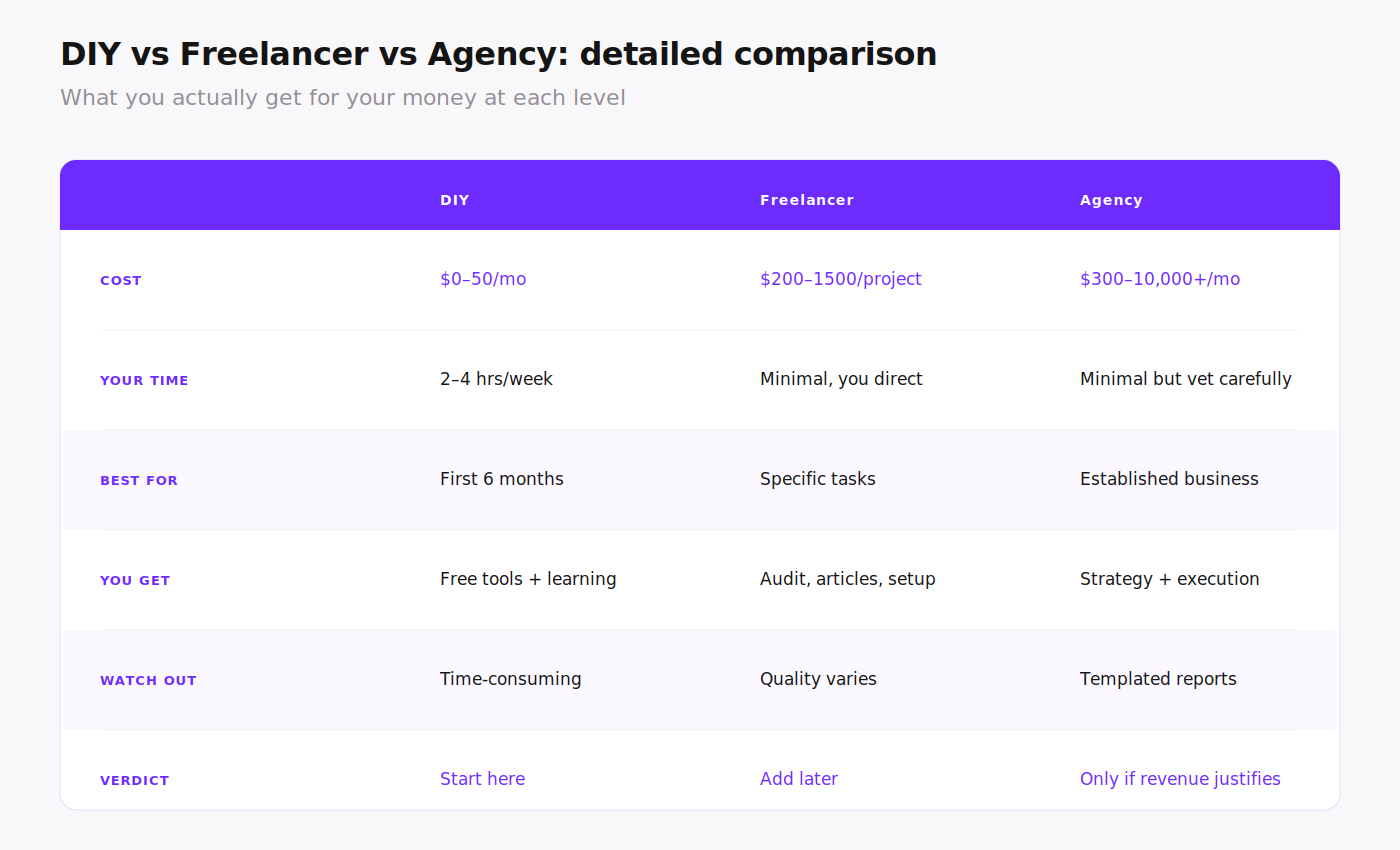
Here's the breakdown of what each approach actually costs and what you get:
DIY SEO: $0 to $50 per month
If you have a few hours a week and the willingness to learn, you can do most of small business SEO yourself, DIY style. This is what 90% of small businesses should start with, regardless of budget. To put it bluntly: is SEO worth paying for at the start? Usually not, until you've maxed out what's free.
What you need:
- Google Search Console (free): shows how Google sees your site, which pages are indexed, what queries bring traffic.
- Google Analytics (free): shows what visitors do once they land on your site.
- A keyword tool ($0 to $30/month): even free tiers of tools like Google Keyword Planner or AnswerThePublic give you enough to start.
- An audit tool ($0 to $20/month): checks pages for missing titles, slow loading, and other technical issues. Most tools offer free audits for one or two pages. IvaBot runs a free audit and explains what to fix in plain language.
- Time: realistically 2 to 4 hours per week for the first 3 months.
Freelancer for specific tasks: $200 to $1500 per project
When you don't want to do everything yourself, a good freelancer is usually a better deal than an agency. The difference: agencies sell ongoing retainers, freelancers solve specific problems and leave.
Useful freelancer tasks:
- One-time technical SEO audit ($200 to $500)
- Setting up Google Search Console + Analytics + sitemap correctly ($100 to $300)
- Writing a batch of optimized articles ($100 to $300 per article)
- Local SEO setup, including Google Business Profile ($150 to $400)
- One-off keyword research project ($200 to $500)
Find freelancers on Upwork, LinkedIn, or through SEO communities. Always ask for examples of small business projects, not enterprise case studies.
SEO agency: a few hundred to several thousand dollars per month
Agencies charge wildly different prices depending on country, region, and what you're getting. A basic monthly retainer in Eastern Europe might start around $300 to $500. In the US or UK, the same scope often starts at $1500 to $3000. Larger agencies with full content production can run $5000 to $10000+ per month.
The honest take: most small businesses don't need an agency. Below a certain price point, you're paying for templated reports, generic recommendations, and account managers nobody asked for. Above that price point, agencies make sense for businesses that have real revenue to protect and no in-house capacity at all.
If you do go with an agency, ask three questions:
- What does the deliverable look like in month one? Vague answers mean vague work.
- Will I get the actual person doing the work, or an account manager? You want the former.
- Can I see real examples from small businesses, not enterprise clients? Many agencies pivot down-market and treat small business as practice.
The full comparison side by side
What to spend money on first
If your budget is limited and you're not sure where to start, this is the order:
- A one-time technical audit so you know what's actually broken.
- Keyword research so you write about the right things.
- Content production, the only thing that compounds long-term.
- Tools, only after you know what you need.
Spending money on agencies, link-building services, or "SEO packages" before you've nailed the first three is the most common way small businesses waste their SEO budget.
"Most small businesses don't need an agency. They need consistency."
The Plan: What to Actually Do for Small Business SEO
Short answer: focus on a few high-impact actions in the first month, then add depth over time. The plan below is built for founders who run their own bakery, salon, or service business and don't have 40 hours a week for SEO.
Below is the order that works for almost any small business or small team: bakery, salon, e-commerce store, freelance practice, small agency, NGO, B2B service company. It's organized by priority, not by chronology. Do the green section first. The yellow section can wait until next month. The red section is what you tackle once the basics are working.
A note on backlinks before we start. A backlink is a link from another website to yours, and they do influence rankings. But for small business they shouldn't be your starting point. Good sites get backlinks naturally as people share useful content. Focus on the steps below first, and links will follow. When you are ready to think about links seriously, see our guide on how to get backlinks for small business with free and paid methods.
Must Do: The Foundation (2 to 4 hours, week 1)
Without these, nothing else works. Block out one afternoon and finish them all.
01
Make sure Google can see your site (10 to 30 minutes)
- Open Google. Type
site:yourdomain.com. If you see your pages listed, you're indexed. If not, Google doesn't see your site. - Set up Google Search Console (free Google tool that shows how your site performs in search) at search.google.com/search-console. Verify ownership.
- Submit your sitemap. Most platforms generate it automatically at yourdomain.com/sitemap.xml.
02
Set up Google Business Profile if you serve local customers (30 minutes)
For local business (bakery, salon, restaurant, dentist, contractor), this is the single highest-return SEO action. Google Business Profile is a free Google service that shows your business in Google Maps and local search results, and it's the foundation of local SEO. It brings traffic almost immediately.
- Go to google.com/business. Claim or create your profile.
- Fill every field: name, address, phone, hours, category, photos.
- Add 10 to 20 real photos: storefront, products, team, finished work.
- Make sure your business name, address, and phone match exactly across your website, social media, and any directory.
For a deeper dive on local SEO setup, reviews strategy, and ranking in Google Maps, see our Local SEO for Small Business guide.
Skip this if your business is fully online with no local component.
03
Write a clear title and meta description for your homepage (15 minutes)
- Title under 60 characters. Format:
What you do + Where + Brand. Example: Custom Wedding Cakes in Bucharest | Maria's Bakery. - Meta description under 155 characters. Tell visitors what they'll find and why to click.
- No "Home" or "Welcome to our website". Be specific.
04
Make one thing obvious on your homepage (15 minutes)
- Decide what the most important action is: book, order, call, view menu.
- Add one clear button above the fold (visible without scrolling).
- Add your contact info to the header or footer so it's visible on every page.
That's it for week one. If you do nothing else, this alone puts you ahead of most small business sites.
Should Do: The Real Work (2 to 4 hours per week, month 1)
This is where SEO starts producing real traffic. Pace yourself: one item per week is enough.
05
Find what your customers actually search
This is where most small businesses fail. They write about what they want to say, not what customers search for. Get this right and the rest of SEO becomes easier.
If you've never done keyword research before, start with the free method below. It's enough to get 80% of the way there without paying for any tool.
The free way (no tools, no signup):
- Make a list of every question customers ask you in person, by email, or by phone. Each question is a potential page.
- Open Google in an incognito window (so your search history doesn't bias results). Type a phrase about your business slowly. Watch the autocomplete suggestions: those are real searches, ranked by what people actually type.
- Scroll to the bottom of the SERP. Read "People also ask" and "Related searches".
- Try variations: add "near me", a city name, "best", "how to", "vs". Each variation reveals a different pattern.
- Pick 5 to 10 phrases that match what you offer. These are your starting keywords.
Optional: Free keyword tools
Optional: Paid keyword toolsFor competitor analysis, accurate volumes, and difficulty scores. Approximate starting prices, May 2026:
- Semrush: from $140/month. Industry standard, the most data.
- Ahrefs: from $129/month. Best for competitor and backlink analysis.
- IvaBot Content Coverage: pay-as-you-go from $5. No subscription, runs SERP gap detection in one go.
06
Update titles and headings on your top 5 pages
- Identify your most important pages: homepage, top services, top products, contact.
- For each: write a unique title with your main keyword at the start.
- Use one H1 per page (the main heading).
- Break long content with H2 subheadings every 200 to 400 words.
07
Add trust signals
For small business, trust is half the conversion. It's also what Google looks at: real photos, real reviews, real people.
- Replace stock photos with real ones: your work, your space, your team.
- Ask 3 to 5 happy customers for Google reviews (linked to your Google Business Profile).
- Reply to every review, positive or negative.
- Update your About page with a real story: who you are, why you started, who's on the team.
- Make sure phone, email, and hours are visible everywhere.
08
Make your site fast and mobile-friendly
- Test at pagespeed.web.dev. Aim for 50+ on mobile.
- Compress all images with TinyPNG before uploading. Hero image should be under 200KB.
- Open your site on your own phone. Can you read it without zooming? Tap buttons easily? Find the contact info?
- Remove popups blocking content, autoplay videos with sound, sticky banners covering half the screen.
Nice to Do: Once the Basics Work (month 2 and beyond)
You don't need these to rank. They make you rank better, faster, and longer.
09
Publish content that answers real questions
One article every two weeks is enough. Start with the questions you collected in step 5. Each article = one question, answered fully.
- Write a clear title with the keyword.
- Answer the main question in the first paragraph (don't bury it).
- Use H2/H3 to break content. Add real photos or simple diagrams.
- Link to related pages on your site (your contact page, your service page).
- Where it adds value, link out to a useful external source.
10
Show your expertise (E-E-A-T)
Google uses E-E-A-T to decide who to recommend: Experience, Expertise, Authoritativeness, Trustworthiness. Show it.
- Add author info to every article: name, photo, one-sentence bio.
- Add short videos where they fit: a 30-second product demo, a behind-the-scenes shot, a tutorial.
- Open comments on blog posts. Real conversations under content show your site is alive.
11
Track what's working
- Set up Google Analytics 4 (analytics.google.com). It's free.
- Once a week, open Google Search Console. Check the "Performance" report. Note which queries bring traffic.
- Once a month, identify your weakest page: high traffic but low conversions, or high impressions but low clicks. Fix one thing on it.
- Don't change everything at once. One change per week is plenty.
Priorities by Business Type
Not every small business should spend energy the same way. Here's the rough split:
Detailed notes per business type:
Bakery, café, restaurant, local food business. Photos and reviews matter more than blog content. Google Business Profile is your number one. Instagram supports GBP (Google now reads social signals). Skip long articles for the first 6 months. Once you're ranking locally, then start a small recipe or tips blog.
Salon, beauty service, fitness studio. Before-and-after photos, short video tutorials, real client testimonials. Local SEO plus Instagram is your stack. Blog content stays a low priority. Reviews are critical: ask for them after every visit.
Freelancer (designer, writer, consultant, photographer). Portfolio plus case studies beat blog content. Pick 3 specific keywords (your niche, service, city if applicable). Your About page and author bio matter a lot. A focused homepage that says exactly what you do beats a generic services page.
Small online store (e-commerce). Product page SEO is more important than blog. Each product page is a landing page: unique title, real photos, full description, reviews on the product. Blog content can support category pages later, but products come first.
Small B2B service company (law firm, accounting, consulting, agency). Content is your strongest weapon. Clients research deeply before choosing. Blog posts answering specific client questions outrank glossy company websites. Focus on demonstrating expertise: case studies, in-depth guides, technical articles.
Common SEO Mistakes
Short answer: most SEO failures aren't about doing the wrong thing. They're about doing nothing, or doing too much without focus. The list below covers the most common mistakes that hurt small business websites.
The page has no clear purpose. A homepage opens and within 5 seconds it's not clear what the business does. The fix: decide one main goal per page. Stop trying to say everything on every page.
The title says nothing useful. Titles like "Home" or "Welcome" tell Google and visitors nothing. The opposite extreme is keyword stuffing. The fix: every title is specific, contains a keyword, and reads naturally. Format: Specific thing + Location or Modifier + Brand.
Clickbait that doesn't deliver. Title says "10 best secrets to ranking #1", page has 3 generic tips, visitors bounce. The fix: match the title to the content exactly. Trust beats clicks.
The site is just one big text wall. Long paragraphs, no headings, no images, no breaks. The fix: break content with H2 every 200 to 400 words. Add real photos. Use bullet lists.
Copy-paste content from another site. Google detects duplicate content and devalues both pages. The fix: link to other articles if worth referencing. Write fresh versions with original angle.
The site is broken on mobile. Most small business traffic comes from phones, yet many sites are designed only on desktop. The fix: open the site on a phone after every change. If text needs zooming, fix it.
Copy-paste content from another site. Google detects duplicate content and devalues both pages. The fix: link to other articles if worth referencing. Write fresh versions with original angle.
No real photos or trust signals. Stock images, generic team avatars, no reviews. The site feels fake. The fix: real photos of work, team, owner. Three real reviews beat ten fake ones.
No analytics, no idea what's working. Content gets published but there's no data on what brings traffic. The fix: install Google Analytics 4 and Search Console. Check both at least once a month.
FAQ: SEO for Small Business
Why am I not showing on Google?
The most common reasons: your site isn't indexed (check by typing site:yourdomain.com into Google), your robots.txt accidentally blocks crawlers, your domain is too new (Google needs 1 to 4 weeks to discover and index a fresh site), or your pages have technical issues like noindex tags or broken redirects. Set up Google Search Console first: it tells you exactly why specific pages aren't appearing in search.
Is SEO worth it in 2026?
Yes. SEO is evolving, not dead. The shape of search is changing: AI Overviews, ChatGPT, Perplexity, and Google's AI summaries now sit between users and traditional results. But every one of those AI tools still needs sources, and most of those sources are SEO-optimized websites. The core game (have a clear, useful page about a specific topic) is the same. The new layer is making your content readable by AI as well as Google.
Can I do SEO myself?
Yes, especially for small business. The basics covered in this guide get you 70 to 80% of the way to competitive performance, and they require time more than expertise. The 20% that requires deeper specialist knowledge (advanced technical SEO, large-scale link building, competitive enterprise SEO) is rarely the bottleneck for small business.
What is the 80/20 rule for SEO?
The 80/20 rule means that 20% of your SEO actions produce 80% of the results. For small business, the high-value 20% is: getting indexed properly, writing clear titles, claiming Google Business Profile, having real photos and reviews, and writing a few pages that answer the questions your customers actually ask. Everything else is the long tail of optimization.
How long does SEO take to work?
Typically 3 to 6 months before meaningful traffic, longer if your niche is competitive. The first month is mostly about Google discovering and indexing your changes. Months two and three start showing impressions in Search Console. Months four through six start showing actual clicks and conversions. Anyone promising results in 30 days is selling something.
How much does SEO cost for a small business?
Anywhere from $0 to several thousand dollars per month, depending on whether you do it yourself, hire a freelancer for specific tasks, or work with an agency. Most small businesses do best with DIY for the first 6 months, then add freelance support for specific tasks like content production or technical audits. Agency retainers usually make sense only above a certain revenue threshold.
Do I need to know HTML to do SEO?
No. Modern website platforms (Webflow, WordPress, Shopify, Wix, Squarespace) handle the HTML for you. You'll need to learn how to edit titles, meta descriptions, and headings inside your platform's editor, but that's interface work, not coding.
Can I do SEO if my website is on Wix, Squarespace, or Shopify?
Yes. All major platforms support proper SEO: editable titles, meta descriptions, headings, sitemaps, mobile-friendly templates. The platform isn't your bottleneck. Your content and structure are.
How do I get my site cited by ChatGPT, Perplexity, or AI search?
This is increasingly important and we cover it in depth in our guide on generative engine optimization. Short version: AI tools cite sources that are clear, well-structured, and authoritative. Use proper headings, write clear answers to specific questions, add structured data (schema.org markup), and build trust signals (real author info, reviews, About page). Most of the SEO work in this guide also helps AI citation.
Should I hire an SEO agency or do it myself?
Do it yourself for the first 6 months. The basics in this guide produce most of the value, and going through the process teaches you what's actually happening. After 6 months, if you have budget and want to scale faster, consider a freelancer for specific tasks (content production, technical audit) before considering an agency retainer. Most small business agency contracts under $1500/month are not worth it.
What's the difference between SEO and AI SEO (or GEO)?
SEO is optimization for traditional search engines (Google, Bing). GEO (Generative Engine Optimization) or AI SEO is optimization for AI-powered search like ChatGPT, Perplexity, and Google's AI Overview. The work overlaps significantly: clear structure, accurate content, and trust signals help both. The main difference is that AI search prefers content that directly answers questions in natural language, with explicit definitions and clear formatting. We'll cover this in detail in a future article.
What's Next
If you've read this far, you have everything you need to start. The plan isn't complicated. The hard part is consistency: doing one thing per week for three months, instead of trying to do everything in one weekend.
Start with the green section. Make sure Google can see your site. Claim your Google Business Profile if you serve local customers. Write one good homepage title. That's a single afternoon of work, and it's already more SEO than most of your competitors have done.
Once that's running, move to the yellow section: keyword research, real photos, mobile checks, trust signals. Pace yourself: one task per week is enough.
Then the rest is content. Write about the questions your customers actually ask, one article every two weeks, for six months. By month seven, you'll have a small library of pages that work for you while you sleep. That's what compounding traffic looks like.
A note on AI search: SEO and AI optimization are starting to merge. The next article in this series will cover what's changing, what's new, and how to make your content easy for both Google and AI tools to cite. Subscribe or come back to read it when it's live.
This article was written using IvaBot Content Builder for the structure and brief, then rewritten and edited by the author based on real SEO experience. The IvaBot suite (Core Audit, Content Coverage, Content Builder) is built for small businesses and content creators who want SEO insights without agency pricing. Try it free at ivabot.xyz.
 25 min read
.jpg)