On May 16, 2026, Google Search Central published the first official guide on optimizing for generative AI search, covering AI Overviews and AI Mode. It is the most direct statement Google has made on this topic so far, and it tackles many of the myths that have spread across the SEO and GEO industry over the last year.
The short version: from Google's perspective, optimizing for generative AI search is still SEO. The acronyms AEO and GEO describe the same work. Several things being sold as 'AI optimization' tactics do not actually influence Google's AI systems, and the guide names them directly.
TL;DR (Quick Summary)
- Google officially says GEO and AEO are still SEO. AI Overviews and AI Mode are built on top of Google's core Search ranking systems, using techniques like retrieval-augmented generation (RAG) and query fan-out.
- Several popular GEO tactics do not influence Google's AI. Google explicitly names llms.txt, content 'chunking' for AI, rewriting content specifically for AI systems, chasing inauthentic mentions, and overdoing structured data.
- What still matters is foundational SEO done well. Unique non-commodity content, clear technical structure, good page experience, E-E-A-T, real brand mentions, real backlinks.
- AI agents are a new category to consider. Browser-based AI agents will visit your site to complete tasks. Google links to a separate guide on making sites agent-friendly.
- There are two sides to AI visibility, not one. Google's guide covers what AI fetches in real time, where classic SEO works. What AI already knows about your brand from its training data is a separate game with different timelines.
- This is Google's position only. Bing, ChatGPT, and Perplexity have not published equivalent guidance, so their crawlers may still respect signals like llms.txt and behave differently.
- The actionable takeaway: stop spending time on AI-only tactics that Google says it ignores, and put that time into the boring foundational work that compounds across both regular search and AI search.
'From Google Search's perspective, optimizing for generative AI search is optimizing for the search experience, and thus still SEO.' Google Search Central, May 2026
What Google officially said
Short answer: AI Overviews and AI Mode are not a separate system. They are built on top of Google's existing Search ranking, with two AI techniques layered on top: RAG to retrieve relevant pages, and query fan-out to expand a single user question into many related searches.
The guide opens with the question most SEO professionals have been asking for two years: is SEO still relevant when AI writes the answers? Google's answer is direct. AI features on Google Search are rooted in the same core Search ranking and quality systems that have always existed. The AI layer sits on top, and it relies on two techniques worth knowing:
- Retrieval-augmented generation (RAG), also called grounding. The AI model does not invent the answer from training data alone. It pulls fresh, relevant pages from Google's Search index, reads them, and generates a response based on those retrieved pages. This is why ranking in regular Google Search still matters: if your page does not rank, RAG cannot retrieve it.
- Query fan-out. Instead of just answering the literal user query, the AI model generates a set of related queries automatically. Google's example: a user types 'how to fix a lawn that's full of weeds.' The model fans this out into 'best herbicides for lawns,' 'remove weeds without chemicals,' and 'how to prevent weeds in lawn.' Each of those sub-queries pulls in additional results that feed the final answer.
The practical implication: AI Overviews show prominent clickable links to the pages that support the answer. If your content is the source, you appear as a citation. If your page does not rank for the original query or any of the fan-out queries, the AI has no path to find you. This is why long-tail keyword research matters even more in AI search than in classic search — each long-tail variation is potentially a fan-out query.
Google also addresses the terminology debate directly. AEO ('answer engine optimization') and GEO ('generative engine optimization') are terms the industry uses for work focused on AI search visibility. Google's framing is that this work is still SEO, because optimizing for the search experience covers both classic results and AI-generated answers. The label matters less than the underlying practice.
Source: Google Search Central, May 2026.
What Google says is not worth your time
Short answer: Google explicitly names five things that do not influence its AI search systems. If you have been investing time in these specifically for Google AI visibility, you can redirect that time.
This is the most useful part of the guide for anyone running a small content operation with limited hours. Google's mythbusting section pushes back on five practices that have been sold as 'AI optimization' by various tools and consultants. Each one is named directly.
01
llms.txt and other 'special' markup
The llms.txt file is a proposed format meant to tell AI systems which pages of your site to crawl and prioritize. It became popular in 2025 as a recommendation in many GEO checklists. Google now states clearly that its AI systems do not use llms.txt. Adding one is not harmful, but it does not influence Google AI Overviews or AI Mode.
Same logic applies to other AI-specific markup or meta tags that have circulated as 'must do' tactics. If they are not part of Google's documented Search systems, Google's AI does not read them.
02
'Chunking' content specifically for AI
'Chunking' refers to artificially breaking content into short standalone passages, often under 200 words, on the assumption that AI engines extract content in chunks. Google says rewriting your pages around this idea is unnecessary. Their systems are already capable of identifying relevant passages within longer, well-structured content.
What matters is clear structure: descriptive headings, focused sections, and direct answers near the start of each section. You do not need to chop articles into bite-sized blocks for the AI to find what it needs.
03
Rewriting content just for AI systems
Some advice circulating in the GEO space recommends rewriting existing articles in a stiffer, more 'extractable' tone, with bullet points instead of paragraphs and every sentence designed to be quoted. Google's position: write for humans first. Their AI systems are trained on human-written content and prefer content that reads naturally. Mechanical rewrites tend to lose the qualities that make a page useful in the first place.
04
Seeking inauthentic mentions
Buying or arranging brand mentions on third-party sites for the specific purpose of being picked up by AI is named as a tactic to avoid. AI engines, like Google's regular ranking systems, get better over time at detecting coordinated inauthentic activity. Real mentions from real publications and communities continue to matter. Fake ones risk being filtered out or, worse, harming the trust signals attached to your brand.
05
Overfocusing on structured data
This one needs nuance. Google is not saying structured data is bad. Article schema, FAQ schema, BreadcrumbList, and HowTo schema remain useful for rich results in regular Search. What they are pushing back on is the idea that piling on every possible schema type, in the hope that AI will read it, somehow improves AI citation rates. It does not. Reasonable structured data is fine. Schema overkill is not a shortcut to AI visibility.
What this means for content you already published If your existing pages have llms.txt, FAQ schema, and standard structured data, none of that needs to be removed. The guide is about where you spend new time, not about cleaning up old work. The point is to stop adding more of this stuff in the hope that it helps with AI search. It does not, at least not for Google.
From the Apply foundational SEO best practices section of the official guide.
What still works (and matters more now)
Short answer: foundational SEO. Useful content with clear authorship, good technical structure, fast page experience, and real signals of trust. The same fundamentals that worked for Google Search before AI also drive AI search visibility now.
The guide spends most of its length on what Google calls 'foundational SEO best practices applied to generative AI search.' There are no surprises here, which is itself the point: the work that pays off has not changed.
Create valuable, non-commodity content
Content that other people find unique, compelling, and useful is the single biggest factor in long-term AI visibility. Google's specific guidance: provide a unique point of view, write people-first content that is helpful and reliable, organize it in a way that helps the reader, add high-quality images and video, focus on what users want, and avoid overdoing it.
The phrase 'non-commodity content' is worth pausing on. If your article on a topic could be swapped for any other article on the same topic without anyone noticing, AI engines have no reason to prefer your version. Specific examples, real numbers, original observations, and a distinct voice are what separate a quotable source from a generic one.
Google also notes that AI-assisted content creation is fine, as long as the result meets the standards of their Search Essentials and spam policies. The line is not 'human-written good, AI-written bad.' It is whether the final content is useful, accurate, and original in some meaningful way.
Build a clear technical structure
The technical side has not changed either. Meet the Search technical requirements, follow crawling best practices, focus on readable HTML over perfect HTML, follow JavaScript SEO best practices if your site relies on JavaScript, deliver a good page experience, and reduce duplicate content.
If your content is rendered by JavaScript and the raw HTML is mostly empty, AI crawlers and traditional crawlers alike will struggle. If your site is slow or breaks on mobile, AI Overviews are less likely to surface it. Boring technical fundamentals quietly compound.
Earn real trust signals
The implicit message throughout the guide is that AI search amplifies the same trust signals Google has always cared about: experience, expertise, authoritativeness, and trustworthiness (E-E-A-T). Real authors with real credentials. Real backlinks from sites with real readers. Real brand mentions across publications that real humans use. These are slow to build and harder to fake.
This connects directly to backlink work. The fastest path to AI citation for a new site is still the slow path: build a backlink profile through honest outreach, niche directories, and a few link-worthy assets. The full process is covered in our guide on how to get backlinks for small business.
AI agents: the new thing on the list
Short answer: browser-based AI agents are starting to visit websites on behalf of users to complete tasks. Google has published a separate guide on making sites agent-friendly. This is the one new area that needs attention beyond classic SEO.
The guide introduces a category that did not exist in earlier Google documentation: AI agents. These are autonomous systems that perform tasks on behalf of users, such as booking a reservation, comparing product specifications, or filling out a form. Examples include browser agents from Anthropic, OpenAI, and others that can access sites the way a human visitor would.
What agents look at when they visit a site:
- Visual rendering. They analyze screenshots of the page, much like a human would.
- DOM structure. They inspect the underlying HTML to identify forms, buttons, and content blocks.
- Accessibility tree. They read the same structure that screen readers use, which means accessibility work pays off here too.
Google links to a separate web.dev article on agent-friendly website best practices. The practical implication for small business: if you want AI agents to be able to use your site (book appointments, comparison-shop your products, fill out forms), make sure the site renders cleanly, has clear interactive elements, and works well with accessibility tools. Most of this overlaps with good UX and accessibility hygiene that already benefits human visitors.
This is the part of the guide most likely to grow in importance over the next year. AI agents are an early category in May 2026, but the trajectory is clear.
What AI fetches vs what AI knows
Short answer: Google's guide only covers half of how AI search works. There are two distinct sides to it, what AI fetches in real time when answering a question, and what AI already knows about your brand from its training data. The strategies for each are completely different.
The mythbusting section of Google's guide makes a lot more sense once you separate AI visibility into these two sides. The guide is specific about which one it covers, but does not explicitly name the other. Knowing the difference clarifies why some 'AI optimization' tactics fail and others compound slowly over years.
| Side | What happens | What works | Timeline |
|---|
| What AI fetches | AI engines like ChatGPT, Perplexity, and Google AI Overviews search Google and Bing in real time when answering a question, then cite the pages they retrieve. This is RAG and query fan-out. | Classic SEO: rank for the original query and the fan-out queries, clean technical structure, schema markup, indexable content, real backlinks. | 1 to 6 months. Direct and reachable for a new site. |
| What AI knows | AI models already 'know' your brand from the data they were trained on before any search happens. Wikipedia entries, mentions in large publications, Wikidata records, authoritative industry sources all feed this side. | Brand mentions in authoritative sources, Wikidata entry for your business, consistent positioning across the web, presence on trusted industry sites. | 2 to 3 years. Compounds slowly through trust signals. |
Google's guide covers only what AI fetches in real time, because AI Overviews and AI Mode are Google's own search products. What AI already knows is a separate game. Model retraining cycles happen on quarter-to-year timelines, not crawl frequencies, and they pull from datasets like Common Crawl, Wikipedia, and large publication archives that Google does not control directly.
This split also explains why some of the tactics Google calls out as ineffective (llms.txt, AI-specific chunking, schema overkill) were never going to work: they target real-time retrieval with signals AI does not read, and they have no influence at all on what AI already knows from training.
Practical takeaway by stage For a new site in year one, real-time retrieval is realistically the only lever you can pull. Focus on classic SEO, get cited by RAG, get clicks from AI Overviews. Year two and beyond, start building what AI knows about you through brand mentions in authoritative sources and a Wikidata entry for your business. Both sides reward the same underlying thing, which is being a real, recognized entity with real signals attached to your name.
Important caveat: this is Google, not everyone
Short answer: this guide reflects Google's position only. Bing, ChatGPT, Perplexity, and Claude have not published equivalent guidance. Some of their crawlers may behave differently and may still use signals Google says it ignores.
It is tempting to read Google's guide as the final word on AI search optimization. It is not. Several other AI systems play a role in the AI search landscape, and they have not published anything similar.
- ChatGPT search uses Bing's index, not Google's. Bing's official guidance on AI optimization remains less detailed than Google's. If you want to be cited by ChatGPT, your starting point is still Bing Webmaster Tools and making sure GPTBot is not blocked in your robots.txt.
- Perplexity uses its own crawlers (PerplexityBot) and ranking systems. They have published some guidance on their site policy, but nothing as comprehensive as Google's May 2026 guide. How its two selection gates work in practice is covered in how to get Perplexity to cite your website.
- Claude (Anthropic) uses ClaudeBot for content discovery. There is no published optimization guide from Anthropic. The general expectation is that quality signals matter, but the specifics are not documented.
- Bing AI Mode, including Copilot, uses Bing's index plus additional signals. Bing has historically been more permissive about signals that Google ignores, including llms.txt.
So if you have an llms.txt file, leave it. If your site is set up for FAQ schema, leave that too. None of it hurts you, and some of it may still help with non-Google AI systems. What changes after this guide is where you put new effort. The honest answer for a small business in May 2026 is to focus on the foundations that work everywhere (good content, good technical health, real backlinks) and treat AI-specific tactics as nice-to-have at best.
For the full breakdown of how to optimize for AI search across engines, including Bing and ChatGPT, see our guide on generative engine optimization, and for why the four engines cite such different sources, where ChatGPT, Perplexity, Claude and Google AI get their information.
What to do this week
Short answer: three short tasks. Each takes under an hour and aligns with what Google's guide actually rewards.
Drop the AI-only tasks from your weekly routine. If you have been spending time maintaining llms.txt, chasing artificial brand mentions, or piling on extra schema types specifically for AI, those hours can go elsewhere. Put them into one of the foundational tasks below instead.
Invest in one boring foundational task instead. Pick one of: rewrite the first paragraph of your three most important pages so the main answer is in the first two sentences; submit your site to two niche directories relevant to your industry; send three personalized outreach emails for guest post or unlinked mention claims. Any of these compounds far more than another schema field.
How to tell whether it worked
Short answer: Search Console shows impressions in Google's AI features but not the questions behind them, so pair it with a prompt check that records what the answer actually said.
Google Search Console now reports how often your pages appear across AI Overviews, AI Mode and the AI features in Discover. It measures visibility rather than traffic, it does not include the queries behind each answer, and it covers only Google's own surfaces. That is half the picture, and it is the half Google controls.
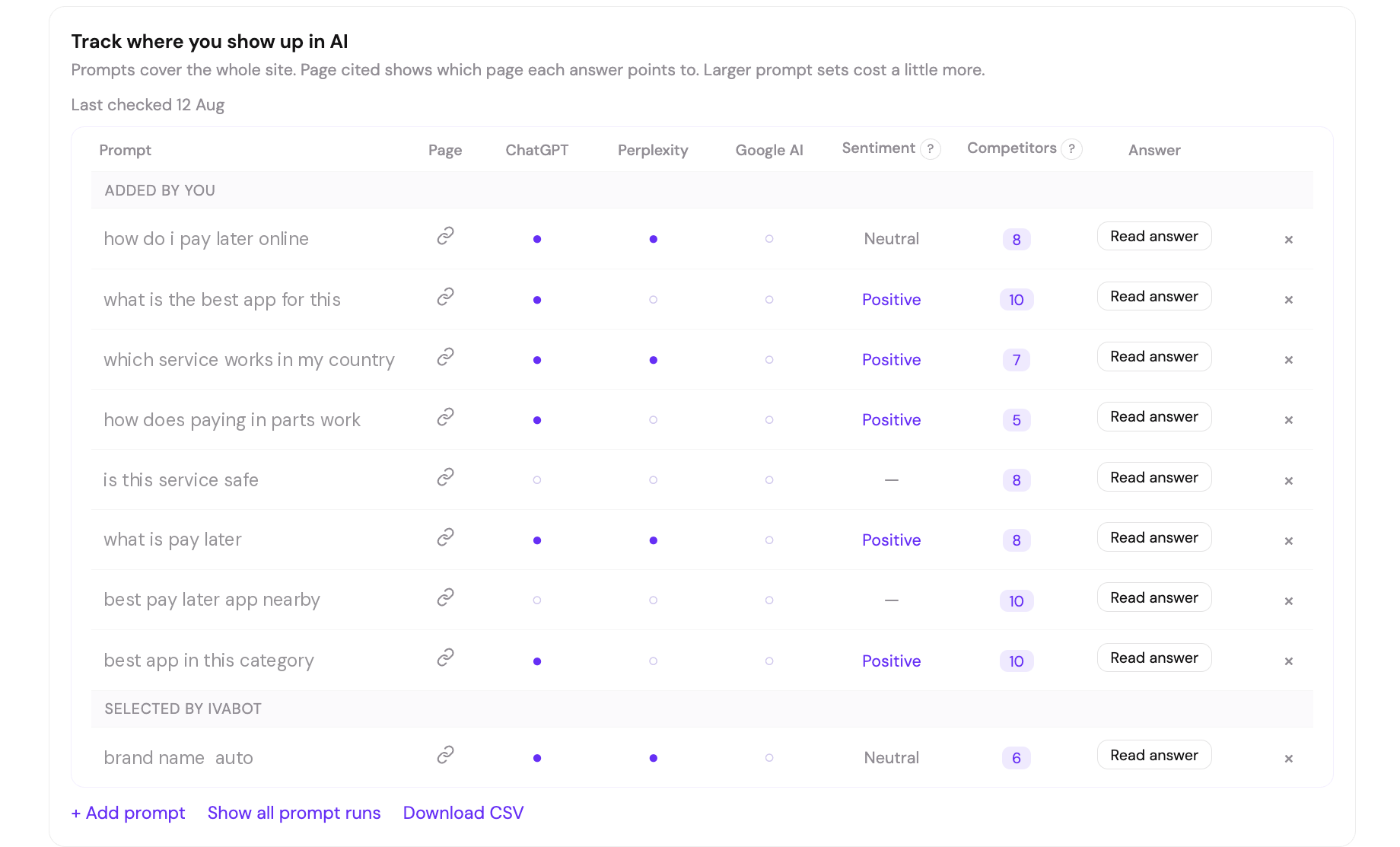
The other half is what the answer said, and whether a competitor was named instead of you. IvaBot runs your prompt list across ChatGPT, Perplexity and Google AI and records, for each one, whether the brand was mentioned, whether a page was cited and which page, the sentiment of the mention, the competitors named in the same answer, and the full answer text. Fifty prompts a month costs about five dollars, and new accounts get three free credits with no card. Run it on your page.
If you would rather compare the dedicated trackers first, their prices and what each gives away for free are in best AI visibility tracking tools for startups on a tight budget and how can I check AI visibility for free.
FAQ
Does Google's guide mean GEO and AEO are dead?
Not dead, but reframed. Google is saying GEO and AEO are not separate disciplines from SEO. The work overlaps so much that calling it a separate practice is misleading. Tools and services marketed as 'GEO platforms' may still be useful, but their advice should map onto foundational SEO, not invent new tactics that Google does not use.
Should I delete my llms.txt file?
No. Google says it does not use llms.txt, but it does not penalize you for having one. Other AI systems, including some smaller crawlers, may still respect it. Leave the file alone, just do not spend time maintaining or extending it for Google AI specifically.
Is FAQ schema still useful?
Yes, for regular search. FAQ schema can power rich results in Google search for eligible sites (mostly authoritative, government, and health domains in 2026). For AI Overviews specifically, schema overkill does not help, but a reasonable amount of structured data on key pages is fine. Do not remove what you already have.
What about content 'chunking' tools that promise AI optimization?
Tools that rewrite content into short standalone chunks specifically for AI extraction are addressing a problem Google says does not exist. Their systems already identify relevant passages in well-structured long-form content. Spend the budget on actual content quality and clear structure instead.
What is the difference between what AI fetches and what AI knows in AI search?
What AI fetches is what AI engines do in real time when answering a question: they search Google or Bing, retrieve fresh pages, and cite them. Classic SEO works here. What AI knows is what models already understand about your brand from the data they were trained on (Wikipedia, large publications, Wikidata, authoritative archives). For a new site, real-time retrieval is reachable in 1 to 6 months. What AI knows compounds slowly over 2 to 3 years through brand mentions in authoritative sources.
Does this apply to ChatGPT and Perplexity too?
Not directly. Google's guide describes Google's AI systems only. ChatGPT, Perplexity, Claude, and Bing AI Mode use different crawlers and ranking systems and have not published equivalent guidance. The foundational SEO principles in Google's guide are likely to translate well across all AI engines, but specifics like llms.txt may still matter for non-Google AI.
How do I measure AI visibility outside Google?
Search Console only covers Google's own AI features, and it reports impressions rather than the questions behind them. For the other engines, run a fixed list of buyer questions through ChatGPT and Perplexity and record whether you were named and which page was cited, either by hand or with a tracker that keeps the answer text. Dedicated trackers start around $20 a month, and a pay-per-run tool costs about five dollars for fifty prompts.
What about AI agents? Do I need to do something special?
If your site offers things AI agents might want to do on behalf of users (booking, comparison shopping, form filling), it helps to be agent-friendly. The basics overlap with good accessibility and clean UX: clear interactive elements, fast page rendering, proper semantic HTML, and an accessibility tree that makes sense. The full agent-friendly checklist is at web.dev/articles/ai-agent-site-ux.
Where can I read the original guide?
The full official guide is published by Google Search Central at developers.google.com/search/docs/fundamentals/ai-optimization-guide. It is the primary source for everything covered in this article. Reading it directly takes about 20 minutes.
What's Next
The most useful thing about Google's May 2026 guide is that it removes ambiguity for a year's worth of advice. The work that pays off is the same work that has always paid off, with one new category (AI agents) added to the list.
If you have a small business website and limited hours, the practical answer is to keep building real content, real backlinks, and real technical health. Read the official guide once, drop any AI-only tasks that Google does not value, and put the time into work that compounds.
Three related guides cover the practical side in more detail: generative engine optimization for small business covers how to get cited across AI engines (Google, ChatGPT, Perplexity), how to get backlinks for small business covers the foundational off-site work that drives both ranking and AI citation, and how to track AI citations shows how to measure whether AI engines are actually picking up your content.
For the small business angle on appearing inside these AI answers, see how to get mentioned in Google's AI search results. For what the tracking tools cost and which one hands over a real report without a card, see the pricing comparison and the free trial test.
This article was drafted using IvaBot Content Builder for structure and brief, then rewritten and fact-checked manually against the official Google source. IvaBot (Core Audit, AI Readiness, Content Builder) is built for small businesses and content creators who want SEO insights without agency pricing. Try it free at ivabot.xyz/app.
 12 min read