How to Get Mentioned in Google's AI Search Results: A Small Business Guide
Galyna ArikhJune 17, 202616 min read
Google's AI now answers at the top of search and cites a few sources. Here is how a small business gets its page to be one of them, with examples, timelines, and a checklist.
Try IvaBot for your site
Find what's hurting your SEO and what to fix first. Free to start, no credit card.
To get mentioned in Google's AI search results, give one clear, self-contained answer near the top of a page that targets a specific question your customers ask, and support it with one concrete fact your page states plainly, such as a price, a service area, a lead time, or a named result. Google's AI tends to quote pages that answer a narrow question directly and back it with something specific it can attribute to a single source.
AI answers now sit at the top of a large share of searches, and they change who gets seen. Pew Research found that people click through to a website far less often once an AI summary appears than when it does not. Younger, lesser-known sites felt this first. The useful part for a small business is that you can still appear inside these answers, and the path in is different from old-style ranking. This guide is short and practical, with real business examples, named sources, honest timelines, and a checklist at the end.
Google now writes an AI answer at the top of many searches (AI Overviews) and a conversational version (AI Mode), and cites a few sources.
A citation is a link that can send you traffic. A mention is just your name with no link. Aim for citations first.
Google's AI links out when it pulls one clear, specific fact from a single page, and tends not to link when it blends general information from many.
AI engines read in short passages, so open every section with a self-contained answer plus one concrete fact.
One question now triggers many related sub-questions (query fan-out), so cover the obvious follow-ups, such as price, area, hours, what is included, booking, and reviews, on the same page.
Keep prices, hours, and details current, because AI tends to favor fresher pages.
A new site is rarely cited immediately. With competition, expect first citations on narrow questions in about a month, growing as content and trust build.
Does Google use AI in search?
Short answer: yes. Google now shows an AI-written summary at the top of many searches and cites a few sources beneath it.
This summary is called an AI Overview, and the fuller conversational version is called AI Mode. Both read several pages, write a short answer, and link to a small number of sources. These answers now appear on a large share of searches, which is why the citation slot matters. Pew Research found that people click through to a website far less often when an AI summary is shown, so for a small business the goal is straightforward. You want your page to be one of those cited sources, because that is how you stay visible when the answer appears above the regular blue links.
A Google AI Overview answers the question at the top and cites a few sources. IvaBot appears among them.
Mentioned or cited: what is the difference?
Short answer: a citation is a clickable link to your page, while a mention is only your name in the text with no link.
Citations can send real visitors, so they behave like traffic. Mentions build name recognition but send no clicks, and they are harder to earn because they depend on your reputation across the whole web. For most small businesses the practical target is the citation, because it is the one you can influence directly through what you put on your own page. The two also move independently, so they are worth counting separately rather than as one number.
Citation
Mention
What it is
A clickable link to your page.
Only your name in the text, no link.
What it does
Can send real visitors, so it behaves like traffic.
Builds name recognition, but sends no clicks.
How you earn it
Directly, through what you put on your own page.
Through your reputation across the whole web.
Where to aim first
Yes, this is the practical target.
Useful, but harder and slower to earn.
For 'local seo for small businesses,' Google's AI lists IvaBot among the cited sources on the right. That link is a citation.
How Google's AI decides what to quote
Short answer: it links out when it can lift one clear, specific fact from a single page, and usually does not link when it blends general knowledge from many pages.
If your page states something exact and easy to lift, a price, a step, a date, a service area, a measured result, the AI can attribute that point to you and show the link. If your page only repeats general advice that lives on hundreds of other sites, there is nothing specific to attribute, so no link appears. This is why concrete numbers tend to be quoted more often than vague claims; 'from 1,200 lei' or 'ready in 48 hours' is liftable in a way that 'affordable' and 'fast' are not.
Two details make this practical. First, AI engines read in short passages, not whole pages. They tend to lift a block of roughly a hundred and thirty to a hundred and sixty words that answers the question on its own, so each section should open with a complete answer rather than a warm-up. Second, evidence helps. The Digital Bloom AI Visibility Report found that adding statistics raised AI visibility by about twenty-two percent, and adding quotations by about thirty-seven percent, so a number with a named source beats a general claim.
When the answer rests on specific figures, Google's AI cites the named sources behind them. Numbers with sources are what it can attribute.
Two more things worth knowing. First, Google's AI answers different people differently depending on their context, so write in the exact words your customer uses, not industry jargon. Second, the AI does not always quote perfectly; it can paraphrase loosely or attribute the wrong line, so it is worth checking how you are actually being cited rather than assuming. Google's own guidance is consistent with all of this: it says there are no special tricks, and that the work is making strong content easy to extract, understand, and trust (Google Search Central).
Why similar searches show different businesses
Short answer: small wording changes can surface different businesses, and that effect is strongest for everyday commercial questions in the middle of the buying journey.
A recent study by Peec AI looked at 1,754 prompts and 37,804 AI answers across five AI engines. It found that more than ninety percent of the ways people phrase a question carry almost the same meaning, so you do not need to chase endless variations. The detail that matters for a small business is where wording does change the result. Broad questions at the start of research and very specific brand questions at the end tend to be stable, because the AI leans on well-known, trusted sources for those, and those slots are hard to take. The middle of the journey, the practical comparing-and-choosing questions, is far less settled, and there small changes in phrasing pull up different names. That unsettled middle is the opening where a smaller site can appear.
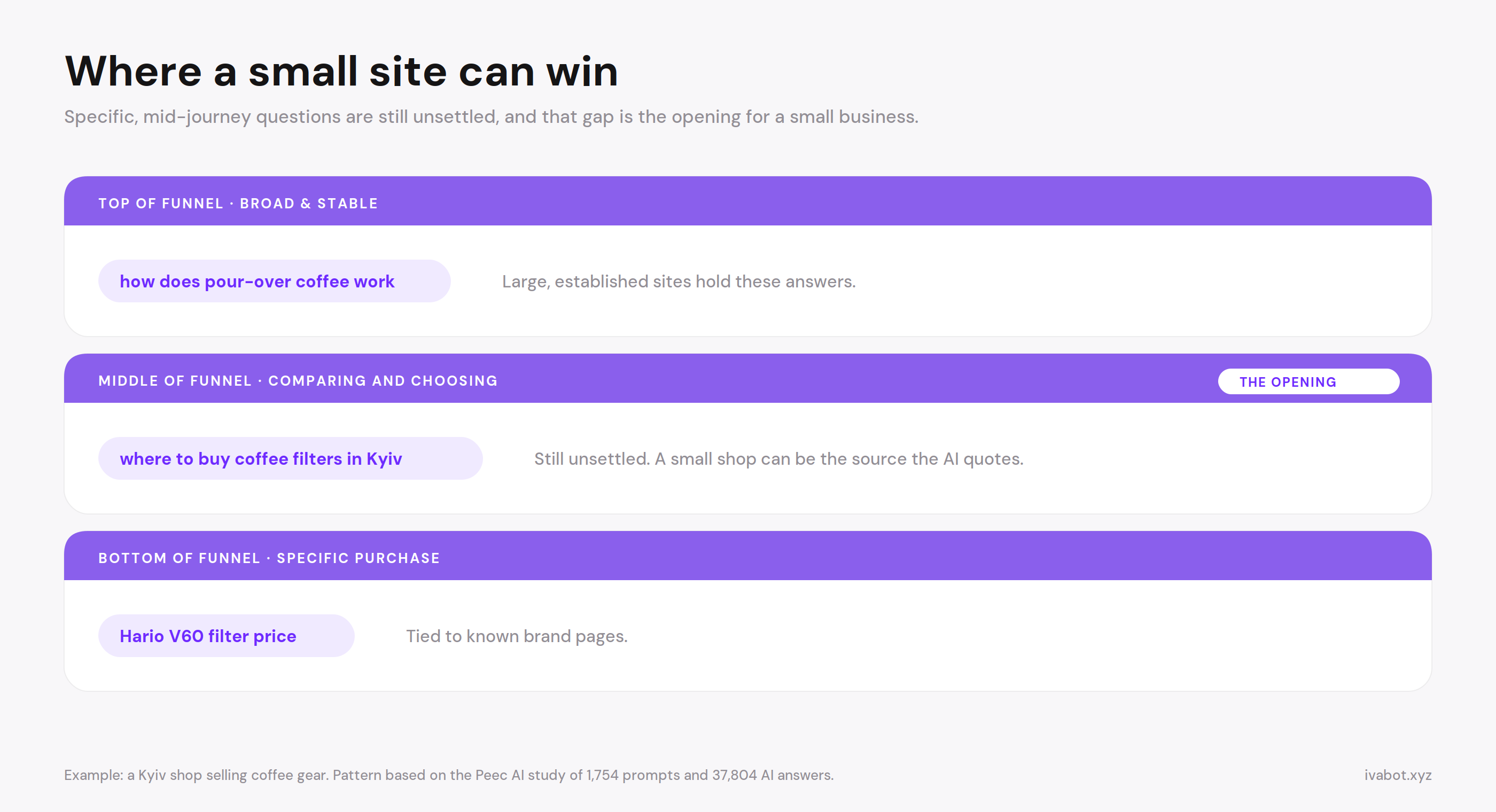
The buying funnel, using a Kyiv shop that sells coffee gear. The middle of the journey is the opening for a small site.
Here is the same idea as a funnel, using a small shop that sells coffee gear in Kyiv:
Top of the funnel, broad and stable: a question like 'how does pour-over coffee work.' Large, established sites hold these answers, so a small shop rarely breaks in.
Middle of the funnel, comparing and choosing, still unsettled: 'where to buy coffee filters in Kyiv.' This is the opening. A page that names the product, the area it serves, the price, and stock can be the specific source the AI quotes.
Bottom of the funnel, a specific purchase and fairly stable: 'Hario V60 filter price,' tied to a known brand and its established product pages.
The middle row is where a small local business has the best chance, because the answer there is still forming. This is the same logic as long-tail versus head terms in traditional SEO: a more specific query brings smaller volume but far more targeted traffic, and it is easier to win.
Two business examples: a wedding photographer and a bakery
Short answer: target the specific, local, middle-of-journey questions your customers actually type, because that is where the answer is still open.
Take a wedding photographer. The opening is not a broad term but a specific, local, commercial question such as 'how to find a wedding photographer in Bucharest' or 'affordable wedding photographer in Bucharest.' A page built around that exact question, naming the city, a clear starting price, and what a package includes, gives the AI a specific fact to lift and a clear reason to cite you for that search.
Now take a bakery. Instead of a broad baking question, the opening is a local buying question such as 'where to buy gluten-free bread in Kharkiv,' or a near-me search like 'birthday cake near me.' A page that states the neighborhood or delivery area, that the bread is gluten-free, and a price or pickup time gives the AI something concrete to quote, and a small bakery can appear in that answer even without a large site.
A near-me search like 'birthday cake near me' pulls local businesses with concrete details. A bakery page that states area, price, and pickup can be one of them.
Pick the narrow question a real customer types, answer it directly at the top of the page, and anchor it with one specific fact only your page states plainly.
Answer the questions behind the question
Short answer: when someone asks one question, Google now runs several related searches at once, so cover the obvious follow-ups on the same page.
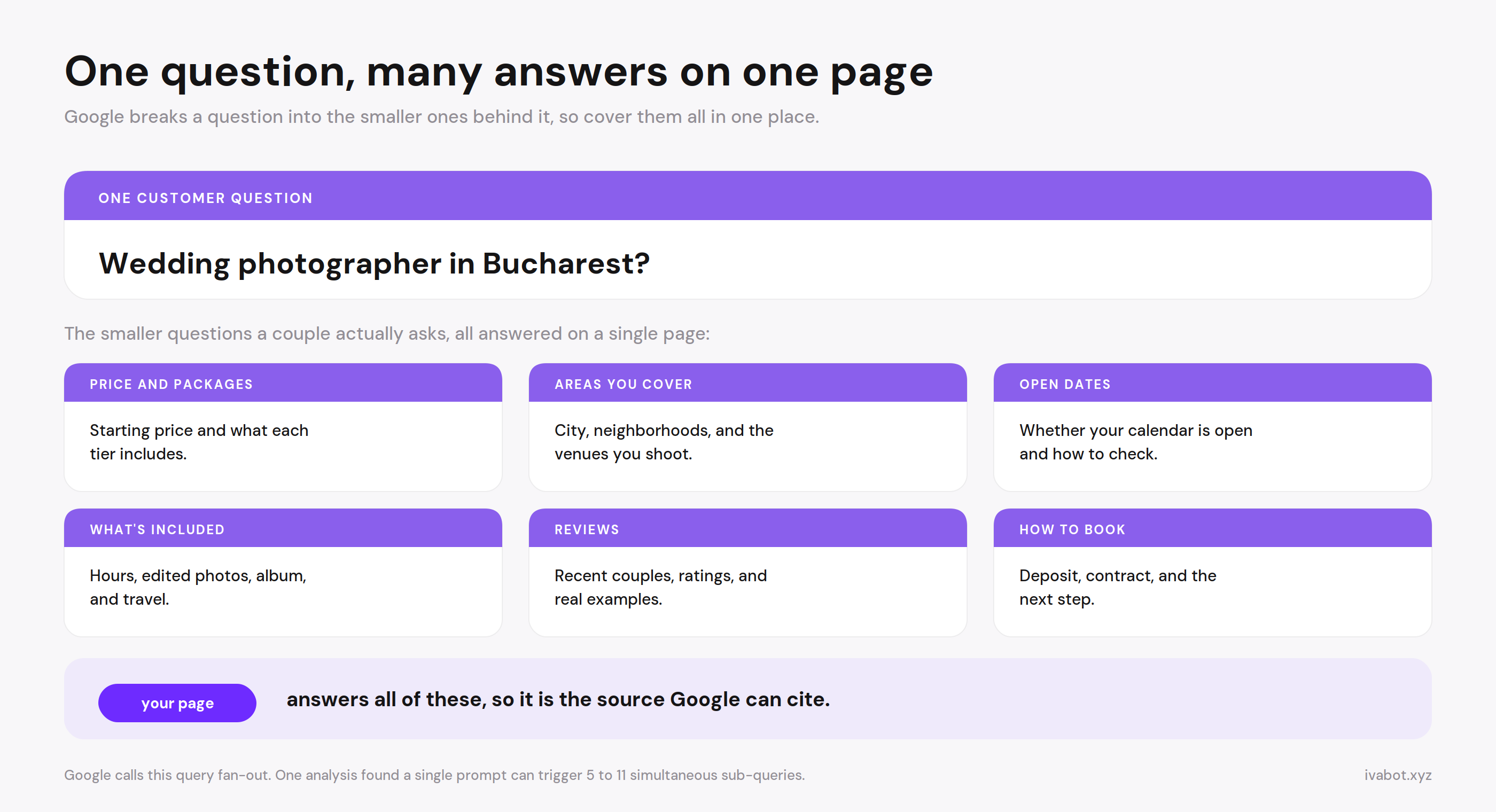
Google calls this query fan-out. Instead of matching one page to one phrase, the system breaks a question into a set of smaller ones and gathers evidence for each. Google's Search Central documentation describes it directly: the model generates concurrent related queries to fetch more results (Google Search Central). One analysis found that a single prompt can trigger five to eleven of these sub-queries at once, and more for complex questions.
Query fan-out: one customer question becomes many sub-questions, and one page that answers them all becomes the source Google can cite.
For a wedding photographer, the question 'wedding photographer in Bucharest' fans out into the questions a couple actually has: how much a package costs, which areas and venues you cover, which dates are open, what a package includes, whether there are reviews, and how to book. A single page that answers those on one screen gives the AI a match for several sub-questions at once.
For a bakery, 'gluten-free bread in Kharkiv' fans out into the price, the neighborhood or delivery area, pickup times, whether the bread is certified, and how to order. Cover those plainly and you become the page that fits the whole question, not just the headline.
Google warns against the opposite move of spinning up a separate thin page for every phrasing. One clear page that answers the related questions beats many overlapping ones, so use fan-out as a checklist of what to cover, not as a reason to multiply pages.
What to put on your page so AI can quote you
Short answer: answer one narrow question directly near the top, in plain language, with one specific fact only your page states clearly.
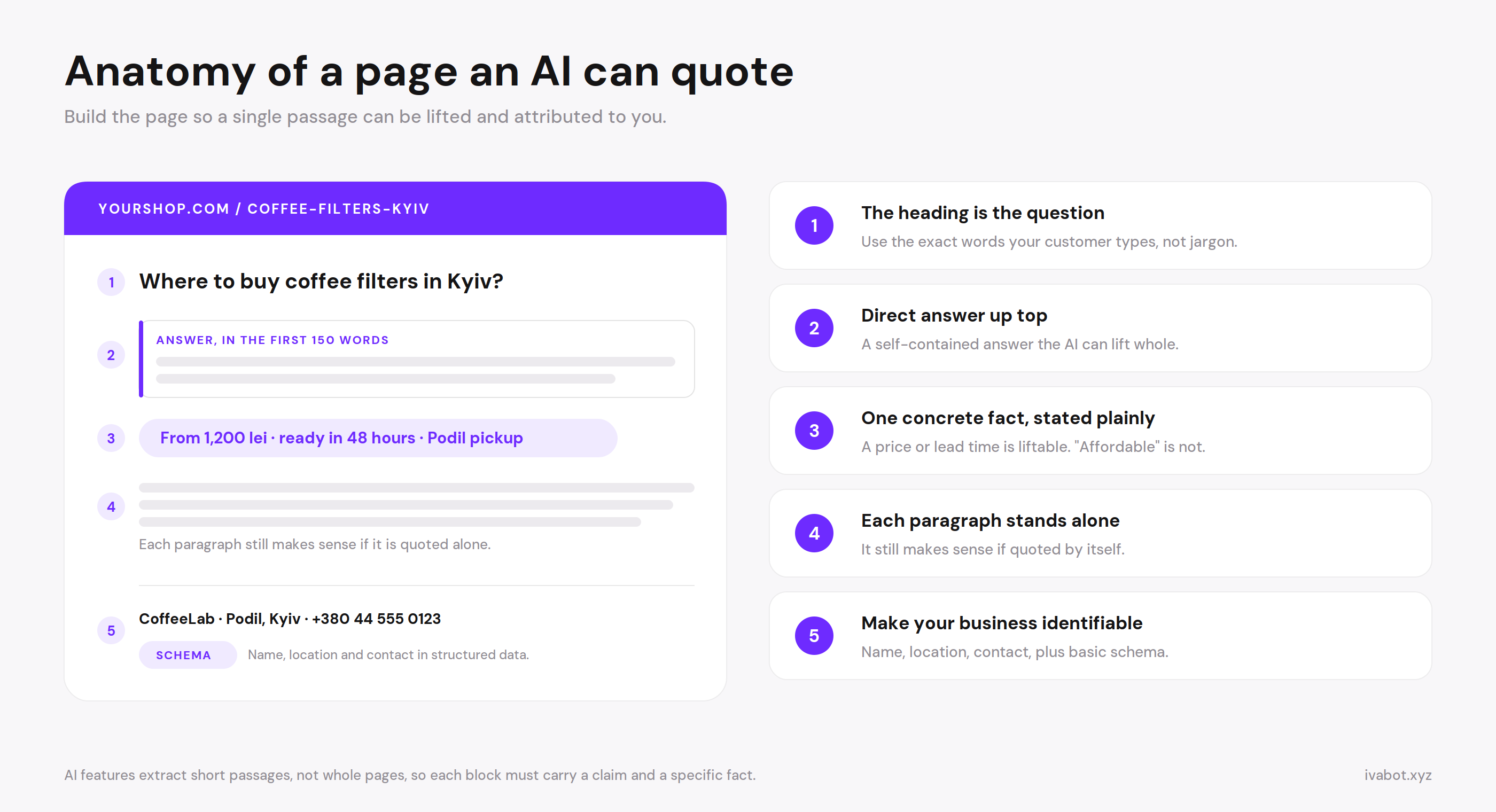
Anatomy of a page an AI can quote: the heading is the question, the answer comes first, one concrete fact is stated plainly, paragraphs stand alone, and the business is identifiable.
1
Open with a direct answer
Open with a direct, self-contained answer in the first hundred to a hundred and fifty words, so it can be lifted without losing meaning. Open each major section the same way, because the AI reads passages, not the whole page.
2
Make the heading the question
Write the main heading as the question your customer asks, and use sub-headings as the related questions from fan-out, such as price, area, and booking.
3
Keep paragraphs self-contained
Keep paragraphs short and complete on their own, so a single paragraph still makes sense if it is quoted alone.
4
Include one concrete fact, and a source where you can
Include one concrete fact: a price, a time frame, a service area, or a measured result. Where it fits, add a number with a named source, because a figure with its source is easier to lift and to trust than a general claim.
5
Use your customer's words
Use your customer's words, not industry terms.
6
Make your business identifiable
Add basic structured data, and make your business name, location, and contact details clear so the AI can identify and trust you.
Make sure Google can find, read, and trust the page
Short answer: a page can only be quoted if Google can crawl it, read it, and see that it is current.
Google's own guidance is blunt: there are no special AI tricks, and the page has to be technically eligible. That means it can be crawled and indexed, it loads quickly, and it works on a phone. If your site builder hides the text behind scripts, or the page is blocked from crawling, the AI never sees the answer, however good the writing is.
Freshness also matters. One analysis by Ahrefs found that AI engines tend to cite pages that are markedly fresher than the ones traditional search favors, on the order of a quarter fresher. For a small business this is simple: keep prices, hours, and availability current, and show when the page was last updated, so the AI is not quoting a figure from two years ago.
How long until a new site gets cited, and what it depends on
Short answer: a new site is rarely cited right away. With competition, it usually starts appearing after about a month, small in volume at first, then grows as the site builds content and trust.
There is no single number that fits every site, so treat the following as ranges, not promises. What actually moves the timeline:
Site age and history. A brand-new domain is trusted less than one with a track record, so it tends to wait longer and appear less often at first.
Competition in your topic. For a low-competition local question, a small site can show up quickly. For a crowded commercial topic it takes longer, because trusted sites already hold those answers.
Amount and depth of content. One page is rarely enough. A small cluster of focused pages around the same topic does more than a single long page, because it signals that you genuinely cover the subject.
Page quality and structure. Pages that answer one clear question with a specific fact get picked up sooner than thin or general pages.
Trust signals. A real business behind the site, clear contact details, reviews, and mentions elsewhere all shorten the path.
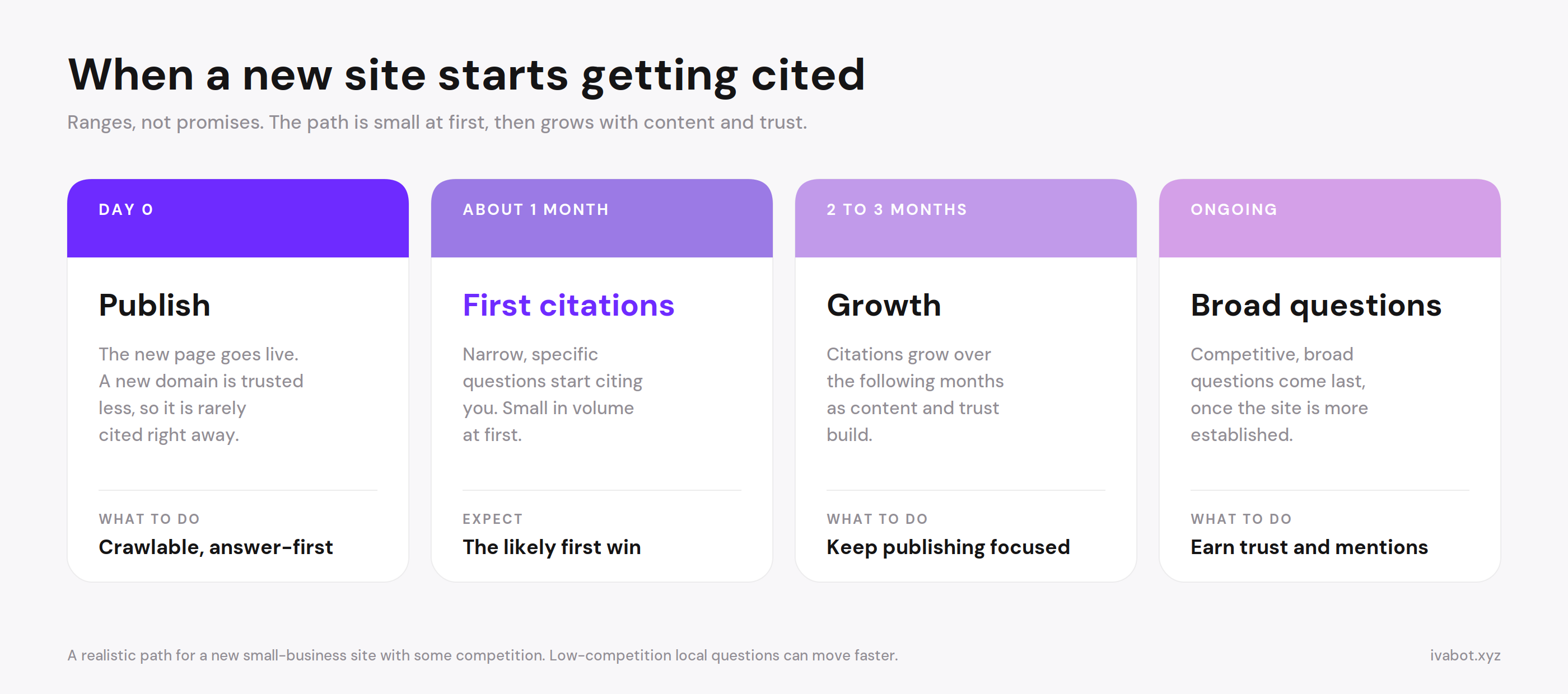
A realistic path: rarely cited at launch, first citations on narrow questions around a month in, then growth as content and trust accumulate.
A realistic expectation for a new small-business site with some competition: first citations on narrow, specific questions within roughly a month, small in volume, then gradual growth over the following months as content and trust accumulate. Broad, competitive questions can take much longer and may stay out of reach until the site is more established.
Site trust, brand mentions, and backlinks
Short answer: your own page is what you control first; wider visibility builds over time from trust and presence across the web.
What is on your page gets you cited, which is why most of this guide focuses there. Everything below is the slower, off-page layer that raises your odds over months, not days.
Site trust and E-E-A-T. Show who stands behind the site: a named business or author, real contact details, and accurate, current information. The AI favors sources it can identify and trust.
Brand mentions and reviews. When other sites and directories mention your business, and when customers leave genuine reviews, you become a name the AI recognizes independently of any single page.
Backlinks and being where AI looks. Links from relevant sites, and a real presence in the places AI draws from, all feed your visibility. This works best as honest participation over time, not as a quick trick.
Where AI looks: sources Google tends to trust
Short answer: besides your own page, it helps to be present in the kinds of sources AI engines pull from. Pick one or two that fit your business and do them properly.
Google Business Profile and local directories. For a local business this is the strongest one, because AI assembles a local answer from several signals at once. It checks your service, your area, your hours, your reviews, and your contact path before it names you. Claim your profile, keep hours, location, and services accurate, and list in relevant local or industry directories.
Genuine reviews. Real customer reviews on the platforms that matter in your niche make you a name the AI recognizes on its own, not just through one page.
YouTube. Google surfaces video often, so a channel answering the same narrow questions, a photographer showing a real shoot or a bakery showing a custom order, is a natural way in.
Communities like Reddit and Quora. Google increasingly treats helpful answers in communities as real expertise, so genuine participation in threads where your customers already ask questions can feed AI answers. Real answers only, not link drops.
'Best X in [city]' lists by others. AI often pulls names straight from these roundups, so being included in a reputable list by a relevant author is a strong signal.
Reputable industry publications and Wikipedia. Harder to earn and slower, but these sit at the top of what AI trusts.
This is the off-page layer, so it works over months, not days. You do not need all of it. One or two channels done honestly beat a thin presence everywhere. If you want to go deeper per engine, the related guides below cover ChatGPT, Perplexity, and the broader approach known as generative engine optimization.
Common mistakes
Short answer: most pages miss AI answers for the same few reasons, and each one is easy to fix.
Burying the answer. The page opens with a long introduction, so there is no self-contained answer for the AI to lift. Put the answer first.
Vague claims. Words like affordable and fast give the AI nothing specific to attribute. State a price, a lead time, or a number with its source.
One giant page, or a thin page per phrasing. Cover the related questions on one clear page, and avoid spinning up a separate page for every wording.
Missing the business basics. A page without a clear name, location, contact, or structured data is harder for the AI to trust and identify.
Stale information. Old prices and hours get skipped. Keep the page current and show when it was last updated.
Treating it as a one-time job. Citations build as content and trust accumulate, so check how you are cited and keep improving.
Checklist: get mentioned in Google's AI search
The page targets one specific question, not a broad topic.
The first paragraph answers that question directly and can stand alone.
The main heading is phrased as the question your customer asks.
The page covers the obvious follow-up questions on one page: price, area, hours, what is included, booking, and reviews.
The page states one concrete fact only you say plainly, and a number with its source where you can.
The language matches how your customer actually speaks.
Business name, location, and contact details are clear, with basic structured data in place.
The page can be crawled and indexed, loads quickly, and works on a phone.
Prices, hours, and details are current, and the page shows when it was last updated.
You have a small cluster of focused pages on the topic, not just one.
You check how AI engines actually cite you, and correct anything wrong.
How to check whether you are being cited
Short answer: ask the questions yourself and write down what came back, because the answer text is what tells you whether you were quoted correctly or only named in passing.
The manual version is fine to start: take the narrow questions from your checklist, ask them in Google AI Mode, ChatGPT and Perplexity, and note whether your business appears, whether the link is there, and which page it points to. Repeat the same questions every week so you are comparing like with like.
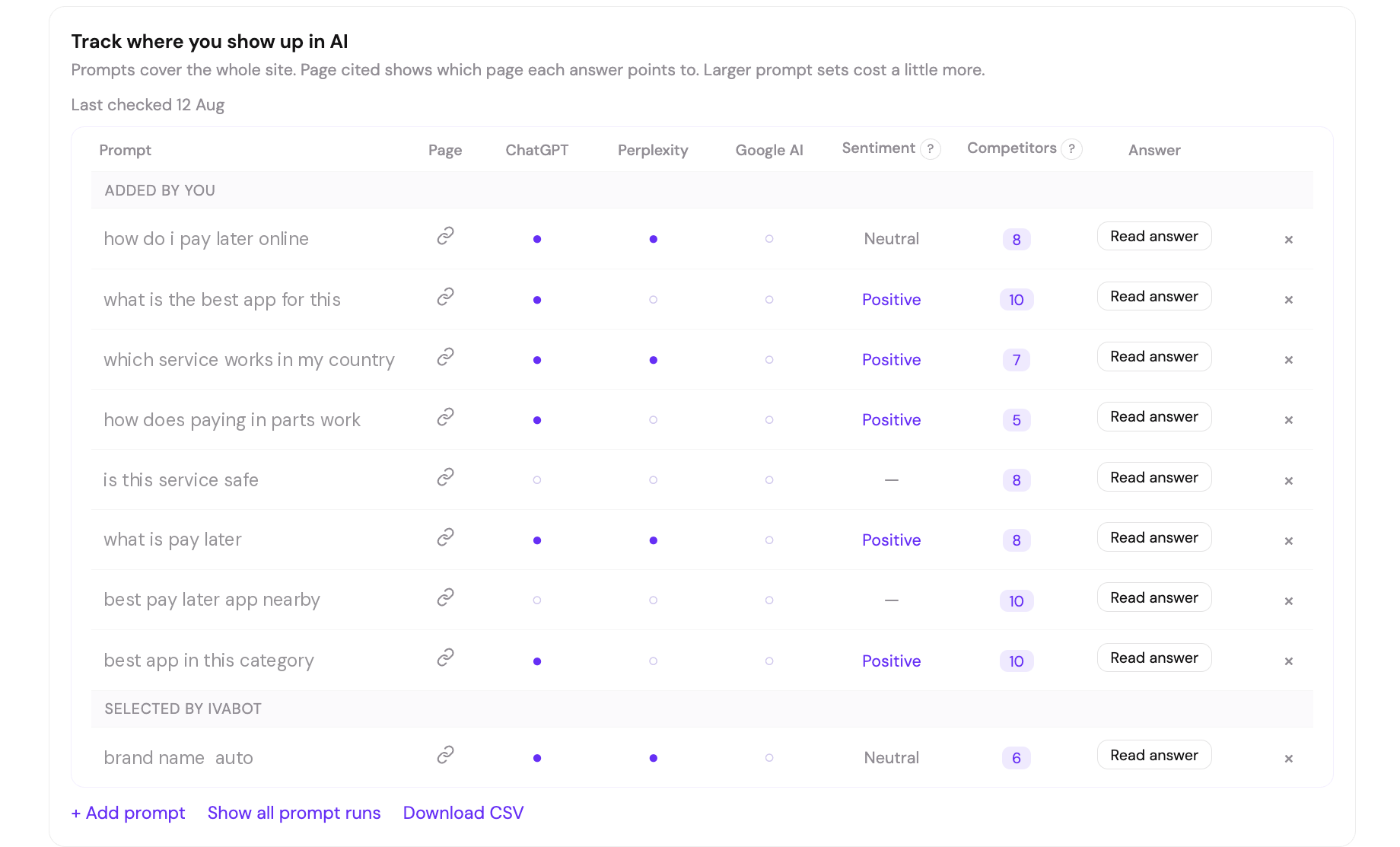
Once the list grows, it stops being a five-minute job. IvaBot runs the same questions across ChatGPT, Perplexity and Google AI and records, for each one, whether the brand was mentioned, whether a page was cited and which page, the sentiment of the mention, the competitors named in the same answer, and the full answer text. Mentions and citations are counted separately, which is the distinction this whole guide rests on. Fifty prompts a month costs about five dollars, and new accounts get three free credits with no card. Run it on your page.
Mentioned and cited are separate columns, because they move independently. The answer itself sits behind the button.
Yes. Google shows an AI Overview at the top of many results and a conversational AI Mode, both citing a few sources.
How do I get my business mentioned in Google's AI search results?
Answer one specific customer question directly near the top of a page, in plain words, with one concrete fact the AI can quote.
What is the difference between being mentioned and being cited?
A citation is a link to your page that can send traffic. A mention is only your name, with no link.
What is query fan-out, and what does it mean for my page?
Google runs several related searches for one question. Cover the obvious follow-ups, such as price, area, hours, what is included, booking, and reviews, on one page so you match several of them at once.
Does it matter how fresh my page is?
Yes. AI tends to favor current pages, so keep prices, hours, and details up to date, and show when you last updated the page.
How many pages do I need, and how long does it take?
There is no fixed number. A small cluster of focused pages does more than one. With competition, expect first citations on narrow questions in about a month, growing over the following months.
Why do similar searches show different businesses?
Because middle-of-journey questions are less settled than broad or brand questions, so small wording differences surface different names.
How do I know whether I was cited or only mentioned?
Look at whether there is a link. If the answer names you with a clickable source, that is a citation. If it names you in the text with no link, that is a mention. Tools that track this keep the two as separate counts, because a brand can gain mentions while losing citations.
What's Next
The fastest way to know whether a page is ready for AI answers is to look at it the way an AI does. Check that there is a clear question, a direct answer near the top, and one specific fact worth quoting.
IvaBot AI Readiness checks those signals on the page and returns the fixes, then tracks your prompts across ChatGPT, Perplexity and Google AI so you can see whether the fixes landed. Core Audit covers positions, backlinks and technical health in the same place. Three free credits, no card. Check your page and see what to fix first.
 16 min read