How to Write SEO Content with AI That Gets Traffic Without Sounding Like a Robot
Galyna ArikhMay 31, 202614 min read
Two ready-to-use prompts, a step-by-step workflow, and the structure that gets articles cited by Google and AI tools — even if English is not your first language.
Try IvaBot for your site
Find what's hurting your SEO and what to fix first. Free to start, no credit card.
If you are not a native English writer, or if you want to speed up your writing process but struggle to put your thoughts into clear, structured sentences, you can still write good articles that bring real value to the visitors of your website. Your voice matters more than your grammar.
In this article you will learn how to write SEO content with AI that gets traffic without sounding like a robot. You will keep your voice, make the article personal, deliver meaning and value to your readers, and stay visible for both Google and large language models like ChatGPT, Perplexity, and Claude.
The article explains how to write SEO articles with ChatGPT or any other AI tool as a base for your first draft, without losing your own voice in the process.
How to Write SEO Content with AI Checklist·Download
TL;DR (Quick Summary)
Search engines and AI tools changed how they reward content in 2026, and the articles that bring long-term traffic are the ones with a real voice, real examples, and a clear structure that both humans and AI tools can read quickly.
This article gives a full example of a good SEO article, the structure that helps a page get cited by ChatGPT, Perplexity, and Google AI Overviews, two ready-to-use prompts you can copy and paste, and guidance on how to add keywords, images, and internal links without losing readability.
The workflow works for non-native English writers and for anyone who wants to speed up the writing process while keeping a personal voice in every article.
"Use AI for the first draft. Edit every sentence yourself before publishing."
What changed in SEO in 2026?
Short answer: Google rewards original information and clear structure, while articles created entirely by AI without human editing lose ranking positions and AI citations.
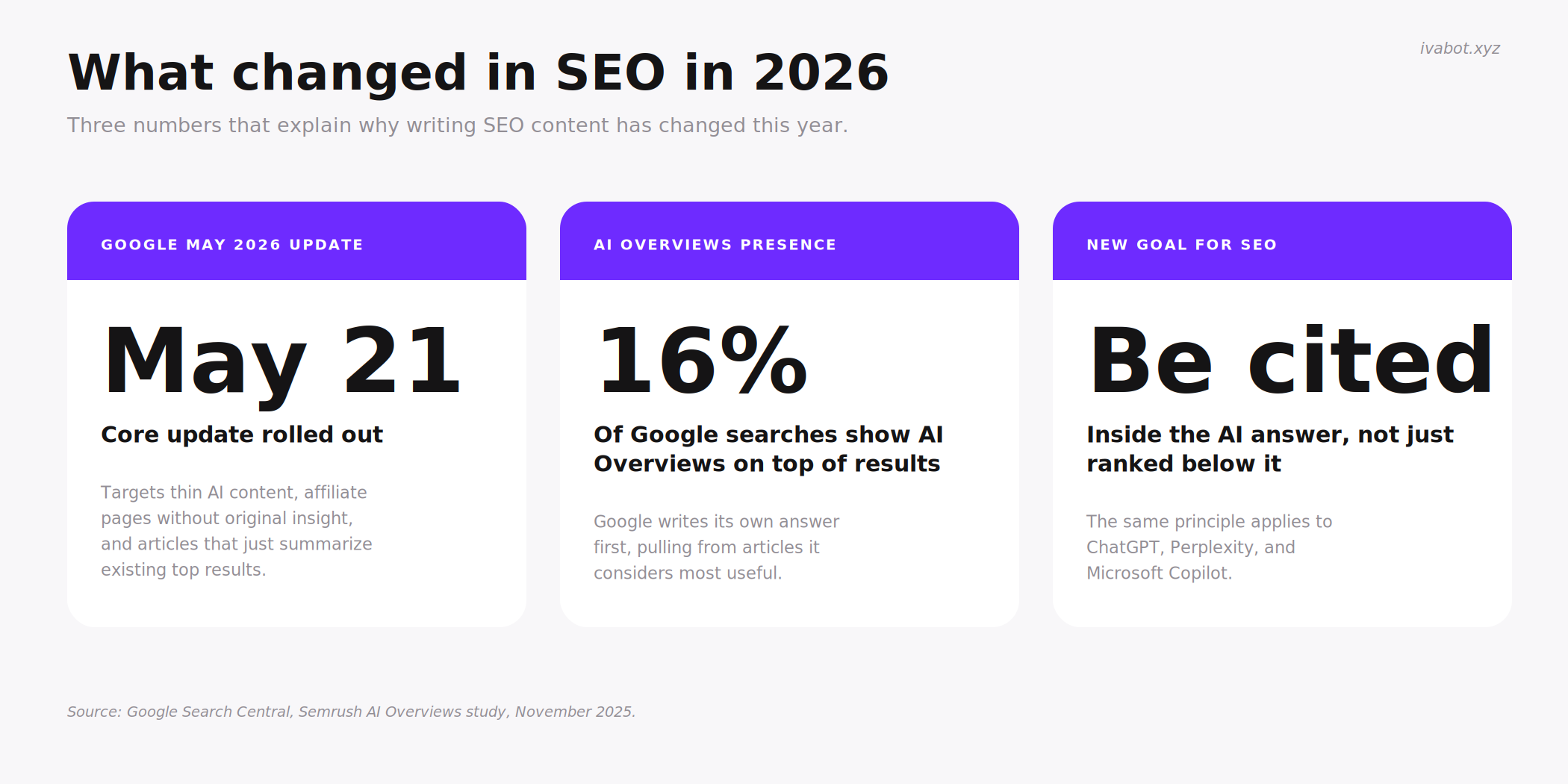
Google released the May 2026 Core Update on May 21, with the rollout expected to take up to two weeks, finishing around the first week of June. Google described it as a regular update designed to better surface relevant, satisfying content for searchers. The wider SEO community (Search Engine Land, Search Engine Journal) reports the update strongly affects thin AI-generated content, affiliate pages without original insight, and articles that summarize existing top results without adding anything new.
Google announced at I/O 2026 that AI Overviews reach 2.5 billion monthly active users and AI Mode reached 1 billion monthly users on the same week. For many queries, Google now writes its own answer at the top of the page, pulling information from articles it considers most useful. To get traffic from search in 2026, your article needs to be the one that Google quotes inside that answer, not just one of the pages listed below it.
The same principle applies to ChatGPT, Perplexity, and Microsoft Copilot. These tools also pull content from real articles and cite their sources directly in the response. An article that is structured to be quoted will continue to bring traffic from AI search engines even when traditional Google rankings change.
Three numbers that explain why writing SEO content has changed this year.
What kind of content brings traffic in 2026?
Short answer: articles that add something new to what already exists on the topic, written with a real voice, with real examples, and with a structure that both humans and AI tools can read quickly.
The articles that bring long-term traffic from Google and AI search engines in 2026 share one common feature: they add something new to what already exists on the topic, instead of repeating what the AI already knows from its training data.
When ChatGPT or any other AI tool writes an article from a short prompt, the output is a summary of the top results that already rank for the keyword. Search engines and AI tools recognize this pattern, because they see hundreds of articles with the same sentences, the same examples, and the same conclusions, and these articles do not get prioritized in rankings or AI citations.
Readers recognize the pattern too. Many readers identify AI content the moment they start reading, and many visitors of a website prefer to read the words of a real author, so they may never return to the page if the article feels assembled by a machine.
A real reader reaction on Reddit, captured from the r/Wordpress community.
The phrases that signal a generated article are predictable. They include "in today's fast-paced digital landscape", "it is important to note that", "furthermore", "this isn't just about X, it's about Y", and "let's dive in". When a reader sees three of these phrases in the same article, the article loses trust, and when Google's ranking system sees them combined with no original examples and no clear author signal, the article does not rank well.
The way forward is to use AI for the parts of the work where it helps, and to keep the parts of the work that only the author can do.
What makes an article rank on Google and get cited by AI in 2026?
Short answer: original information, a clear structure, a real author identity, real external sources, and a consistent voice across the whole article.
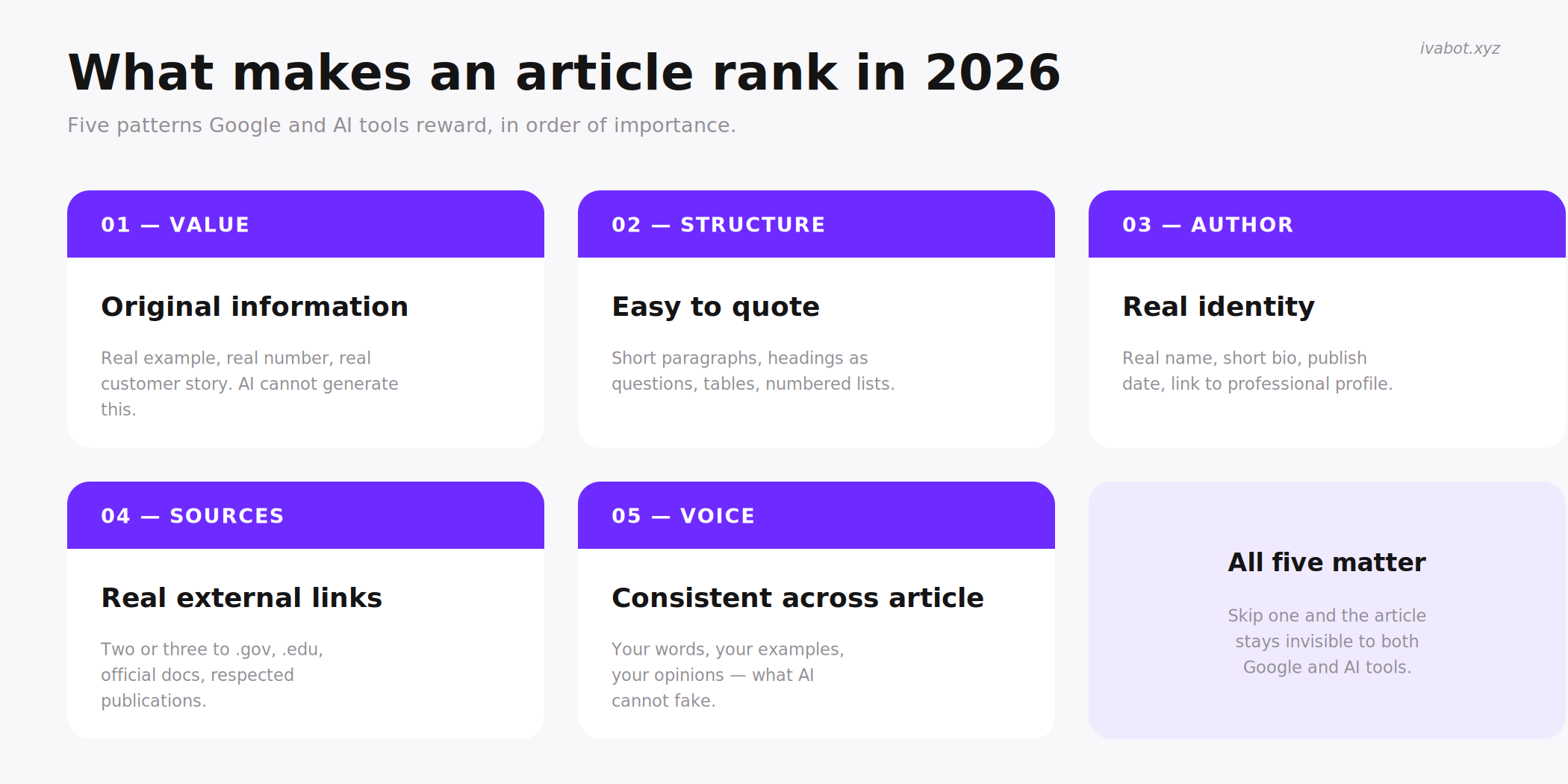
Five things determine whether an article brings traffic from both Google and AI search engines in 2026.
Content brings emotion or real value
The first thing is original information that gives the reader something to feel or to use. The article can be educational, entertaining, surprising, comforting, or it can simply teach something new that the reader cannot find elsewhere on the first page of Google. The original part can come from your own experience, a specific number you measured yourself, a customer story you witnessed, an opinion that goes against the common advice in your industry, or a personal observation about your topic. AI tools cannot generate this kind of content from a prompt, and this is the part of the article that only you can write.
Content has a structure that is easy to read and easy to quote
The second thing is a clear structure that both humans and AI tools can read quickly. Use short paragraphs of 100 to 180 words, with each paragraph answering one specific question. Write headings as actual questions instead of marketing slogans, because this format matches how people ask ChatGPT and how Google indexes content for AI Overviews. Add tables for comparisons and numbered lists for steps, since this format helps AI tools extract a clean answer from your article and quote it directly in their responses.
Content has a clear author identity
The third thing is author identity. Add your real name to the article, a short bio that explains why you are writing on this topic, a date of publication, and a link to your other work or your professional profile. Google's quality systems use author signals to decide whether the content comes from a real person with real experience or from an automated account, and readers also trust an article more when they see who stands behind it.
Content is based on real sources
The fourth thing is real sources that support what you write. Add two or three external links to authoritative places such as a .gov website, a .edu institution, an official Google documentation page, or a respected industry publication. These links signal that the article was researched rather than generated, and AI tools often follow citations to verify the information before quoting it in their answers.
Content has a consistent voice
The fifth pattern is a consistent voice across the whole article, built through the words the author chooses, the examples the author gives, and the personal details that no AI prompt would invent. The full process of building this voice into an AI draft is described in Step 5 of this article.
Five patterns Google and AI tools reward, in order of importance.
How to write an SEO article step by step
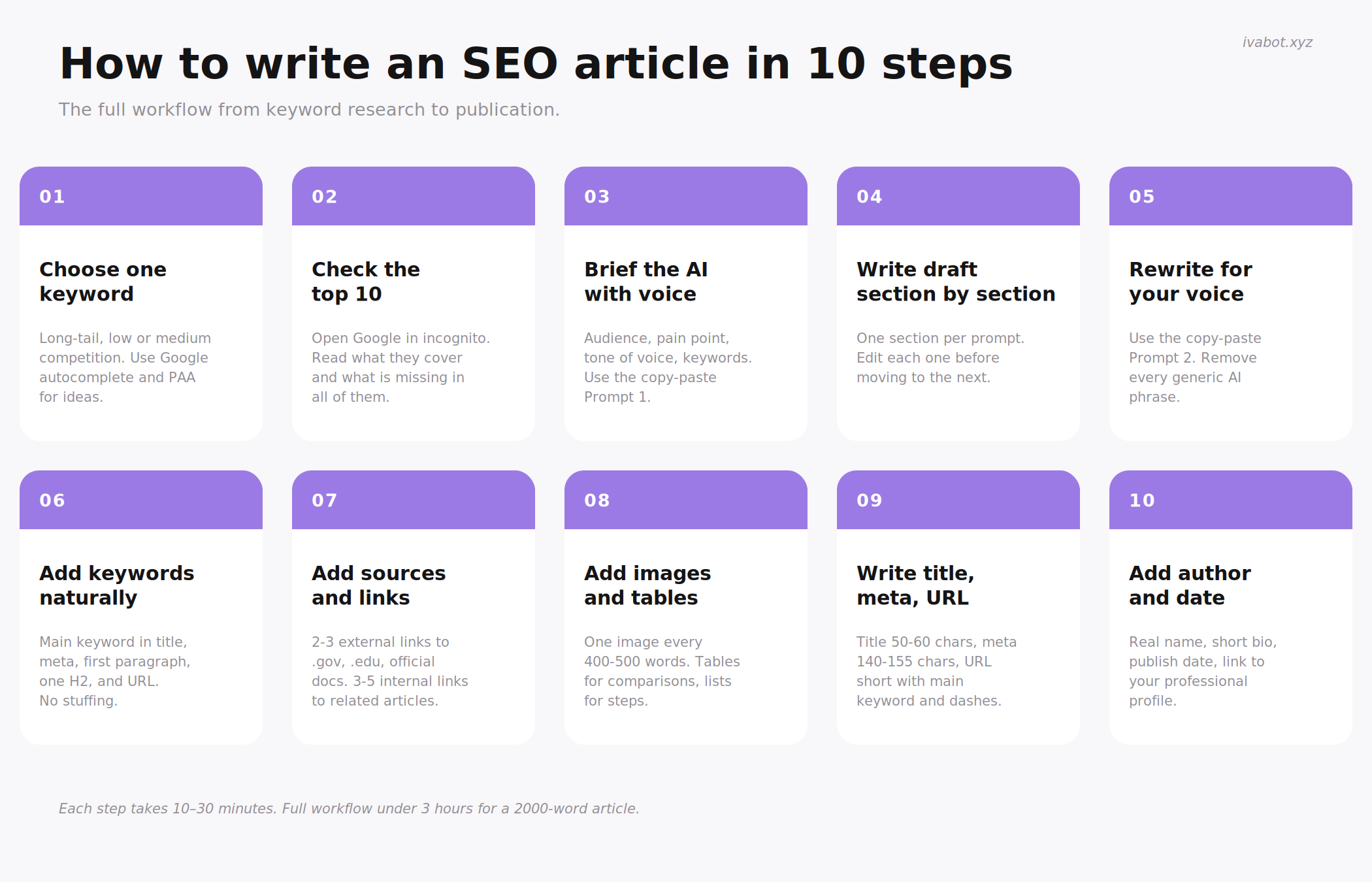
Short answer: pick one keyword, check the top 10 results, brief the AI with your voice, write section by section, rewrite for voice, add keywords naturally, add sources and internal links, add images, write the title and meta, add the author block.
The process below works for any topic in any niche, and it brings predictable results when each step is followed in the order it is described.
The full workflow from keyword research to publication.
01
How to choose keywords that can rank for your website
Pick one main keyword for the article before writing anything. Use Google autocomplete, the People Also Ask section in Google search results, and the Related Searches at the bottom of the search results page to collect ideas. Choose a keyword with low or medium competition, because high-competition keywords are dominated by large websites with thousands of backlinks, and a new site cannot outrank them on the same topic.
For a new website, the safest approach is a long-tail keyword with four or more words, since long-tail keywords have fewer competitors and bring visitors who already know what they want. One article should target one main keyword and two or three secondary keywords that appear naturally in the headings and the body text.
If you are not sure how to find the right keyword for a new site, the article why your website is not getting traffic and how to fix it explains the full process step by step. IvaBot Content Builder also runs keyword research with real Google search data automatically, including search volume, keyword difficulty, and the questions from People Also Ask, so the keyword decision is based on numbers rather than guessing.
02
How to check what the top 10 search results already cover
Open Google in incognito mode to avoid personalized results, and search your main keyword. Read the top 10 organic results, the People Also Ask box, and the Related Searches at the bottom of the page. Write down every topic that the top results cover, and write down every topic that is missing from all of them.
Your article needs to cover the same topics as the top 10 results, and it also needs to add at least one section that no other article in the top 10 includes. This new section is the reason a search engine or an AI tool will quote your article instead of one of the existing ones, because it gives the reader information that is not already available on the first page of Google.
03
How to brief the AI with your audience, topic, and voice
The first prompt to the AI is the most important one, because it sets the tone and the structure for the rest of the article. A short prompt like "write a blog post about SEO writing" gives a generic result that sounds like every other article on the internet, and a detailed prompt that includes the audience, the pain points, the tone, and the secondary keywords gives a draft that already has the right direction.
The prompt below is the one to copy into ChatGPT, Claude, or any AI tool.
Prompt 1 — Outline brief (select all text below and copy)
You are helping me write an SEO article on [topic]. The main keyword is [keyword]. The secondary keywords are [keyword 2], [keyword 3].
My audience is [describe audience in one sentence]. They struggle with [main pain point]. They already know [what they already understand about the topic]. They do not know [what needs to be explained from the basics].
My tone of voice is [3 to 5 adjectives, for example: direct, calm, practical, no marketing language]. I avoid the phrases: "in today's fast-paced world", "let's dive in", "it is important to note", "furthermore", "this isn't just about X, it's about Y".
Create a detailed outline for the article with H2 and H3 headings written as real questions that the audience would ask. Include sections that cover [list two or three specific angles you want covered]. Do not write the body of the article yet.
The same prompt also works inside IvaBot Content Builder, which already asks the same questions through a guided chat interface. The tool collects the audience description, the main pain point, the tone of voice, and the secondary keywords, and it adds real Google search data on top of the brief, including the actual search volume of the keyword, the top 10 competitors for the topic, and the People Also Ask questions that the audience is already asking. The base of the article comes out structured and based on real search results from the first prompt.
IvaBot Content Builder asks the same questions as Prompt 1 through a guided chat.
04
How to write the first draft section by section
Ask the AI to write one section at a time based on the outline from Step 3, because section-by-section generation keeps the structure of the outline and gives the chance to edit the direction of the article after every step. A long article generated in one response tends to repeat itself across the sections and lose the focus of the outline.
This approach keeps the voice consistent across the whole article, and it also gives the chance to correct the direction of the article early, before the AI applies the same pattern in every following section.
05
How to rewrite the AI draft in your own voice
The first draft from the AI is the starting point, not the finished article. Every section needs to be rewritten through a second prompt that strips the generic AI patterns and matches the tone of voice of the author.
The prompt below is the one to use for this step.
Prompt 2 — Voice rewrite (select all text below and copy)
Rewrite the text below in my voice. Use full sentences, not fragments. Remove every generic AI phrase, including: "in today's fast-paced world", "let's dive in", "it is important to note", "furthermore", "navigate the complexities", "this isn't just about X, it's about Y", "delve into".
Keep the meaning exactly the same as in the original text. Do not add new information. Do not summarize or shorten the explanation. Use this tone: [3 to 5 adjectives]. Use simple words and write in complete, calm sentences.
Here is the text to rewrite: [paste section]
Run every section of the article through this prompt, and read the result out loud after the rewrite. If a sentence sounds unnatural or robotic when spoken, rewrite it by hand until it reads the way the author would actually say it in conversation.
06
How to add keywords without keyword stuffing
The main keyword goes in five specific places of the article: the article title, the meta description, the first paragraph of the article, at least one H2 heading, and the URL of the published page. The secondary keywords go inside H2 and H3 headings where they fit the sentence naturally, and inside the body text wherever they describe the topic of the paragraph.
The natural density of the main keyword is one mention for every 100 to 150 words of body text, which works out to around 13 to 20 mentions across a 2000-word article. The secondary keywords appear two or three times each in the whole article. The natural spacing for the same keyword is one mention per paragraph, which gives the reader and the search engines enough context without overuse.
If a keyword does not fit a sentence naturally, leave it out of that sentence, because a forced keyword damages the readability and the trust of the article, and skipping one keyword in one paragraph does not affect rankings. IvaBot Content Coverage & AI Readiness scans the published page and shows which keywords are missing or used too often, so the keyword density can be checked without counting manually.
07
How to add real sources and internal links to other articles
Two or three external links to authoritative websites support the credibility of the article, and the best sources to link to are a .gov institution, a .edu university, an official Google documentation page on the topic, or a respected industry publication that covers the same area. These links signal to both Google and AI tools that the article was researched, and AI tools often follow the citations to verify the information before quoting the article in their answers.
Three to five internal links to other articles on the same website help the reader explore the topic further, and they also help Google understand how the articles on the site are connected. The anchor text for the internal links should describe the article being linked to, not a generic phrase like "click here".
08
How to add images, screenshots, and visual breaks to the article
At least one image goes after the introduction of the article, and one additional image goes every 400 to 500 words of body text. The images can be diagrams that explain a concept, screenshots that show the result of a process, charts that compare data, or simple illustrations that match the topic. Every image needs an alt text that describes what is shown in the image, and the alt text can include the main keyword or a related word when it fits the description naturally.
A table is the best format when the article compares two or more options, because tables are easier for AI tools to extract and quote than long paragraphs, and tables are also the parts of an article that ChatGPT and Perplexity quote most often in their answers. A numbered list works the same way for step-by-step instructions, and it makes the article easier to scan for a reader who does not want to read the full text.
09
How to write the title, the meta description, and the URL
The article title is between 50 and 60 characters long, and the main keyword appears close to the beginning of the title, because the words at the start of the title carry more weight in search results. The meta description is between 140 and 155 characters long, includes the main keyword once, and tells the reader exactly what the article will cover, so the click from the search results matches the content of the page.
The URL of the article is short, includes the main keyword, and uses dashes between the words instead of spaces or underscores. A short URL is easier to share, easier to remember, and ranks slightly better in search results than a long URL with many parameters.
10
How to add the author block and the publication date
The article needs the real name of the author, a short bio of one or two sentences that explains why the author is qualified to write on this topic, the date of publication, and a link from the author name to an author page or to a professional profile. The author block usually goes at the top of the article under the title, or at the bottom of the article after the conclusion.
Author identity is one of the strongest trust signals that Google and AI tools use in 2026 to decide whether an article comes from a real person with real experience or from an automated account, and the same signal also helps the reader decide whether to trust the content of the article before reading it.
Good vs bad: a side-by-side comparison
Short answer: the same topic, the same keyword, and the same length can produce either a top-10 article or one below position 50, depending on the work done after the AI writes the first draft.
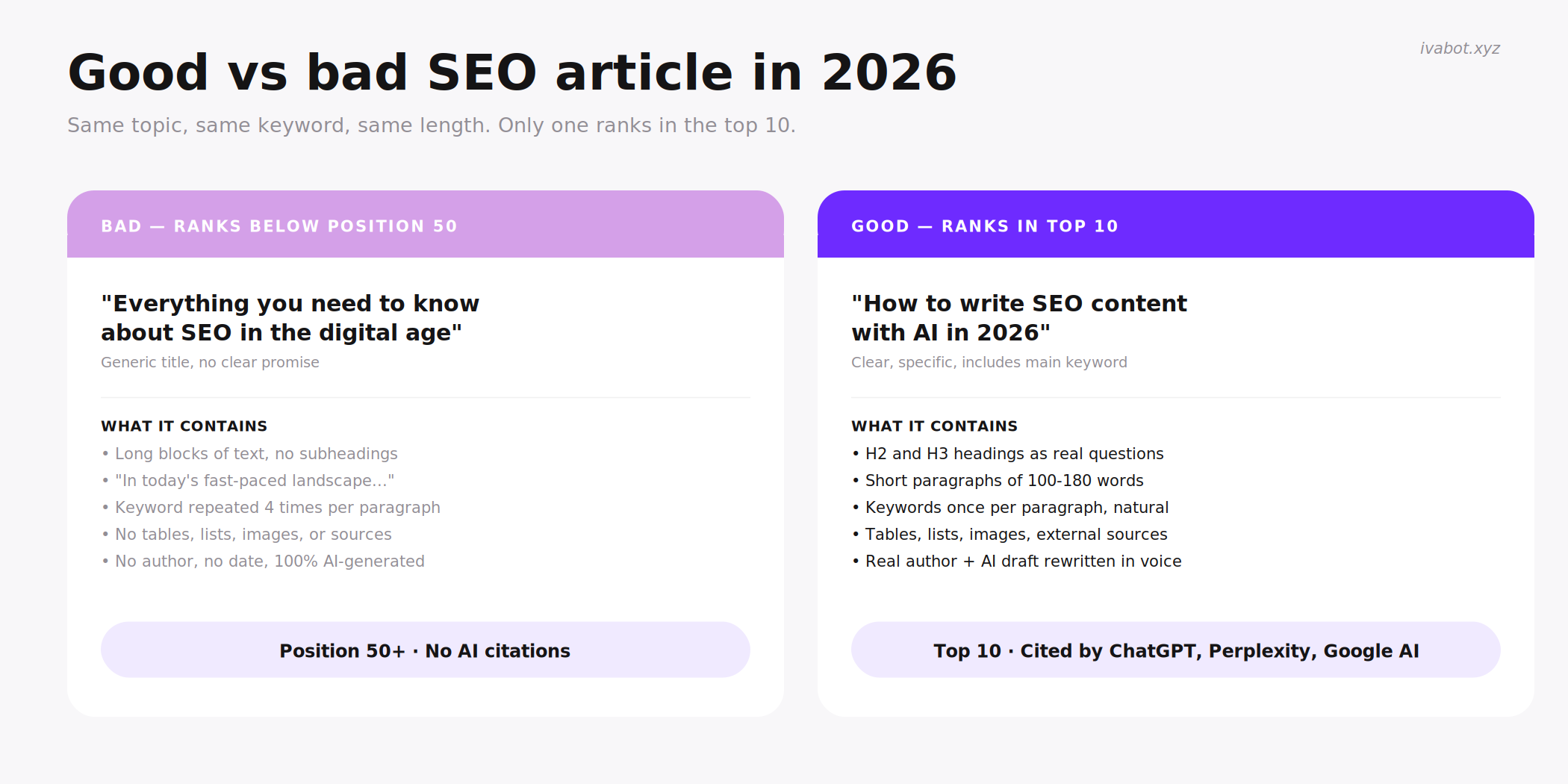
The table below compares two articles on the same topic, written with the same keyword, and shows what changes between an article that has a chance to rank in the top 10 and an article that ends up below position 50.
Same topic, same keyword, same length. Only one ranks in the top 10.
Element
Good article
Bad article
Title
Clear, specific, includes the main keyword and a benefit for the reader
Generic, made of buzzwords, no clear promise
Introduction
Answers the main question in the first three sentences and tells the reader what the article will cover
Starts with a vague paragraph about why the topic is important
Main keyword placement
Appears in the title, the first paragraph, one H2 heading, the URL, and the meta description
Appears in random places of the body text, repeated four times in the same paragraph
Example sentence
SEO in 2026 is no longer only about keywords, and the articles that bring traffic are the ones that answer a real question with a real example.
In today's fast-paced digital landscape, content creators must navigate the ever-evolving complexities of SEO.
Structure
Has H2 and H3 headings written as questions, short paragraphs of 100 to 180 words, at least one table and one list
Long blocks of text with no headings, no lists, no tables
Visuals
At least one image after the introduction, one image every 400 to 500 words, alt text on every image
No images, or only generic stock photos with empty alt text
Sources
Two to three external links to .gov, .edu, or official documentation pages
No external links, or only links to commercial pages
Internal links
Three to five links to related articles on the same website with descriptive anchor text
No internal links, or only "click here" links
Author identity
Real name, short bio, publication date, link to author page or professional profile
No author name, or only a generic "Admin" account
Expected ranking
Top 10 positions in Google, citations from ChatGPT, Perplexity, Google AI Overviews
Below position 50, no AI citations
Tools to write SEO articles with AI in 2026
Short answer: the combination of two or three tools usually covers the full process from keyword research to publication.
IvaBot Content Builder — for the brief, the keywords, and the first draft
IvaBot Content Builder is the tool built specifically to write SEO articles with ChatGPT-grade AI on top of real Google search data. The tool walks through the same questions as Prompt 1 above through a guided chat interface, and it adds the search volume, the top 10 competitors, and the People Also Ask data for the keyword automatically. The first draft from IvaBot Content Builder already includes the right outline, the secondary keywords, and the questions that the audience is actually asking.
The free credit at the end of this article gives access to the tool without a payment.
ChatGPT, Claude, or Gemini — for the voice rewrite step
Any general AI tool works for Step 5, the voice rewrite. The tool that produces the most natural-sounding output depends on the topic and the language of the article, and a useful approach is to test the same Prompt 2 on two tools and pick the result that needs fewer manual edits.
Google autocomplete and People Also Ask — for keyword research
Both features are free, both work directly in Google search, and both give real data about what the audience is searching for. Google autocomplete shows the most popular completions of a search query in real time, and the People Also Ask box shows the questions Google considers most related to the main query.
IvaBot Content Coverage & AI Readiness — to check the article before publishing
The Content Coverage & AI Readiness tool inside IvaBot scans a published page and shows which keywords are missing from the body, which AI readiness signals are present, and what to fix before the article is indexed by Google.
Hemingway and Grammarly — for the final readability check
Both tools help spot long sentences, complex words, and passive voice. The articles that learn how to write SEO content with AI and keep readability at a sixth-grade level rank better, because Google measures the average dwell time of the reader, and an article that is easy to read keeps the reader on the page longer.
The workflow works in practice
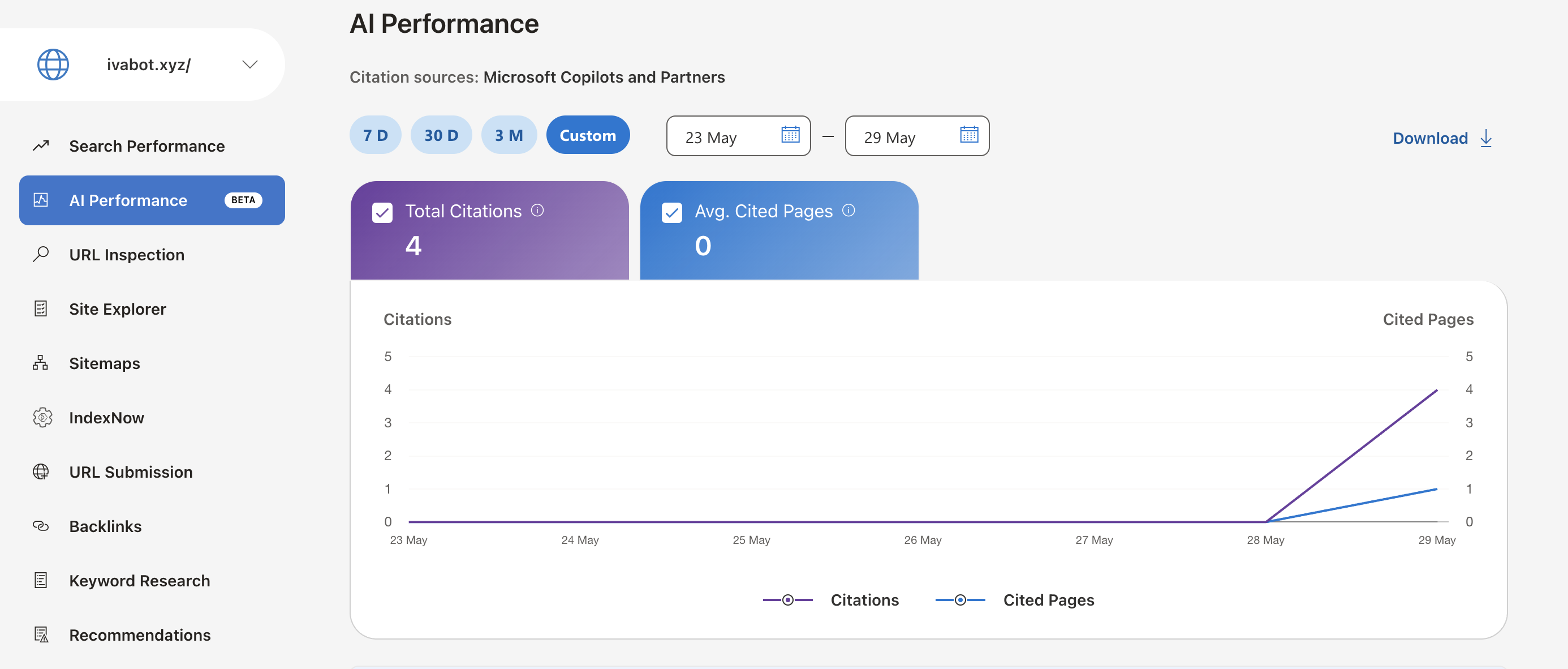
A real example from ivabot.xyz: an article published on the blog using this exact workflow was cited four times by Microsoft Copilot inside Bing within one week of publication, visible in Bing Webmaster Tools.
Bing Webmaster Tools showing four AI citations for an ivabot.xyz article one week after publication.
How long does it take for an article to bring traffic from Google?
Short answer: an article on a new website usually starts bringing real traffic between three and six months after publication, depending on the age of the domain, the topical authority of the site, and the competition of the keyword.
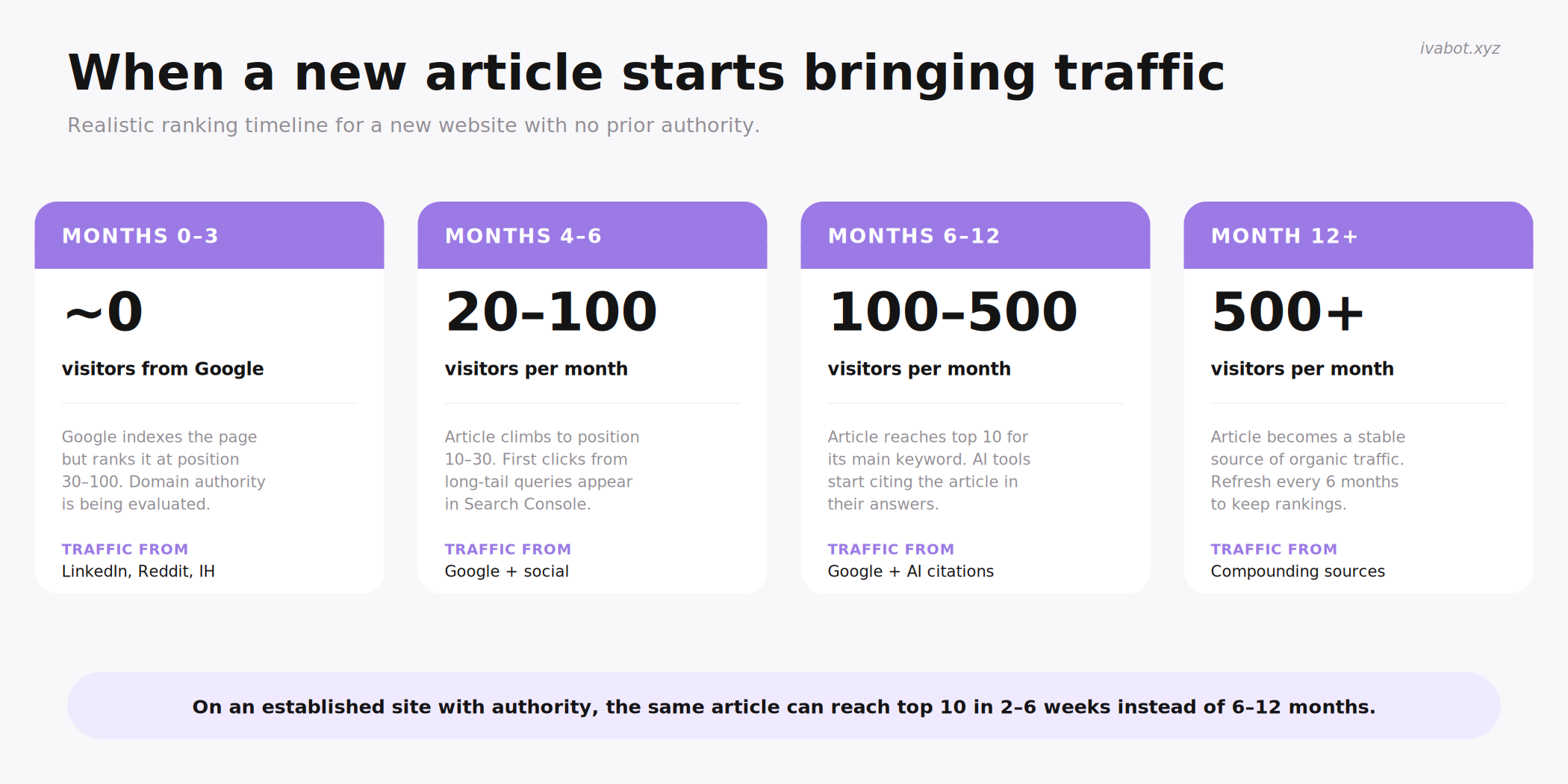
Realistic ranking timeline for a new website with no prior authority.
The articles published on a new website usually start bringing real traffic between three and six months after publication, and the wait depends on the age of the domain, the topical authority of the site, and the competition of the keyword.
A new domain registered less than six months ago goes through an indexing period during which Google evaluates the trustworthiness of the website before assigning ranking positions, and during this period most articles appear at low positions even when the content quality is high. The same articles begin to climb after the website accumulates internal links, backlinks from other websites, and a consistent publication history of at least 20 to 30 articles on related topics.
The pattern is consistent across niches. A small blog owner reported that the first 10000 monthly visitors arrived after 45 published articles on the same site, and many other small blog owners report between 50 and 200 articles before the same milestone, depending on the niche and the level of competition.
The longest part of the wait is the first three months, during which the published articles appear indexed in Google but at positions 30 to 100 in the search results. The articles begin to climb to positions 10 to 30 between month four and month six, and the articles that reach the top 10 usually arrive there between month six and month twelve.
For an established website with topical authority on the subject, the same articles can reach the top 10 in two to six weeks, since the website already has the trust signals that a new site needs to build from scratch.
The traffic curve is predictable. The first articles bring almost no traffic for several months, and the same articles later become the strongest performers of the blog once the website accumulates enough authority for Google to trust the content. The right approach is to publish consistently and update the older articles regularly, since updates can bring as much traffic as a new article, or more.
How do backlinks help an article rank faster on Google?
Short answer: backlinks from other reputable websites tell Google that an article is trustworthy, and articles with quality backlinks rank faster and climb higher than the same articles without them.
Backlinks are external links from other websites that point to an article, and Google uses backlinks as one of the strongest signals of trust and authority. The articles with backlinks from other reputable websites rank faster, climb higher in search results, and bring more traffic than the same articles without backlinks.
The quality of the backlinks matters more than the quantity. One backlink from a respected publication in the same industry has more impact than 100 backlinks from random low-quality websites, and Google can identify the difference automatically. The best backlinks come from articles on other websites that mention the topic naturally, link to the article as a source, and use descriptive anchor text that matches the topic of the linked article.
The ways to earn backlinks for a new website include writing guest articles for other publications in the same niche, answering questions on Reddit and Quora with a link to a relevant article when the link adds value to the discussion, participating in community projects like Indie Hackers and Hacker News with a public profile, getting listed in industry directories such as AlternativeTo or Product Hunt, and creating original research or data that other writers want to cite in their own articles.
A new website with five to ten high-quality backlinks ranks significantly better than a new website with no backlinks, even when both websites publish the same number of articles on the same topics.
Where do new blogs get traffic before Google ranks them?
Short answer: the first traffic to a new blog comes from LinkedIn, Reddit, Indie Hackers, newsletters, and direct outreach, since Google takes three to six months to start ranking new articles.
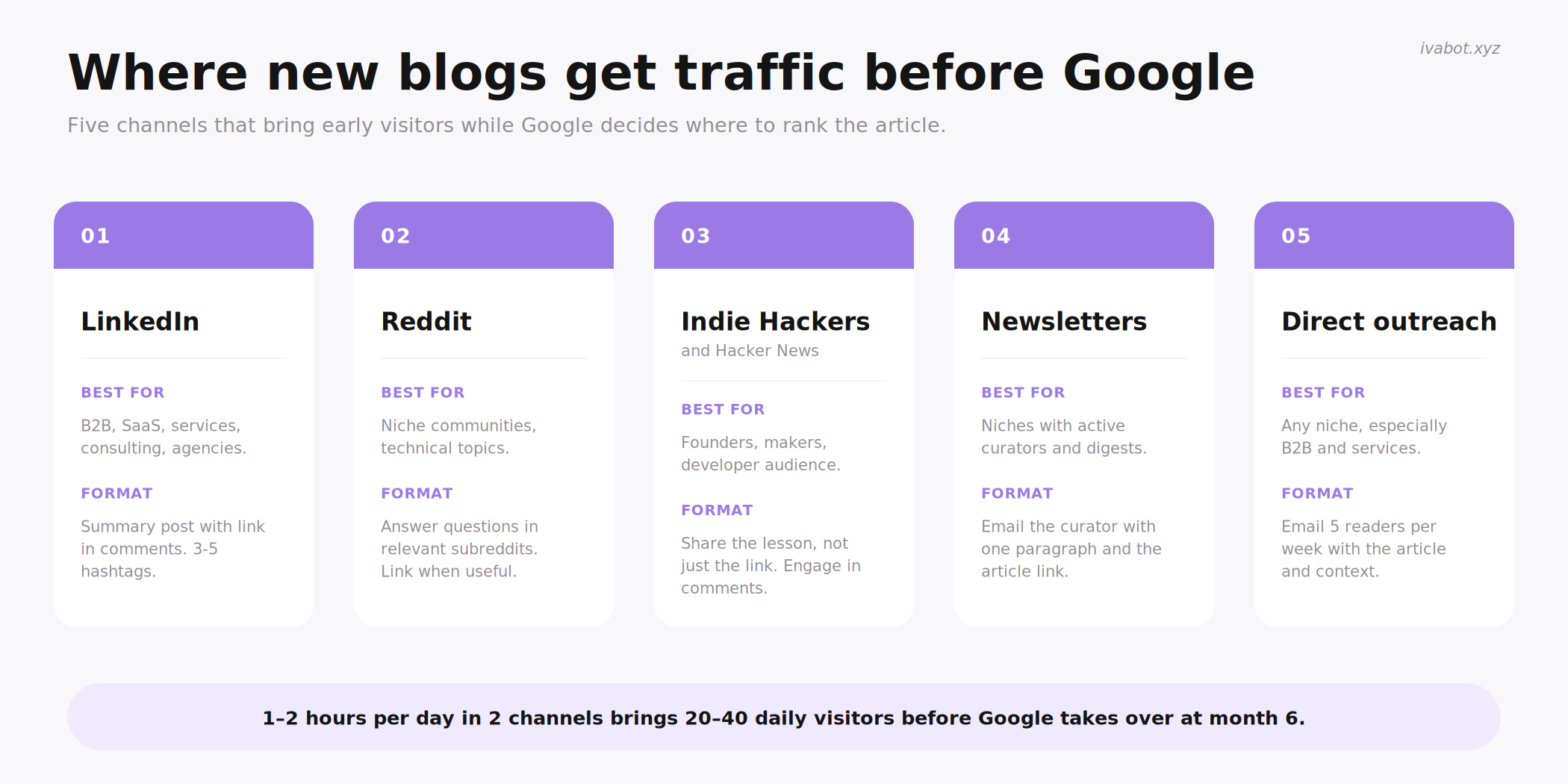
Five channels that bring early visitors while Google decides where to rank the article.
The first traffic to a new blog rarely comes from Google, since Google needs several months to start ranking the articles. The traffic in the first three to six months comes from other channels, and the channels that work best for new blogs depend on the niche and the audience.
The channels that bring early traffic include LinkedIn posts that summarize a blog article and link back to it, Reddit comments in relevant subreddits where the article answers a question someone asked, Indie Hackers and Hacker News posts that share the article with the maker community, newsletter mentions from other writers in the same niche, and direct outreach to potential readers through email or messaging.
The pattern from successful small bloggers is consistent. The first 20 to 40 daily visitors usually come from one to two hours per day spent in relevant communities, answering questions, sharing observations, and linking to the blog when the link is useful for the discussion. The same effort sustained over three to six months brings the website to a point where Google traffic takes over as the main source.
Common questions about writing SEO content with AI
Is SEO dead in 2026?
SEO is not dead in 2026, although the way SEO works has changed. The articles that bring traffic from Google in 2026 are also the ones that get cited by ChatGPT, Perplexity, and Google AI Overviews, and the same writing patterns work for both traditional search and AI search.
How long should a blog post be for SEO?
The length of a blog post for SEO depends on the topic and the keyword. For a long-tail keyword with low competition, an article of 1500 to 2500 words is enough to rank in the top 10. For a competitive keyword with high search volume, a pillar article of 3000 to 5000 words performs better, since depth and topical coverage are what Google measures for competitive topics. The articles that rank in the top 10 for most informational keywords average around 2000 to 2500 words.
Why doesn't my article get traffic?
The most common reasons an article does not get traffic are a high-competition keyword that the website is not strong enough to rank for, a topic that has no search demand, a slow indexing process for a new website, an article structure that AI tools cannot extract a clean answer from, or a missing author identity that lowers the trust signal for Google.
What is replacing blogging in 2026?
Blogging is changing rather than disappearing. Long-form articles still bring traffic from Google and citations from AI tools, while short-form formats like Reddit posts, LinkedIn articles, and video content cover the topics that benefit from quick reactions. The combination of long-form blog content and short-form distribution works better than either format alone.
What is the 80/20 rule for blogging?
The 80/20 rule for blogging means that around 80% of the traffic on a blog comes from around 20% of the articles. The pattern applies to most blogs of any size, and the implication is that updating the top 20% of articles regularly brings more traffic than publishing many new articles that may never rank.
How to write SEO content with ChatGPT?
Writing SEO content with ChatGPT follows the same workflow described in this article: choose one main keyword, check the top 10 results for the keyword, brief ChatGPT with the audience and the tone of voice using Prompt 1, generate the article section by section, rewrite every section through Prompt 2 to match the personal voice, and add real examples, internal links, and external sources before publishing.
How long until a new article ranks on Google?
A new article on a new website usually takes between three and six months to reach its peak ranking position, and this period includes the initial indexing, the first ranking signals from Google, and the gradual climb in the search results. On an established website with topical authority, the same article can reach its peak ranking in two to six weeks.
Should AI write blog posts entirely?
AI writes a good first draft when the prompt includes the audience, the tone of voice, the main keyword, and the secondary keywords. The final article needs editing, real examples, and a personal voice from the author to bring long-term traffic and citations from both Google and AI tools.
Did the May 2026 Core Update affect new articles?
The May 2026 Core Update affected articles created by AI without human editing, articles that summarize existing top results without adding new information, and articles without clear author identity. New articles that follow the workflow in this guide are not affected by the update, since the workflow already produces the kind of content the update rewards.
How can I check if my article is good before publishing?
Ask one question before publishing: if the page disappeared tomorrow, would anyone search for it again? An article that brings real value usually has at least one section that the reader would save, share with a colleague, or refer back to later. The articles that pass this test bring long-term traffic and earn citations from AI tools, since the same usefulness that makes the article worth saving for the reader is the same signal that Google and AI tools use to rank and quote content.
How specific should my article be?
The articles that bring the most traffic cover one specific question for one specific audience, with examples that match the exact situation of the reader. An article on "easy dinners" reaches a small audience compared to an article on "one-pan chicken dinners ready in 25 minutes for nights with no energy", since the specific phrasing matches the exact search query of the reader and the exact pattern of the questions asked inside AI tools.
Should I use AI as a writer or as an assistant?
Use AI as a junior assistant for the parts of the work where it helps, including the first draft, the outline, the keyword research, and the structure of the article. The expertise, the examples, the opinions, and the final voice come from the author, since these are the parts that no AI tool can generate from a prompt.
What is GEO and how is it different from SEO?
GEO stands for Generative Engine Optimization, and the term describes the process of preparing content to be cited by AI tools such as ChatGPT, Perplexity, Claude, and Google AI Overviews. The same writing patterns work for both GEO and SEO in 2026, since Google now uses AI inside its own search results, and the articles that get cited by AI tools are also the ones that rank in traditional Google search. The full breakdown is in Generative Engine Optimization: how to get cited by AI search.
What's Next
The workflow in this article works in any niche, in any language, and for any level of writing experience. The hard part is consistency: one article per week, every week, with the same brief, the same voice, and the same rewrite step.
Start with the smallest possible piece. Pick one keyword from Google autocomplete that matches the topic of your business. Open the top 10 results, write down what is missing from all of them, and brief the AI with Prompt 1 from this article. Generate the outline, write one section, rewrite it through Prompt 2, and publish. The full process can take less than three hours for a 2000-word article.
After publication, wait three to six months before judging the result. In the first weeks, share the article on LinkedIn, in relevant Reddit threads, and with newsletters in the same niche. The early traffic from these channels keeps the website active while Google decides where to rank the article in the long term.
The next article will reach its rankings faster than the first one, and the third article faster than the second, since each new article adds to the topical authority of the website on the same subject.
To write the first article with the right structure, keywords, and brief in one place, try IvaBot Content Builder. The tool walks through the questions from Prompt 1 through a guided chat, adds the real Google search data for the keyword automatically, and produces the base of the article in one session. A free credit is included for the first article.
This article was written using IvaBot Content Builder for the structure and brief, then translated and rewritten by hand through an AI editor to keep the original voice and meaning. Generic AI phrasing was removed where noticed. The remaining imperfections are intentional. Try IvaBot free at ivabot.xyz.
 14 min read